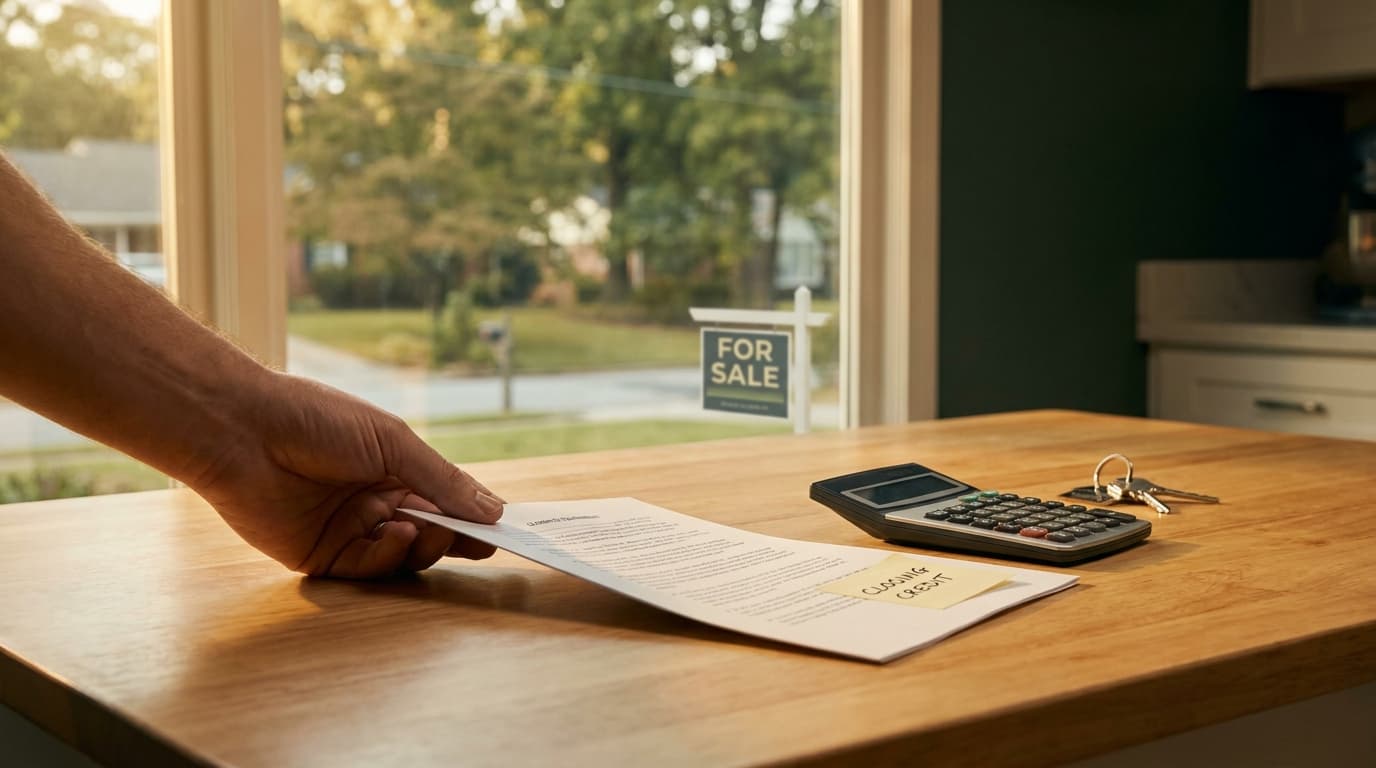
For most of the 2021 and 2022 buying frenzy, a Georgia seller could name a price, sit back, and let competing offers do the work. That leverage is shifting. As metro Atlanta inventory climbs into 2026 and homes take longer to sell, sellers are reaching back for a tool that all but disappeared during the boom: the closing-cost credit.
According to data from Georgia MLS reported by Atlanta News First, April 2026 units sold across 12 metro counties fell roughly 5% year-over-year, and homes under contract dropped 21.8% from a year earlier, with supply outpacing demand. That is the profile of a market in transition, and it is exactly the kind of market where a seller starts offering to help with the buyer's costs to get a deal across the line.
It is not just an Atlanta story. Nationally, Redfin found that sellers offered concessions in 44.4% of U.S. home sales in the first quarter of 2025, up from 39.3% a year earlier and just shy of the 45.1% record high set in early 2023. By May 2025, that figure reached 46.2% of sales, the highest share on record for that month, per Redfin's follow-up data. A concession, in Redfin's accounting, includes money toward closing costs, repairs, and mortgage-rate buydowns.
What a seller credit actually is
A seller credit is money the seller agrees to apply at closing toward the buyer's closing costs. That can include lender, title, and settlement fees, prepaid items such as property-tax and homeowners-insurance escrows, and in many 2026 deals, a rate buydown. In lender language, this is an "interested-party contribution," or IPC, because the money comes from a party with an interest in the transaction closing.
The mechanics matter. To count, the credit has to be written into the purchase contract and disclosed on the closing disclosure. This is not a handshake at the closing table. Under Fannie Mae's rules, an undisclosed IPC makes the loan ineligible for sale to Fannie Mae, so the credit must appear on the contract and the closing disclosure to be legitimate.
There is also a hard boundary on what a credit can do. Per Fannie Mae's Selling Guide, interested-party contributions can never be applied to the down payment, to financial reserves, or to the borrower's minimum required contribution. A credit reduces the cash you need for costs, not the equity you are required to put in.
Credit vs. price cut: two different levers
Buyers and sellers often treat a credit and a price reduction as interchangeable. They are not, and the difference shows up in your bank account on very different timelines.
A closing-cost credit reduces your cash-to-close right now. If your closing costs and prepaids run $9,000 and the seller credits you $9,000, you bring far less money to the table on closing day. That is powerful for a cash-constrained buyer who has enough for a down payment but is stretched on the rest.
A price cut works the other way. Lowering the sale price reduces your loan amount, which lowers your monthly payment and total interest over the life of a 30-year mortgage. It does little for your upfront cash, but it saves money slowly for decades. That favors a buyer with a long time horizon and enough cash on hand.
The rate-buydown angle sits inside the credit column. A common 2026 structure is a seller-funded temporary buydown, such as a 2-1 buydown, where the credit is used to lower the buyer's interest rate for the first years of the loan. That is another way a credit can translate into monthly relief early on, though it is temporary rather than permanent.
The comp and appraisal wrinkle
Here is a piece sellers care about and buyers should understand: a credit leaves the recorded sale price intact. If a home sells for $400,000 with a $10,000 credit, the public record still shows $400,000. A price cut to $390,000 shows up in public records and can drag down nearby comparable sales.
That is why a seller may prefer to give a credit rather than cut the price by the same amount, even when the buyer's benefit is similar. The credit supports neighborhood comps for future appraisals and protects the seller's net at a given headline number.
But the appraisal still has to support the price. A credit does not change the fact that the home must appraise for the contract price for the loan to work. Stack a large credit onto an inflated offer, and the deal can die at the appraisal.
The caps by loan type
Credits are not unlimited. Every loan program caps how much an interested party can contribute, and the cap depends on your loan type and, for conventional loans, your down payment.
-
Conventional (Fannie Mae). Per Selling Guide B3-4.1-02, the IPC cap is 3% of value with less than 10% down, 6% with 10% to 25% down, and 9% with more than 25% down, for primary and second homes. Investment properties are capped at 2%.
-
FHA. Seller and interested-party contributions are capped at 6% of the lesser of the sales price or appraised value. They cannot cover the FHA minimum required investment, meaning the down payment.
-
VA. Seller concessions above 4% of the established reasonable value are considered excessive. Importantly, normal seller-paid closing costs and reasonable discount points generally fall outside that 4% concession cap, a nuance confirmed by cap references at MortgageResearch.com and MyMortgageInsider.
-
USDA. Interested-party contributions are allowed up to 6% of the purchase price. Because USDA loans require no down payment, that 6% can potentially cover all of a buyer's closing costs.
Across all of these, the same guardrail applies: a credit can pay costs, but it can never fund your down payment, your reserves, or your minimum required investment.
Why a credit is not free money
The biggest trap is a credit baked into a higher purchase price. If a buyer agrees to pay $410,000 instead of $400,000 in exchange for a $10,000 credit, the credit is not a gift. It is being financed. The loan balance is larger, the monthly payment is higher, and the total interest paid over 30 years goes up. You are borrowing your own closing costs at your mortgage rate.
That inflated price also has to clear the appraisal. If the home appraises at $400,000, the $410,000 contract has a problem, and the credit strategy can collapse.
There is a second technical consequence. Under Fannie Mae's rules, a credit that exceeds the loan-type cap is reclassified as a "sales concession" and must be deducted from the sale price. The lender then recalculates loan-to-value and combined loan-to-value on the lower value. In plain terms, going over the cap does not just waste the extra dollars; it can shrink the value the loan is measured against and change the deal's math.
How to ask for a credit without weakening your offer
In a market where sellers are already offering concessions, asking for a credit is not the same as lowballing. The framing matters. A competitive offer price paired with a reasonable closing-cost credit often reads better to a seller than a low price, because it protects the seller's headline number and comps while still helping you with cash-to-close.
A few practical guardrails:
-
Match the request to your loan's cap. Do not ask for a 5% credit on an FHA loan when the cap is 6% but your actual costs are smaller, and do not ask for more than the program allows on any loan type. Excess just gets reclassified.
-
Keep the offer price honest. A credit stapled to an inflated price can fail at the appraisal and quietly raises your long-term costs.
-
Loop in your lender and agent early. The credit has to clear underwriting, appear on the contract, and land correctly on the closing disclosure. Your lender can also run the buydown math if a seller-funded rate buydown is on the table.
Georgia-specific notes
In a Georgia transaction, the credit is written into the purchase contract using the concession language in the standard GAR (Georgia Association of Realtors) forms, then reflected on the closing disclosure as a seller credit toward the buyer's costs. Work with your agent to make sure the concession is documented in the contract, not promised on the side, and confirm with your lender that the amount fits your loan program's cap.
If a seller-funded buydown is part of the conversation, ask a local lender to model it against a straight closing-cost credit and against a simple price reduction. In a slower Atlanta market, sellers have more reason to say yes, but the right structure depends on your cash position, how long you plan to stay, and what your loan type will actually allow.
The bottom line
Closing-cost credits are back because leverage is shifting toward buyers, in metro Atlanta and nationally. Used well, a credit can turn a stretched budget into a workable deal and preserve a seller's comps at the same time. Used carelessly, buried in an inflated price or pushed past the loan-type cap, it costs you more than it saves. Know your cap, keep the price honest, and make sure every dollar of the credit is on the contract and the closing disclosure before you sign.
Related reading
-
[The Spam Calls After You Apply for a Georgia Mortgage Are Finally Illegal — How the New Trigger-Lead Ban Changes Your 2026 Rate Shopping](/article/georgia-mortgage-trigger-lead-ban-2026-rate-shopping)
-
Fulton County Property Tax Bill 2026: What the Corrected Bill Changes
Sources
-
[Fannie Mae Selling Guide B3-4.1-02, Interested Party Contributions (IPCs)](https://selling-guide.fanniemae.com/sel/b3-4.1-02/interested-party-contributions-ipcs)
-
Redfin: 44% of Home Sellers Are Giving Concessions to Buyers (Q1 2025)
-
Redfin: 46% of Home Sellers Gave Concessions in May, Highest on Record for That Month
-
[Atlanta News First: Metro Atlanta home sales down as inventory climbs (May 5, 2026)](https://www.atlantanewsfirst.com/2026/05/05/metro-atlanta-home-sales-down-inventory-climbs-data-shows/)
-
MortgageResearch.com: Interested Party Contribution (IPC) Limits — Conventional, FHA, VA, USDA
-
MyMortgageInsider: Seller Contribution Maximums for Conventional, FHA, VA, USDA