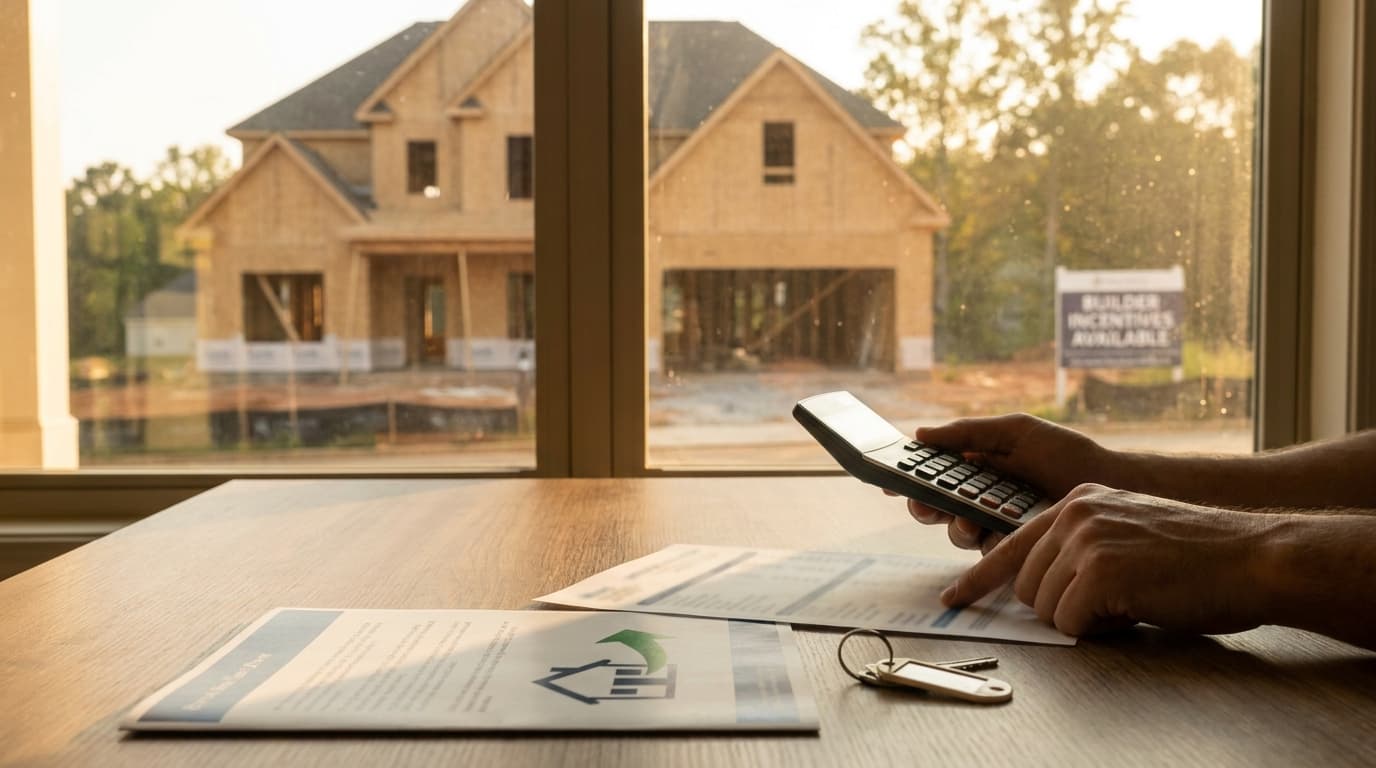
Drive through a new-construction community in Forsyth County or along the Alpharetta–Cumming corridor right now and you will see the same pitch on every flag and billboard: tens of thousands of dollars in builder incentives, headlined by a mortgage rate that sounds far below anything an existing-home buyer can get. Several Atlanta-metro builders have been advertising six-figure incentive packages — and the centerpiece is almost always a rate buydown rather than a cut to the sticker price.
It is worth being precise about why. The working assumption many buyers carry — that builders are sweetening deals because resale homes are scarce — is backwards in these exurbs. Verified 2026 data shows the opposite: active listings in the Cumming/Forsyth market are up more than 20% year over year, homes are taking 52 to 60 days to sell and closing at 97–98% of list price, according to the North Georgia Group. Nearby Alpharetta sits at 4.7 months of inventory — a formally balanced market — per Homes by Marco's June 2026 report. Builders are leaning on incentives because new-home demand has softened, not because there is nowhere else to buy.
That distinction matters, because it shapes everything about how you should read the offer. This is not a one-off Atlanta promotion: at least 60% of builders nationally have been using sales incentives for more than a year, per the NAHB/Wells Fargo Housing Market Index cited by Movement Mortgage. The buydown is an industry-standard demand tool. The job for a Georgia buyer is to figure out what it actually costs.
Which Atlanta builders are actually offering six figures
The verifiable year-end deals in the Atlanta metro, compiled by Stacker via NewHomeSource, belong to a handful of national builders:
-
Lennar — advertised price reductions ranging from $25,000 to $100,000.
-
Toll Brothers — discounts of roughly $25,000 to $56,000.
-
Beazer Homes — a "$50K to Spend Your Way" credit.
-
Smith Douglas — also promoting incentives in the Atlanta market.
One name worth flagging: if you see a "$100,000 from Century Communities" headline, read it carefully. Century's own Atlanta Metro page states only that incentives like closing-cost credits and rate buydowns "vary by market" — there is no advertised $100,000 Atlanta package. The $100K figure circulating online is a national "up to" advertised cap, not a confirmed local deal. That is exactly the kind of number to ask a sales agent to put in writing for the specific home you are considering.
What the package actually contains
A six-figure incentive headline usually bundles three different things, and only one of them is the rate buydown:
-
The rate buydown — the builder pre-pays to lower your interest rate, either temporarily or for the life of the loan.
-
Closing-cost credits — money applied to your settlement costs, often conditioned on using the builder's preferred lender.
-
Design-center dollars — credits toward upgrades and finishes.
Here is the part the marketing never says out loud: none of these reduces the price you finance. The buydown lowers your interest rate; the credits offset your cash to close; the design dollars buy carpet and countertops. The amount written on the contract — the figure your loan balance, appraisal, and future resale comp are all measured against — does not move. Keep that frame as we get into the mechanics.
How a 2-1 buydown works — and the year-three cliff
The most heavily advertised version is the temporary 2-1 buydown. As Movement Mortgage explains, it cuts your interest rate by 2 percentage points in year one and 1 point in year two, then resets to the full note rate in year three and stays there for the remaining term. The builder funds the gap up front at closing. Critically, the loan's underlying rate and payment never actually change — only the first two years feel cheaper because someone else pre-paid part of your interest.
Put numbers to it on a representative Forsyth-County price. Forsyth's median sale price is running roughly $560,000–$595,000 in 2026, so take a $575,000 home with 10% down — about a $517,500 loan — and assume a note rate of 6.5% on a 30-year fixed:
-
Year one (rate effectively 4.5%): principal and interest around $2,622/month.
-
Year two (rate effectively 5.5%): roughly $2,938/month.
-
Year three onward (full 6.5% note rate): about $3,271/month — and it stays there for 28 more years.
That is a real $649/month jump from your first-year payment once the buydown burns off. The relief is genuine and front-loaded, but it is temporary by design. If your plan to afford the home depends on the year-one number, you are underwriting yourself on a payment that disappears. Qualify on the year-three figure, because that is the loan you actually signed.
Why the builder buys down the rate instead of cutting the price
This is the heart of it. Movement Mortgage is unusually candid about the motive: a public price cut "drags down the comparable sales that every remaining home is measured against" and "can even create appraisal problems down the line." Incentives let a builder advertise a lower monthly payment while protecting the sticker price — and, with it, the neighborhood comps that determine what the next ten homes in the subdivision can sell for.
For the builder, that is smart inventory management. For you, the buyer, it has two consequences that rarely make the brochure:
-
Your appraisal still has to support the un-discounted price. Because the incentive is baked into the price rather than knocked off it, you are financing the full sticker amount. The appraiser has to find comparable sales that justify that number — and if the builder has been carefully keeping recorded sale prices high precisely to avoid "dragging down comps," the appraisal is being asked to validate a price the open market may not yet support.
-
Your resale comp is set at the higher number. When you eventually sell, the recorded price you bought at — not the value of a buydown that expired years earlier — is the comp. You inherit the high sticker price as your cost basis and your starting line for resale, with none of the temporary rate relief attached.
That is the buried cost in the headline. The incentive is, in effect, financed inside a price you must appraise against and resell against.
The honest comparison: buydown vs. an equivalent-dollar price cut
Suppose a builder offers you, say, $20,000 toward a 2-1 buydown — or you could instead negotiate that same $20,000 off the price. Which is better? It depends entirely on where you want the value to land, and the two options put it in completely different places. The worked framework from CLR Sales Group lays this out clearly:
-
A temporary buydown usually wins a pure month-one payment comparison — it concentrates the dollars into the first two years, so the early monthly number looks dramatically lower. But that relief is gone by year three.
-
A price cut permanently lowers your loan balance, your total interest paid over 30 years, your property-tax basis, and — the one builders most want to avoid — the appraisal and resale comp. It is less flashy and does less for your first-year cash flow, but it works for the entire life of the loan and follows you to closing when you sell.
Rule of thumb: if you are genuinely cash-tight in the first year or two — say you expect income to rise, or you are bridging to a refinance you have good reason to believe in — the buydown's front-loaded relief can be the right call. If you plan to hold the home for many years, a documented price reduction almost always delivers more total value. In a balanced-to-buyer-favorable 2026 exurb market, you may well be able to negotiate the price cut instead of being limited to the incentive the builder prefers to offer.
Permanent buydown vs. temporary: ask for the safer variant
There is a meaningfully different product the marketing tends to bury: the permanent buydown. Here the builder pays discount points at closing to lower your rate for the full loan term — there is no year-three reset and no payment cliff. As Movement Mortgage notes, this is a materially different and often safer instrument than a temporary 2-1.
If a builder is willing to spend real money buying down your rate, it is entirely fair to ask whether that money can buy a permanent reduction instead of a two-year teaser. The first-year payment under a permanent buydown will look higher than the 2-1's, but it never resets — what you see is what you pay for 30 years. Ask both questions explicitly: Is this rate temporary or permanent? What is my payment in year three?
The preferred-lender trap
Most builder incentives — especially the closing-cost credits — come with a string attached: you must use the builder's preferred or affiliated lender. Know your rights here. Under RESPA, a builder may incentivize but cannot require the use of an affiliated lender as a condition of sale, and must disclose the relationship through an Affiliated Business Arrangement statement, per Silblawfirm. Regulators have tightened the rules specifically around tying incentives — including guaranteed rates and buydowns — to an affiliated mortgage company, as BuilderOnline reports. You retain the right to shop and compare.
The practical move: get the builder's lender to quote the buydown as an isolated line item — the rate, the cost, and the year-three payment, in writing — and then price that against a straight, no-gimmick rate from an independent Georgia lender. Sometimes the preferred-lender package genuinely is the better deal once the credits are counted. Sometimes an outside lender's plain rate beats the buydown's year-three reality and you can negotiate to keep some of the credit anyway. You cannot know without making them compete.
A Georgia buyer's checklist before you sign
-
Is the rate temporary or permanent? A 2-1 resets; a permanent buydown does not.
-
What is the year-three monthly payment? Qualify yourself on that number, not the teaser.
-
Is the same home available at a lower price without the incentive? Make them show you the trade.
-
Can I use my own lender and keep the credit? RESPA gives you the right to shop — test it.
-
Will this home appraise at the un-discounted price? Ask how recent recorded sales in the community support the contract price.
-
What does the full incentive break down to? Separate the buydown from closing-cost credits and design dollars so you know what each is really worth.
The bottom line
For context on why these exurb builders compete on payment rather than location: Forsyth County typically prices $100,000–$200,000 below comparable Alpharetta and Milton homes, so a lower monthly number is the lever they have. That is fine — a buydown can be a legitimate, useful tool, particularly a permanent one or a short-term bridge for a buyer who genuinely needs early cash-flow relief.
But in a 2026 exurb market that is balanced to buyer-favorable, with resale inventory rising rather than tight, you are negotiating from more strength than the flags suggest. A documented price reduction lowers your balance, your interest, your tax basis, and your resale comp for the life of the loan — while a flashy 2-1 buydown front-loads relief that evaporates by year three and leaves you holding the un-discounted price. Before you sign, make the builder show you the math both ways, in writing. The number that survives to year three is the one you are actually buying.
Related reading
-
[Georgia's First New Mortgage Credit Score in Decades Is Live: How VantageScore 4.0 Could Finally Count Your Atlanta Rent Payments](/article/vantagescore-4-fico-10t-atlanta-rent-mortgage-credit-score-2026)
-
The Refi Window Just Cracked Open for Georgia's 2023–2024 Borrowers — Here's the Break-Even Math