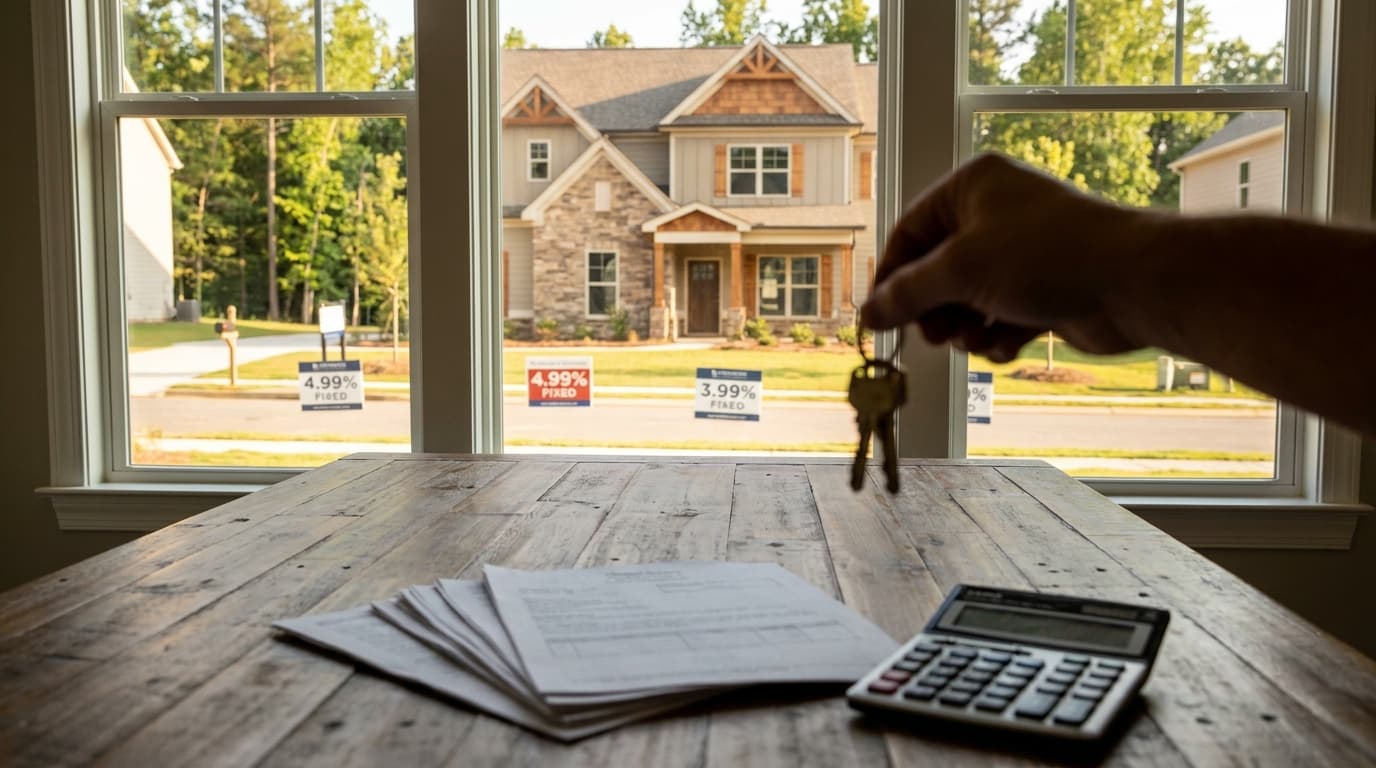
Drive past a new-construction community in Forsyth, Cherokee, Henry, or Paulding County this spring and the yard sign reads like a time machine: 4.99% fixed. 3.99% fixed. 0.99% year one. Meanwhile, Freddie Mac's Primary Mortgage Market Survey put the average 30-year fixed at 6.53% as of the May 28, 2026 release — roughly 150 basis points above what the on-site sales agent is quoting (Freddie Mac PMMS).
That gap does not close itself. It is being financed — and in most cases, it is being financed by the buyer, inside the home's sticker price. This article walks through who is offering what in metro Atlanta right now, the line-by-line math on a permanent versus a temporary buydown, the captive-lender mechanics that hide the real cost, and the specific concessions you can negotiate before you sign a reservation.
The backdrop: rates are off the peak, but builders still need to close the gap
The Freddie Mac PMMS 30-year average of 6.53% in late May is about 36 basis points below year-ago levels, but it is still far above what builders need to keep monthly payments inside a first-time buyer's qualifying ratio (FRED MORTGAGE30US). The Atlanta REALTORS Association's March 2026 market brief counted 17,723 active listings across the 11-county region and a 4.0-month supply — the most balanced spring market in three years and a clear signal that resale inventory is competing harder for the same buyers (Atlanta REALTORS Market Brief, March 2026).
The exurbs where builders are concentrated are showing the same pressure on the production side. HBWeekly's Q1 2026 permit tally for metro Atlanta shows Cherokee at 295 permits (down 25% year-over-year), Forsyth at 252 (down 36%), and Paulding at 248 (down 1%) (HBWeekly Q1 2026). Softer starts in the exact submarkets where the rate-buydown banners are heaviest is not a coincidence — it is the marketing budget responding to demand.
Who is offering what in the four counties
D.R. Horton has been the loudest. The company reported that 73% of its homebuyers received a mortgage rate buydown in fiscal Q4 2025, up from 72% the prior quarter, and has publicly leaned into a 3.99% permanent buydown as a headline rate (ResiClub Analytics). It has also run a 3-2-1 promo that starts at 0.99% in year one, steps to 1.99% in year two and 2.99% in year three, then resets to a permanent 3.99% (The Truth About Mortgage).
PulteGroup — which builds Pulte, Centex, and Del Webb communities across Cherokee and Forsyth — is showing the cost from a different angle. The company's incentive spend on a $600,000 home has risen from a 'normal' $18,000–$21,000 to roughly $52,200, which is somewhere between 5% and 8% of price now embedded in buydowns and credits (ResiClub Analytics on Pulte). KB Home's most recent SEC filing acknowledges the same margin pressure as it leans on its 'Personalize Your Rate' program (KB Home Form 8-K, FY2026). Lennar's 'Everything's Included' communities are folding rate concessions into the same package.
Why builders prefer buydowns to price cuts
The American Enterprise Institute's Housing Center has been tracking this for three years. As of mid-2025, AEI estimates about 64% of new homes sold by the largest builders used a permanent rate buydown, averaging a 1.3 percentage-point discount and costing roughly 5% of the loan amount. Crucially, AEI argues this is the mechanism builders use to avoid 10–12% list-price reductions that would reset neighborhood comps and trigger appraisal problems on the next house out the door (AEI Housing Center).
Industry analysts at HousingWire push back, arguing buydowns expand access for buyers who would otherwise be priced out (HousingWire). Both can be true at once: the buydown does lower your monthly payment today, and the underlying price stays high enough that the same buydown becomes part of the comp that prices the next phase of the subdivision.
The math, line by line
The general rule of thumb: a permanent buydown via discount points costs about 1% of the loan amount for roughly 0.25 percentage points off the rate (Better Offers buydown explainer). The CFPB describes the same trade-off in plain terms in its consumer guide (CFPB on lender credits and points).
Permanent buydown example — $475,000 loan. To go from a market 6.5% to 5.0%, you are buying down 1.5 percentage points. At roughly 1 point per 0.25%, that is six discount points, or about $28,500 in cost. If the builder pays it as a seller concession, that money lives somewhere — either in the base price, a lot premium, or a design-center credit that was already inflated.
Temporary 2-1 buydown — $350,000 loan at a note rate of 6.5%. Year one the borrower pays at 4.5%, year two at 5.5%, year three onward at 6.5%. The total cost is the sum of the two years of payment savings, which typically runs $8,000–$10,000. That money sits in an escrow account and is drawn down each month. If you refinance or sell before the buydown fully amortizes, any unused balance generally credits to the loan payoff — confirm this is in writing.
The break-even question. A $28,500 permanent buydown that saves roughly $430 a month at the front of the amortization schedule needs about 66 months — five and a half years — to break even on a cash basis, before considering the time value of money or the possibility of refinancing into a lower market rate. If you expect to be in the house under five years, the temporary 2-1 almost always wins. If you plan to hold ten-plus years and do not expect rates to drop enough to refinance, the permanent buydown is more defensible — only if the effective rate prices below what an outside lender would quote you with the same cash applied as a price reduction.
Where the $20,000–$50,000 actually hides
Three places, in roughly this order:
-
Base-price elevation. The sticker on the model home is set so that a 'standard' buydown package can be offered without the builder cutting margin. AEI's framing is the cleanest version of this: a 10–12% list cut would damage comps; a 5%-of-loan buydown does not.
-
Lot premiums. The $15,000–$40,000 lot premium for a cul-de-sac or wooded view is one of the easiest line items to negotiate down or eliminate. It does not appear on any comp database the next buyer will see.
-
Design-center credits. The 'we'll give you $20,000 toward options' offer often gets recycled back into the incentive pool if you opt for a smaller package. Ask whether unused design credit can be redirected to a price reduction or non-recurring closing costs.
The Kiplinger consumer explainer covers the same trade-offs in plain English and is worth reading before you walk into a model home (Kiplinger on builder incentives).
The appraisal angle
Because builders prefer buydowns to price cuts, recent new-construction comps in Forsyth, Cherokee, Henry, and Paulding stay high. The financed amount on a $475,000 home with a $20,000 embedded buydown will appraise — because the comps the appraiser uses are other new-construction sales from the same builder at the same elevated price. The buyer, however, is mortgaging that $20,000 of buydown at the new rate for the full 30 years. If you ever need to refinance into a softer resale market, or sell to a non-builder buyer who is rate-shopping at par, that embedded cost does not come back.
The captive-lender mechanics
The biggest credits — the permanent rate buydowns, the 'up to $25,000 in closing costs' offers — are almost always conditioned on using the builder's affiliated mortgage company. That is legal. Under the Real Estate Settlement Procedures Act, builders cannot require use of a captive or affiliated lender as a condition of the sale, but they can offer incentives for doing so (Builder Magazine on the RESPA required-use rule).
The practical implication: you can shop the loan. The builder cannot pull the home from the contract because you used an outside lender. What you may lose is the incentive — which means the comparison you actually need to run is:
-
Captive lender total cost: their rate, their points, their fees, minus the builder credit, over your expected hold period.
-
Outside lender total cost: their rate, their points, their fees, with the builder credit removed, over the same hold period.
-
Outside lender plus negotiated price reduction: what happens if the builder gives you, say, 70% of the buydown dollars back as a price cut instead.
The TILA-RESPA Integrated Disclosure (TRID) rules require lender credits and discount points to be itemized on the Loan Estimate and Closing Disclosure. Lender credits may be 'specific' (tied to a particular cost) or 'general,' and seller/builder concessions toward a buydown must be disclosed so they can be compared apples-to-apples (CFPB TRID Guide to the Loan Estimate and Closing Disclosure). When you get the Loan Estimate from the captive lender, you have three business days to get a competing Loan Estimate from an outside lender before the offer effectively locks in.
A negotiation playbook
-
Get the buydown cost in writing as a dollar figure. 'The builder is contributing $X toward rate buydown' is the number you need. Without it, you cannot evaluate the cash-equivalent.
-
Ask for the same dollars as a price reduction and request a re-quoted Loan Estimate at market rate from both the captive and an outside lender. Builders will often refuse a dollar-for-dollar swap because of the appraisal/comps issue — but they may agree to 50–70% of the value as a price cut, which is still meaningful.
-
Pull a competing Loan Estimate from an outside lender within three days. This is your leverage and your sanity check on the captive lender's pricing.
-
Negotiate non-recurring closing costs and HOA prepaids before touching the rate. Title fees, transfer taxes, and the first year of HOA dues are easier asks and do not affect the comp.
-
Push for design-center and lot-premium credits rather than rate credits. Dollars taken out of the lot premium come straight off the financed amount; dollars routed through a buydown are financed indirectly via the elevated base price.
-
If you choose a temporary buydown, confirm in writing that any unused escrow balance credits to the loan payoff if you refinance or sell before year three.
-
Read the Closing Disclosure carefully. Points should appear in Section A (Origination Charges), seller/builder concessions in Section L (Paid Already By or On Behalf of Borrower at Closing). Watch for any prepayment penalty language on builder ARMs.
When the buydown actually wins
A 2-1 temporary buydown can make sense when the expected hold is under five years and the buyer genuinely expects rates to fall enough to refinance before the note rate fully kicks in. The cash cost is modest, the monthly relief is real, and the unused escrow generally credits back. A permanent buydown is harder to justify unless the effective discount prices below what an outside lender would quote you with the same cash applied as discount points — at which point you should ask why the outside lender is more expensive in the first place, because in a transparent market the secondary-market price of those points should be the same regardless of who is paying.
Industry margin pressure is on your side here. Trade coverage of Q1 2026 earnings shows that the largest builders are absorbing incentive costs against their gross margins, which is precisely why they are negotiable on the components of the package (The MortgagePoint, May 2026).
Seven questions to ask the on-site sales agent before signing the reservation
-
What is the dollar value of the rate buydown the builder is contributing? Put it in writing.
-
If I use an outside lender, what specifically do I lose — the buydown only, or other credits as well?
-
Will you accept 50–70% of the buydown dollars as a base-price reduction instead?
-
Is the lot premium negotiable, and can unused design-center credit be redirected to closing costs or price?
-
On a 2-1 buydown, does any unused escrow balance credit to the loan payoff at refinance or sale?
-
Will you give me the Loan Estimate from the captive lender today so I can shop it within three business days?
-
What is the base price of this floor plan in this community ninety days ago, and what is it today? (You are testing whether base price has been elevated to fund the incentive.)
The bottom line
The advertised 4.99% rate in a Cherokee or Forsyth subdivision is not a trick — the buyer really does pay 4.99%. The question is whether the dollars used to get there would have done more work as a price reduction, a smaller loan, or a competing offer from an outside lender. With metro Atlanta inventory at a 4.0-month supply and the largest builders publicly absorbing record incentive spend, the negotiating environment for new construction is the most buyer-favorable it has been in three years. Walk in knowing what the buydown costs in dollars, and you will leave with more of those dollars in your pocket — whether they show up as a lower price, lower closing costs, or a smaller loan balance to carry for the next thirty years.
Related reading
-
[Georgia Mortgage Rates Aren't Past 6.6% — They're Easing Toward 6.4%: The Four 'Deal-Rescue' Tactics, and the Two That Actually Pencil Out](/article/georgia-mortgage-rates-easing-four-deal-rescue-tactics-which-two-pencil-out)
Sources
-
[FRED — 30-Year Fixed Rate Mortgage Average in the United States (MORTGAGE30US)](https://fred.stlouisfed.org/series/MORTGAGE30US)
-
D.R. Horton: We're leaning heavily into a 3.99% rate buydown — ResiClub Analytics
-
D.R. Horton Offering 0.99% Mortgage Rate — The Truth About Mortgage
-
PulteGroup is offering ~$50K incentives per sale — ResiClub Analytics
-
Three Years Later, Permanent Rate Buydowns Continue to Prop Up New Home Prices — AEI Housing Center
-
Incentives, Price Cuts Squeeze the Margins for Major Homebuilders — The MortgagePoint
-
TILA-RESPA Integrated Disclosure Guide to the Loan Estimate and Closing Disclosure — CFPB
-
Mortgage Rate Buydowns Explained: 2-1, 1-0, and Permanent — Better Offers
-
Homebuilder buydowns bolster access, not higher home prices — HousingWire