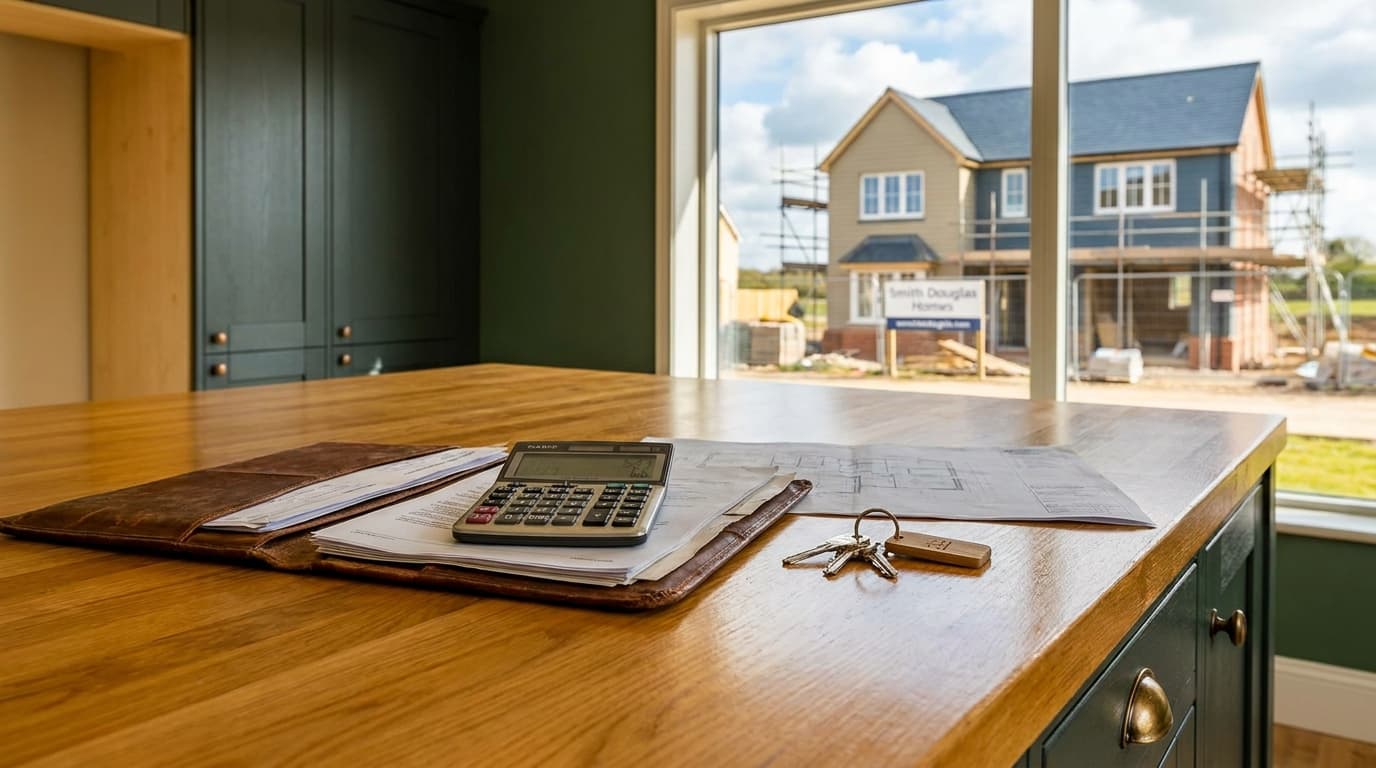
On August 12, 2026, National Mortgage News reported a number that most Georgia buyers have suspected for two years but nobody could prove: borrowers financing through a homebuilder's affiliated lender were locking 30-year loans at a weighted-average note rate of 5.23%. Everyone else was locking at 6.6%. That is a spread of 137 basis points — 1.37 percentage points — between two buyers with the same credit profile shopping the same week.
What makes this different from every "rates as low as" banner you have driven past on Highway 92 is the source of the data. These are executed locks: the actual note rate a borrower committed to, pulled from loan pipelines, not an advertised rate, not a quote, not a survey response. The gap is not marketing. It is what people are signing.
So take the number seriously. Then take the rest of this article seriously too, because a 137-basis-point discount is not free money. It is a price the buyer pays somewhere else — in the contract price, in the property tax basis that follows the contract price, and in the comp the next seller on the street will have to beat.
Why this number is new
The figure comes from the [Live Mortgage Rate Lock Index](https://mct-trading.com/press-release/mortgage-rate-index/), which Mortgage Capital Trading launched on August 11, 2026 — one day before the story ran. It is the first public benchmark that separates builder-affiliated locks from non-builder locks as distinct series.
The methodology is the reason it matters. MCT builds the index from a weighted average of actual borrower note-rate locks submitted through its MCTlive! platform, drawn from roughly $9.4 billion in average monthly origination volume across all 50 states and all four channels — retail, wholesale, correspondent, and consumer-direct. It covers both conventional and FHA new-home originations. It is not an application count, not a rate sheet, and not a consumer survey.
Paul Yarbrough, MCT's Senior Director and Head of Data & Analytics, framed the point directly: "Isolating builder-affiliated locks shows a spread that headline rate averages tend to smooth over and that spread is where you can see buydown activity at work."
That sentence is doing real work. The obvious skeptical response to a 137-basis-point gap is that builder buyers must simply be different — better credit, bigger down payments, some quirk of the borrower pool. Yarbrough's read is that the spread is the buydown: money the builder spends to move the rate, showing up on the note.
One useful sanity check on the other side of the ledger. Freddie Mac's Primary Mortgage Market Survey put the 30-year fixed at 6.67% on August 13, 2026 (6.69% the prior week, 6.58% a year earlier), with the 15-year at 5.96%. MCT's non-builder side at 6.6% sits right on top of the national survey. When two independently constructed measures agree on the baseline, it strengthens the outlier — the 5.23% builder figure — rather than casting doubt on it.
Two cautions on how to read the headline. First, MCT's own launch release led with a 1.79% gap; the 137 basis points is the spread on the specific day NMN reported it. The gap had run as wide as 179 basis points earlier in August. It moves. Second, 6.6% is a lock-weighted average on one date, not a standing market rate. If you are shopping this week, pull the current PMMS reading and your own Loan Estimate — do not treat either figure here as the rate available to you today.
Why builders are paying this much
Builders do not buy rates down out of generosity. They do it when standing inventory is expensive to hold and buyers will not clear it at the sticker price.
The national picture backs that up. The NAHB/Wells Fargo Housing Market Index for August 2026 came in at 35 — up a single point from July, and the 16th consecutive month below 40. Sixty-three percent of builders reported using sales incentives, unchanged from July. Thirty-five percent cut prices outright, down slightly from 37%, at an average reduction of 6%. That is also the 16th straight month in which at least 30% of builders reported cutting prices. Back in April 2026, NAHB had incentive use at 64% and price cuts at 37%, and noted the median new home price was down roughly 5% from 2022. This is not a spike. It is a plateau that has lasted well over a year.
The metro Atlanta version
Locally, the demand side explains the behavior. Georgia MLS data for the Atlanta MSA in July 2026 showed a median sales price of $405,000, up 2.50% year over year, on 6,447 units sold — essentially flat at −0.06% YoY — against 27,887 active listings and 4.82 months of inventory.
Read those together. Prices are not falling. Sales are not collapsing. But nearly five months of supply is a balanced-to-buyer market, and a builder carrying finished spec homes in a five-month market has a carrying-cost problem, not a pricing problem. Buying the rate down is how you convert a slow month into a closed month without publishing a lower price.
The supply side tells the same story from the other direction. HBWeekly's mid-year 2026 review counted 9,636 metro Atlanta single-family permits through Q2, down 11% year over year. Cherokee pulled 678 permits (−18%) and Gwinnett 1,546 (−6%), while Hall ran 897 (+16%) and Carroll 396 (+26%). Permits declining while incentives stay elevated is the signature of builders working down completed inventory rather than starting new. They are clearing the shelf, not restocking it.
The Atlanta exhibit: what a buydown costs the builder
You do not have to take this on theory. Smith Douglas Homes, headquartered in Atlanta, reports the trade-off in public filings.
In its second-quarter 2026 results, released August 5–6, 2026, the company posted 839 closings and $273 million in home closing revenue, up 22% year over year. Net new orders came in at 970, up 32%, on $311.6 million of contract value. Backlog stood at 1,000 homes worth $322.1 million.
Now the other column. Average sales price fell to $325,000 from $335,000. Home closing gross margin fell to 17.6% from 23.2% a year earlier — 560 basis points gone. The quarter included $7.6 million of inventory impairment and lot option abandonment charges.
Orders up 32% while margin drops 560 basis points is not a mystery. That is pace bought with price, disclosed on an income statement. The rate the buyer sees is printed on the note; the cost of producing that rate is printed on the builder's gross margin line. Both numbers describe the same transaction.
A note on what we are not publishing: we could not independently verify Smith Douglas's current Georgia promotional rates or the specific terms of its preferred-lender requirement before this piece went out, and several rate figures circulating in secondary summaries could not be traced to the company's own offer page. We are not repeating them. If you are shopping a Smith Douglas community — or any builder's community — get the offer and its disclaimer in writing from the sales office and read the fine print yourself.
Anatomy of the discount: three structures, three different animals
"Builder rate" is not one product. You will be shown one of three things, and they behave very differently after closing.
1. The permanent forward buydown
The builder pays discount points at closing to lower the note rate for the full 30 years. This is the real thing — a 5.23% note is a 5.23% note in year 12. The catch is where the money comes from. A permanent buydown deep enough to move the rate 100+ basis points is expensive, and that cost typically rides inside the purchase price. You are usually financing the discount you are receiving.
2. The 2-1 or 3-2-1 temporary buydown
This is the structure most likely to be misunderstood, and the rulebook is unambiguous. Under Fannie Mae Selling Guide B2-1.4-04, "the lender must qualify the borrower based on the note rate without consideration of the bought-down rate."
Read that twice. Nobody qualified at 2.99%. The underwriter approved the file at the full note rate; the buydown funds sit in an escrow account and subsidize the payment temporarily. The same section caps the rate increase at 1% in any one-year interval, and requires the buydown agreement to state that the borrower remains obligated on the full note terms even if the buydown funds become unavailable.
That last clause is the one that surprises people. The subsidy is a convenience, not a term of your loan. Your obligation is the note.
3. The ARM start rate dressed up as a rate
An adjustable-rate mortgage's initial rate is the lowest number in the whole transaction and the least informative. If a quoted rate is materially below everything else on the market, ask whether it is fixed for 30 years or fixed for five.
The point that survives all three structures: the qualifying rate never went down. Your payment may have. Your debt did not.
The ceiling nobody mentions at the sales trailer
There is a hard limit on how much a builder can hand you, and buyers rarely hear about it until it bites.
Fannie Mae Selling Guide B3-4.1-02 caps financing concessions from interested parties — the builder, the seller, the affiliated lender — on a principal residence at:
-
3% of value when LTV is above 90%
-
6% when LTV is 75.01% to 90%
-
9% when LTV is 75% or below
-
2% on investment property, regardless of LTV
Anything above the applicable cap is not simply disallowed. It is reclassified as a sales concession, deducted from the sales price, and the LTV and CLTV are recalculated off the reduced value.
Here is the practical failure mode. The buyer most attracted to a deep buydown is often the buyer putting 3–5% down — which puts them in the 3% concession tier, the tightest one. A buydown generous enough to be worth 137 basis points, stacked on top of closing-cost credits and a title incentive, can run past 3% of value. When it does, the deal gets repriced in underwriting, weeks after everyone shook hands in the model home. Ask early, in writing, what the total interested-party contribution is as a percentage of value, and which tier your loan falls in.
The shopping problem — and what the rule actually says
Buyers frequently ask whether it is legal for a builder to make its best rate available only through its own lender. Broadly, yes.
Under RESPA's Regulation X, 12 CFR § 1024.15, an affiliated business arrangement is permitted where a written disclosure is provided and the consumer is not required to use the affiliate. An incentive conditioned on using the builder's lender is generally not treated as prohibited "required use" — you remain free to finance elsewhere, you just do not get the incentive. What the rule forbids is compensation flowing for the referral itself: the lender paying the builder for sending the borrower, or funding the builder's incentive in a way that operates as a disguised kickback.
So the incentive can lawfully be exclusive. Your right to shop is intact. Use it, and use it correctly:
-
Get a Loan Estimate from an outside lender on the same property, on the same day. Rates move; a stale comparison is not a comparison.
-
Compare APR and total five-year cost, not the monthly payment. The payment is the number the incentive was engineered to move.
-
Ask, in writing: what is the price of this home with no financing incentive? If the answer is "the same price," ask why the builder is giving away basis points for nothing. If the answer is a lower price, you have just measured the buydown.
The Georgia consequence: the buydown expires, the assessment does not
This is the part no national article will tell you, and it is the reason a concession structure matters more in Georgia than in most states.
O.C.G.A. § 48-5-2(3) provides that "the transaction amount of the most recent arm's length, bona fide sale in any year shall be the maximum allowable fair market value for the next taxable year." And under O.C.G.A. § 48-5-7, confirmed by the Georgia Department of Revenue, property is assessed at 40% of fair market value.
Be precise about what that statute does. It is a ceiling: it caps what the county may assess your home at for the following tax year. In a rising market, that protects buyers — the county cannot value you above what you just paid.
But a ceiling works both ways. If the concession is buried in an inflated contract price, you have raised your own ceiling and given up the single strongest argument available in a Georgia assessment appeal: I just bought this house on the open market and I paid less than your number. You cannot make that argument when the recorded price is the high number.
Worse, the recorded price does not just follow you. It follows the subdivision. It becomes a comp the assessor uses for your neighbors and an appraiser uses for the next resale — a price nobody actually paid in economic terms, because a chunk of it went to buying down a rate that resets or a loan that gets refinanced.
The arithmetic on a $25,000 price premium: at 40%, that is $10,000 of additional assessed value. Multiply by your county's combined millage rate — school, county, city, and any special districts — expressed in dollars per $1,000 of assessed value, to get the annual dollar cost. Millage rates are set annually and vary meaningfully across metro counties and municipalities, so pull the current rate from your county tax commissioner's office rather than a number in an article. We are not printing a rate here that we have not confirmed against the current digest.
The framing that matters: a 2-1 buydown is gone in 36 months. A refinance can retire the note rate entirely. The assessed value follows the deed.
The side-by-side, with every assumption on the table
Consider an illustrative choice a metro Atlanta buyer might face this fall — say in an outer-ring county like Paulding, where new-construction inventory is concentrated:
-
Option A: a $425,000 new build financed at 5.23% through the builder's affiliated lender
-
Option B: a $400,000 resale financed at 6.6% through an outside lender
Assumptions — read these before the numbers. 10% down on both. 30-year fixed. Principal and interest only. No points paid on the resale. Property taxes, homeowners insurance, HOA dues, and mortgage insurance are excluded from every figure below. Both loans are above 80% LTV and therefore both carry mortgage insurance, priced by credit profile — and the new build's larger loan carries it on a larger base. Closing costs and selling costs are excluded. These are illustrative figures for a specific pair of prices and rates, not a forecast and not a quote.
| | A: $425,000 new build @ 5.23% | B: $400,000 resale @ 6.6% | | --- | --- | --- | | Down payment (10%) | $42,500 | $40,000 | | Loan amount | $382,500 | $360,000 | | Monthly principal & interest | $2,107 | $2,299 | | Balance at 36 months | $365,400 | $347,300 | | Balance at 60 months | $352,400 | $337,400 | | Balance at 120 months | $313,300 | $306,000 | | Total P&I paid, 60 months | $126,427 | $137,946 | | Total cash in at 60 months (down + P&I) | $168,927 | $177,946 |
The headline result is the one the sales office will show you: the more expensive house costs about $192 a month less. Over five years that is roughly $11,500 less paid in principal and interest, against $2,500 more down — about $9,000 less cash out of pocket, on a home that cost $25,000 more.
That is a genuine benefit and we are not going to talk you out of it. The question is what happens when you sell.
Scenario 1 — the new build holds its price
Both homes resell at what you paid, five years in. Equity at sale: $72,625 on the new build ($425,000 − $352,400), $62,600 on the resale ($400,000 − $337,400). Netting the equity against total cash in, the builder-financed buyer comes out roughly $19,000 ahead over five years, before transaction costs and before the higher tax line.
Scenario 2 — the premium does not survive
The new build resells at $400,000, because the next buyer in that subdivision is being offered the same rate incentive on a comparable home and will not pay a premium for yours. Equity at sale drops to $47,600. Now the builder-financed buyer is roughly $6,000 behind over five years — and that gap widens once you add the tax on $10,000 of extra assessed value each year, plus the fact that mortgage insurance was running on a larger balance the whole time.
Two scenarios, one variable. The break-even is not in the monthly payment. The break-even is whether the $25,000 price premium survives resale — and that depends entirely on whether the concession was priced into your contract or genuinely came out of the builder's margin. Smith Douglas's 560-basis-point margin drop suggests that at least some of it is real builder money. The NAHB finding that 35% of builders are also cutting prices outright, at an average of 6%, suggests some of it is not.
The test is boring and decisive: what did the last three closings in this subdivision actually record at? Not list. Not "starting from." Recorded. That is public record in Georgia, and it tells you whether the price you are being quoted is the price the market is paying.
Decoding "rates as low as 4%"
A sub-4% headline in a 6.6% market is almost always describing year one of a temporary step structure or the start rate on an ARM. Advertising law is why the giveaway is usually sitting right next to it.
Under Regulation Z, 12 CFR § 1026.24, an advertisement stating specific credit terms may state only terms that are actually offered. If the ad states a rate of finance charge, it must use the term "annual percentage rate" or "APR." A simple annual interest rate may not be shown more prominently than the APR. And where more than one rate can apply over the life of the loan — ARMs, and by extension stepped and temporary structures — additional rate disclosures are triggered.
Which means the disclosure that tells the real story is legally required to be on the page. It is just in six-point type at the bottom. Read it.
Two questions collapse the ambiguity every time:
-
What is the note rate? Not the year-one payment rate. The rate on the promissory note you will sign.
-
What is the APR? If the APR is far above the advertised rate, you are looking at points, a temporary structure, or both.
What to ask before you sign
-
Ask for the note rate and the APR in writing — not the monthly payment. The payment is the output the incentive was designed to move.
-
Ask for the price with and without the financing incentive. The difference is the buydown, expressed in the only unit that matters at resale: dollars of contract price.
-
Get the buydown agreement itself and find the year-three payment. If it is a 2-1, the payment you budgeted for is not the payment you will make in month 25.
-
Obtain an outside Loan Estimate on the same property, the same day. Compare APR and total five-year cost.
-
Confirm the total interested-party contribution fits inside your LTV tier's cap — 3%, 6%, or 9% under B3-4.1-02 — before you are three weeks into underwriting.
-
Pull the recorded sale prices of the last three closings in the subdivision. That is your comp, your appraisal risk, and, under § 48-5-2(3), a preview of the tax ceiling you are accepting.
-
Confirm what happens to the incentive if you switch lenders. Get the answer in writing alongside the affiliated business arrangement disclosure.
The bottom line
The 137-basis-point gap may be the most honest number in the mortgage market right now, precisely because it is measured off executed locks rather than advertised rates. Builders really are financing at 5.23% while the rest of the market clears at 6.6%. If your alternative is a 6.6% loan on a house you like less, a builder incentive can be the better deal — and in a market with 4.82 months of supply, you have room to negotiate for it.
But name the transaction accurately. This is a transfer, not a discount. Builders are converting gross margin into rate to move standing inventory — you can watch it happen on Smith Douglas's income statement — and the buyer absorbs part of that cost through the contract price, through a Georgia tax basis that outlives the buydown, and through a comp that the next seller on the street will have to beat.
The rate resets. The refinance is available. The recorded price is forever.
Related reading
Sources
-
New rate-lock data shows impact of homebuilder buydowns — National Mortgage News, August 12, 2026
-
MCT Launches Live Mortgage Rate Lock Index — Mortgage Capital Trading, August 11, 2026 (index methodology and Yarbrough quote)
-
Freddie Mac Primary Mortgage Market Survey — Mortgage Rates Average 6.67%, August 13, 2026
-
Affordability Pressures Keep Builder Confidence Low — NAHB Eye on Housing, August 2026 HMI
-
Builders Respond to Affordability Challenges with Buyer Incentives — NAHB, April 1, 2026
-
Fannie Mae Selling Guide B2-1.4-04 — Temporary Interest Rate Buydowns
-
Fannie Mae Selling Guide B3-4.1-02 — Interested Party Contributions
-
12 CFR § 1024.15 — Affiliated business arrangements (Regulation X / RESPA) — CFPB
-
Property Tax Valuation — Georgia Department of Revenue (assessment at 40% of FMV, O.C.G.A. § 48-5-7)
-
Atlanta MSA July 2026 Market Recap — Georgia MLS
-
Metro Atlanta New Residential Construction Update: A Mid-Year Look at 2026 — HBWeekly
-
Smith Douglas Homes Reports Second Quarter 2026 Results — August 2026
Editor's note: Rate figures cited here are dated and reflect specific measurement days in August 2026; they are not quotes and not current market rates. Payment and balance figures are illustrative calculations based on the stated assumptions and exclude taxes, insurance, HOA dues, and mortgage insurance. Nothing here is a loan offer or individualized financial advice — verify all figures with a licensed lender and your county tax office before making a decision. This article contains AI-assisted content and has been reviewed in our publication workflow.