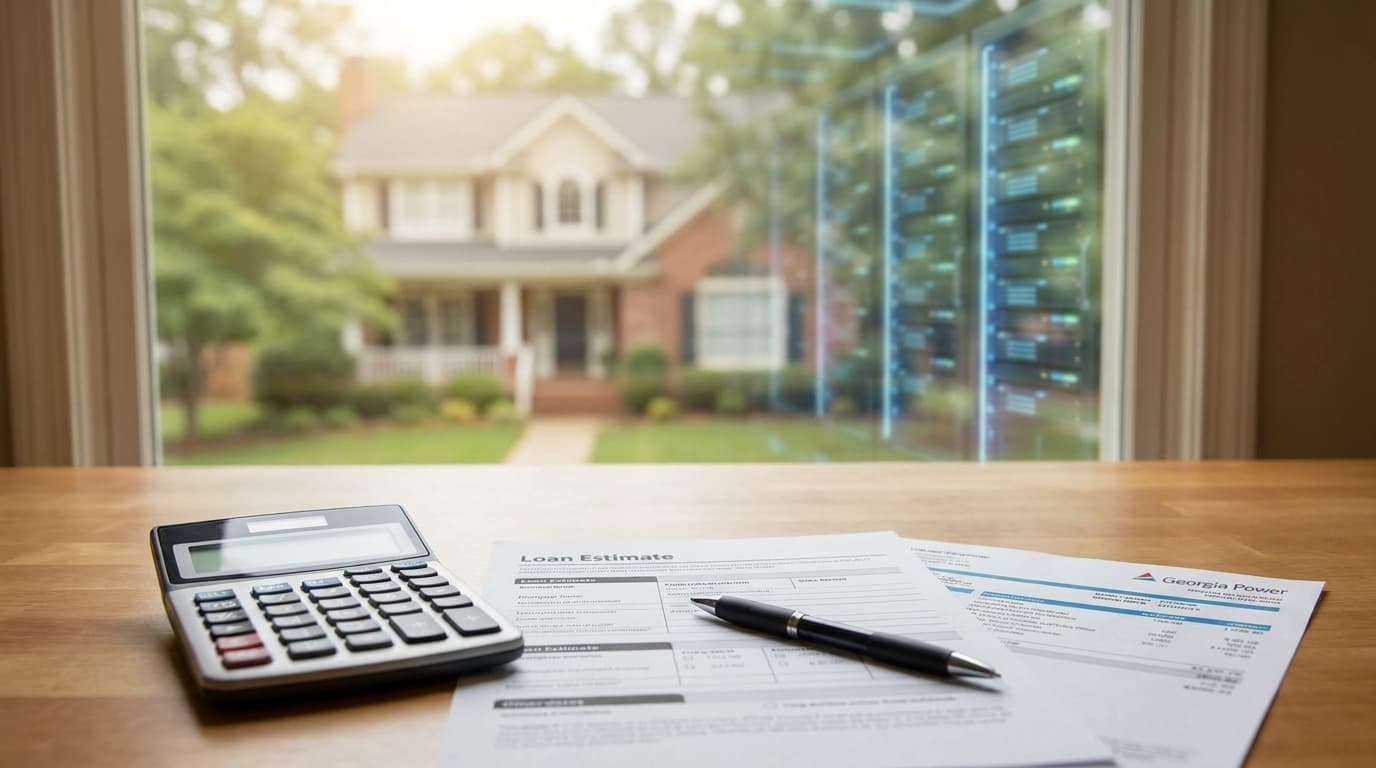
If you are shopping for a house in Georgia this year, you have probably heard some version of a reassuring headline: Georgia Power's rates are frozen through 2028. It is true. The Georgia Public Service Commission approved the plan on July 1, 2025, and the company's own consumer page puts it in about as plain a sentence as a utility ever writes: the amount you pay per kilowatt-hour stays the same for the next three years.
One word in that headline is doing almost all of the work, and it is base.
What the freeze actually froze
The July 2025 order extended Georgia Power's 2022 alternate rate plan through a stipulation with the PSC's Public Interest Advocacy staff, holding base rates flat through at least the end of 2028. But base rates are defined as what customers pay per kilowatt-hour exclusive of fuel costs. And storm restoration costs were explicitly carved out of the freeze and pushed into a separate proceeding expected in the first half of 2026.
Fuel and storm recovery are, in most years, the two largest swing factors on a residential bill. Freezing base rates while leaving both of those to their own dockets is not a promise about what you will pay. It is a promise about one component of what you will pay.
The separate dockets, told honestly
Georgia Power filed both on February 17, 2026: Fuel Cost Recovery in Docket 56765 and Storm Cost Recovery in Docket 44280. That filing is the cleanest available proof that these ride outside the freeze — if they were inside it, there would be nothing to file.
Here is the part that gets misreported, so it is worth stating flatly: those 2026 dockets went down, not up. On May 29, 2026, the PSC approved a stipulation that cut roughly $50 a year — about $4 a month — for a typical residential customer effective June 1, 2026, worth about $285 million in total annual customer savings, with storm cost recovery reduced by nearly 60 percent.
That is a real decrease, and anyone who tells you the freeze was quietly undone in 2026 is wrong. The point is the mechanism, not the direction. The same channel that delivered $50 a year back to customers in 2026 is the channel that delivers whatever comes next, and there is real money queued up in it. Georgia Power's storm reserve was under-recovered by $912 million, proposed for recovery over four years. Hurricane Helene alone caused nearly $800 million in damage in 2024 — more than 12,200 poles, over 1,500 miles of line, roughly 5,000 transformers. Those recoveries are ongoing, and they are not governed by the freeze.
If you are signing a 30-year note, the useful takeaway is not "bills are going up." It is that the freeze does not fix your monthly bill, in either direction, and the parts it does not fix are the parts that move.
The buildout underneath all of it
On December 19, 2025, the PSC voted 5-0 to approve 9,885 megawatts of new generation, largely tied to data-center load. The construction cost is $16.3 billion. PSC staff estimated that customers will ultimately repay something on the order of $50 to $60 billion over coming decades, once interest and the utility's authorized return are included.
The load-growth trajectory behind that vote is striking on its own. Georgia Power's stated seven-year capacity need went from about 400 MW in 2022, to 6,600 MW in 2023, to 8,500 MW in 2025 — with data centers named as the driver.
"Over coming decades" is a phrase that lands differently when you are about to commit to a payment through 2056. Nobody can tell you what share of that $50–60 billion lands on residential customers, in what years, through which docket. But it is not a rounding error, and it is not resolved.
Both sides, fairly stated
Georgia Power argues the buildout helps residential customers. On its data centers page, the company says incremental large-load revenue of at least $556 million per year will put downward pressure of at least $8.50 per month — about $102 per year — on a typical 1,000 kWh residential customer. The company also points to large-load tariff protections: upfront payment for local infrastructure, longer contract terms, minimum bills, financial security and collateral requirements, and termination payments.
Read the timing carefully. That $8.50 is framed as downward pressure, tied to the next base rate case in 2028, with effect beginning around 2029. It is a prospective, conditional argument about a future proceeding — not a credit on next month's bill and not a decrease anyone has ordered.
The other side is on the record too. At the May 2026 fuel proceeding, Southern Environmental Law Center attorney Bob Sherrier argued that large industrial customers raise average fuel costs for everyone else by 5 to 11 percent monthly, with no offsetting benefit; Georgia Power's attorney countered that large-load base-rate benefits offset that effect. SELC had already objected to the December 2025 approval as lacking sufficient customer protections.
Advocacy voices go further. In a signed guest opinion in the AJC — her own argument, not the paper's editorial position — Patty Durand of Georgians for Affordable Energy cites six rate increases totaling 40 percent over three years, a 25 percent increase effective May 1, 2024 tied to Plant Vogtle, more than $35 billion in grid expansion, and residential rates rising three times faster than industrial rates since 2010. The AJC has also published the opposing view, that Georgia is maximizing data center growth while protecting energy consumers.
You do not have to referee this. The regulator hasn't. The PSC opened a separate investigation into how fuel costs are allocated between large industrial customers and residential and small-business classes — which is an official acknowledgment that the question is unsettled.
The pivot: the line item underwriters don't look at
Now the part that matters for your loan.
When a lender calculates your debt-to-income ratio, it uses monthly housing expense. Fannie Mae's Selling Guide B3-6-03 defines that as PITIA: principal and interest, property insurance, flood insurance where applicable, mortgage insurance, real estate taxes, ground rent, special assessments, HOA dues — including any common-area utility charges — co-op fees, and payments on subordinate financing.
And then it says, in the guide's own words, that monthly housing expense excludes any utility charges that apply to the individual unit.
Note the asymmetry. Utilities for the shared hallway of a condo count, because they arrive as an HOA line. Utilities for the house you are actually going to live in do not. Electricity is structurally invisible to your DTI. Not underweighted — absent.
It isn't escrowed, and it isn't disclosed
The Loan Estimate discloses origination charges, services you can and cannot shop for, homeowner's insurance, property taxes, mortgage insurance, and an Estimated Taxes, Insurance & Assessments block. Utilities appear nowhere on it. They are ongoing operating costs of owning a house, not loan or escrow items, so no page of your file carries them.
Compare that to the other cost shocks Georgia owners face. A property tax reassessment shows up in your escrow analysis. An insurance premium jump shows up in your escrow analysis, usually with a letter. Both are unpleasant, but both surface — some document eventually tells you. A power bill that runs $180 a month higher than you assumed for the four months of a Georgia summer surfaces exactly nowhere in the transaction. You find it in July.
The math, done carefully
Suppose the gap between the house you think you're buying and the house you're actually buying is $40 a month of electricity — a modest number for the difference between a well-sealed house with a modern heat pump and a 1978 ranch with original windows.
At roughly 6.5 percent on a 30-year note, $40 a month of payment capacity is worth about $6,300 of loan amount. That is the cleanest way to state it: an invisible cost is lost borrowing power.
You can also state it as a rate equivalent, but only if you name the balance. At 6.5 percent, 25 basis points changes principal and interest by about $16.50 per $100,000 borrowed. So:
-
On a $240,000 loan, $40 a month is roughly 25 basis points.
-
On a $320,000 loan — a $400,000 metro Atlanta house at 20 percent down — the same $40 is only about 19 basis points.
The equivalence shrinks as the balance grows, which is why "a $40 utility swing equals a quarter point" is a sentence that needs its loan size attached or it overstates the case.
One caveat while we are talking about DTI, because the old rule of thumb is now wrong as stated: 43 percent is not a legal ceiling. The CFPB's December 2020 General QM final rule removed the 43 percent DTI limit and replaced it with price-based APR thresholds, effective March 1, 2021 and mandatory for applications received on or after July 1, 2021 (which also ended the GSE Patch). Forty-three percent survives as a widely used underwriting benchmark and as Fannie Mae's manual-underwriting cap, and automated underwriting routinely approves to 50 percent. Call it a benchmark, not a statute.
The practical consequence is the same either way. If you qualify at 47 percent DTI, the system approved you on a housing expense that never included the power bill. The margin you are counting on to absorb it may be thinner than the approval letter suggests.
Why this bites harder in Georgia
Two reasons. First, cooling load. Georgia's summer is long and the shoulder seasons are short, so an inefficient envelope and an aging air handler cost you real money for a third of the year — the months when a bill is least forgiving and most likely to catch a new owner off guard.
Second, every percentage move in these dockets applies to a bill that starts from a real base. Georgia Power's own residential benchmark customer uses 1,000 kWh a month, which is the unit the company itself uses when it quotes an $8.50-a-month effect. If your house runs well above that benchmark, every proportional change — up or down, fuel or storm or a future rate case — lands on you with more force than the press-release math implies.
What to actually do before you go under contract
The data exists. The trick is getting it early enough to matter.
-
Ask the seller to sign the release. Georgia Power has a Release of Billing History to Third Party form that releases up to 12 months of billing history for a specific address. It must be signed by the account holder — the current owner — and only one request is permitted per 12-month period. That makes it a due-diligence ask during the inspection period, alongside the inspection and the survey. You cannot pull it unilaterally.
-
Read the months that matter. Do not average the twelve. Look at July, August, and September, and look at January. Those four months tell you what the envelope and the equipment actually cost to run. An annual average smooths away exactly the information you need.
-
Underwrite the house at its real load. Take the worst month, not the mean, and subtract it from what you were prepared to spend. If that number moves your comfortable payment by $40, you now know it is worth about $6,300 of price — a fact worth having before you write the offer rather than after.
-
Know what arrives too late. Georgia Power's My Power Usage tool gives hourly, daily, and monthly usage with downloadable history. It is genuinely good, and it is useless to you as a shopper — you get it once the account is yours. Which is the whole point of this article: the data exists, but by default it arrives after the loan is priced.
The honest close
The base rate freeze is real. The June 2026 decrease was real, and it was a decrease — roughly $50 a year for a typical residential customer. Neither of those is a promise about 2029, or 2035, or the years in which PSC staff expects customers to repay $50 to $60 billion for generation approved in December 2025.
Your lender will not price that gap, because Fannie Mae's guide tells it not to. Your Loan Estimate will not disclose it, because the CFPB's form has no line for it. Your closing disclosure will not mention it. No one in the transaction is required to hand you the number.
So get twelve months of billing history, read the summer, and price it yourself.
Related reading
-
Pending Sales Just Fell 30% in Metro Atlanta — What That Actually Buys You at 6.65%
-
How the Georgia Home Closing Process Works From Contract to Keys
Sources
-
Georgia PSC Approves Plan to Freeze Georgia Power Base Rates Through at Least 2028 — Georgia Power, July 1, 2025
-
Rate Freeze — Georgia Power consumer page
-
Georgia Power Delivers Lower Costs for Customers with Latest Filings — February 17, 2026 (Dockets 56765 and 44280)
-
Georgia PSC Backs Disputed Georgia Power Fuel Deal Amid Data Center Cost Concerns — GPB, May 29, 2026
-
Georgia Regulators Approve Huge Electric Generation Increase for Data Centers — AP via U.S. News, December 19, 2025
-
Data Centers & Your Georgia Power Bill — Georgia Power
-
PSC Unanimously Votes to Approve Georgia Power's Data Center Plan Without Sufficient Customer Protections — Southern Environmental Law Center
-
Opinion: Data Center Expansion in Georgia Has Implications for Consumers' Power Bills — Patty Durand, guest opinion, AJC, July 2026
-
Opinion: Georgia Maximizes Data Center Growth While Protecting Energy Consumers — AJC, August 2026
-
Data Center Fact Sheet — Georgia Public Service Commission
-
Selling Guide B3-6-03: Monthly Housing Expense for the Subject Property — Fannie Mae
-
Loan Estimate Explainer — Consumer Financial Protection Bureau
-
Qualified Mortgage Definition Under TILA (Regulation Z): General QM Loan Definition — CFPB final rule
-
Release of Billing History to Third Party — Southern Company / Georgia Power
-
My Power Usage — Georgia Power
This article contains AI-assisted content and has been reviewed in our publication workflow. It is general information, not financial or legal advice; rate and payment figures are illustrative calculations at approximately 6.5% on a 30-year fixed loan and will differ from any specific quote.