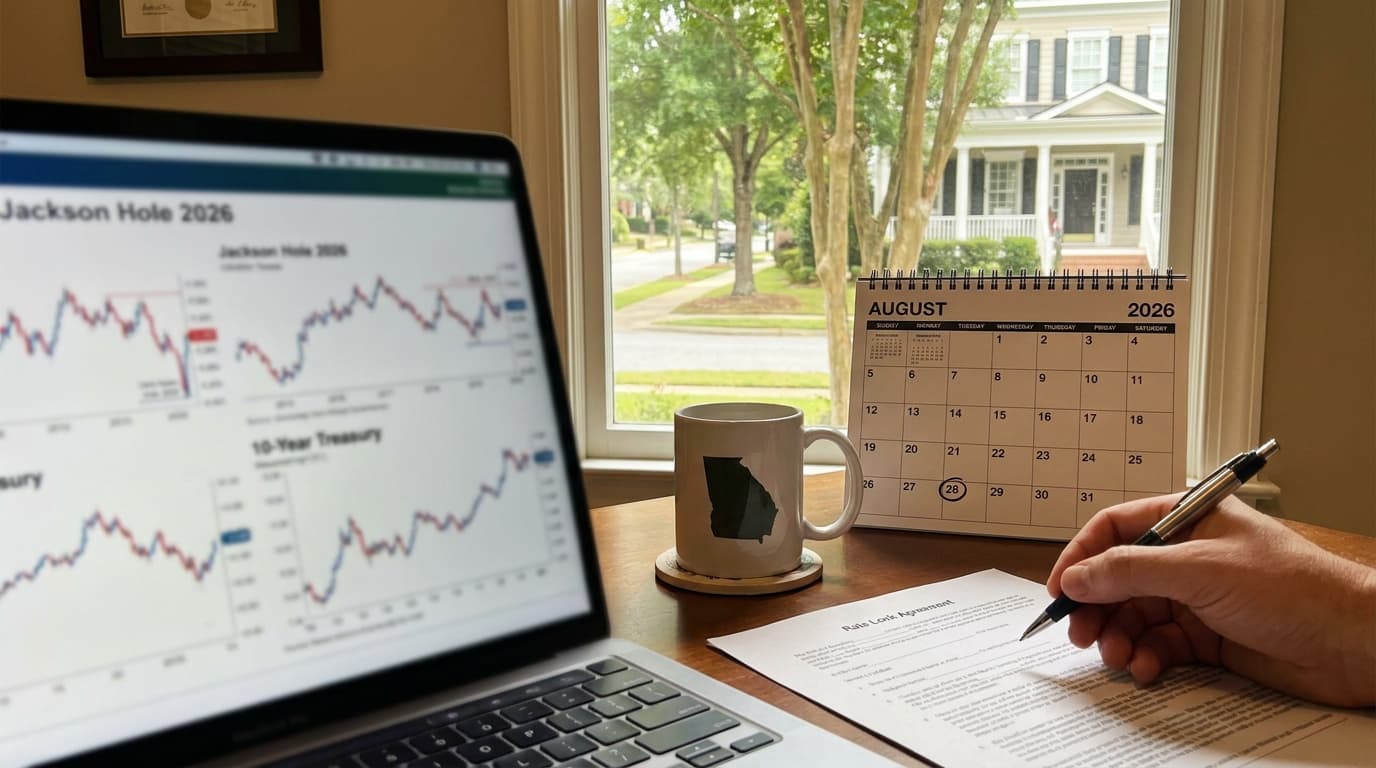
On Friday, August 28 at 10:00 a.m. Eastern, Kevin Warsh delivers the keynote address at the Jackson Hole Economic Policy Symposium in Wyoming — his first as chair of the Federal Reserve, having been sworn in on May 22, 2026. If you are a Georgia homebuyer sitting on an unlocked rate with a closing date in September, that speech is the most consequential 45 minutes on your calendar this month.
But before going further, a correction to a premise that has been circulating widely, including in early drafts of this piece: markets are not pricing a September rate cut. They are pricing the opposite risk.
Start With the Correct Odds
The July 29, 2026 FOMC statement held the federal funds target range at 3-1/2 to 3-3/4 percent — and drew three dissents from Beth Hammack, Neel Kashkari, and Lorie Logan, all of whom preferred an immediate 25 basis point increase. That is an unusually hawkish vote. The statement's language was blunt about why: "Inflation remains elevated relative to the Committee's 2 percent goal, in part reflecting supply shocks that have driven price increases in certain sectors, including energy." On the labor side, "Job gains have kept pace with the workforce, and the unemployment rate has changed little" — no deterioration that would argue for easing.
As of August 18, prediction markets Kalshi and Polymarket converged on roughly the same distribution for the September 16 decision:
-
Hold at 3.50–3.75%: ~70.5%
-
Hike 25bp: ~28.5%
-
Cut 25bp: ~0.5–1.0%
A cut is a longshot, not the base case. (These odds move quickly — see the caveat at the end of this article.) So if you have been floating your rate on the theory that the Fed is about to ease and you will catch a better number in September, the trade you are actually making is: a roughly 70% chance nothing happens, a roughly 28% chance rates move against you, and a roughly 1% chance you are right.
The next FOMC meeting is September 15–16, 2026 — a two-day meeting that includes a Summary of Economic Projections. The decision lands on the 16th. Write that date down; every lock calculation below keys off it.
Why This Particular Speech Carries More Weight
Warsh has curtailed the Fed's use of forward guidance. Under his predecessor, expectations were shaped continuously — a drip of speeches, interviews, and carefully seeded signals that let markets adjust in small increments. With that channel narrowed, information concentrates into set-piece events. A Jackson Hole keynote from a chair who does not otherwise telegraph is a higher-information event than the same words would have been two years ago.
There is also a sequencing detail worth understanding. The Bureau of Economic Analysis releases July Personal Income and Outlays, including the PCE price index, on Wednesday, August 26 at 8:30 a.m. ET — two days before Warsh speaks. PCE is the Fed's preferred inflation gauge. Warsh will step to the podium having seen it and having had time to think about it. Anyone deciding whether to lock on Thursday afternoon is, in a small way, trading against a speaker with fresher information.
Friday is also the last scheduled moment before September 16 when the chair himself can move the board.
Where Georgia Rates Actually Stand Right Now
Freddie Mac's Primary Mortgage Market Survey for the week of August 20, 2026 put the 30-year fixed at 6.65%, down from 6.67% the prior week — a second consecutive weekly decline. The 15-year fixed came in at 5.95%, down from 5.96%.
Do not read too much into two small declines. A year ago the 30-year was 6.58% and the 15-year was 5.69%. Both are higher today than they were twelve months ago. The honest description is drifting, not falling.
The Section That Matters Most: The Fed Funds Rate Is Not Your Mortgage Rate
This is the part most coverage of Jackson Hole gets wrong, and it is the reason a dovish Warsh could coexist with a higher Georgia mortgage rate next month.
The federal funds rate is an overnight bank funding rate. It is currently 3.50–3.75%. Your 30-year fixed mortgage is a 30-year asset that prices off the 10-year Treasury yield plus a mortgage-backed securities spread — compensation investors demand for prepayment risk, duration risk, credit risk, and the simple supply-and-demand of MBS. The Federal Reserve Bank of Boston's research on why mortgage rates exceed Treasury yields decomposes exactly these components.
Run the current numbers. The 10-year Treasury closed at 4.74% on Friday, August 21 — up about 3 basis points on the session and testing 20-month highs. Against a 30-year mortgage rate of 6.65%, that implies a spread of roughly 191 basis points. The long-run historical norm is closer to 170 basis points; it compresses toward 130bp in calm markets and blows past 250bp under stress. On August 3 the spread was about 201bp, so it has narrowed slightly — a modest tailwind that partly offsets what the Treasury market is doing.
And what the Treasury market is doing is the story. The Fed has not moved since before July, yet long-end yields have surged since then — driven by heavy corporate issuance from the AI sector and by federal deficit spending. That is a supply problem, not a policy problem. More bonds hitting the market require higher yields to clear.
The practical implication: Warsh could sound softer than expected on Friday, short-term rate expectations could ease, and your quoted mortgage rate could still be higher the following week if the long end sells off on issuance. The Fed controls one input. It does not control the one that prices your loan.
The Asymmetry, in Dollars
Here is what the current odds distribution costs or saves on a $400,000 Georgia loan, 30-year fixed, principal and interest only:
| Rate | Monthly P&I | vs. today | Over 30 years | | --- | --- | --- | --- | | 6.40% (25bp better) | $2,502.02 | −$65.84 | −$23,702 | | 6.65% (today) | $2,567.86 | - | - | | 6.90% (25bp worse) | $2,634.40 | +$66.54 | +$23,955 | | 7.15% (50bp worse) | $2,701.63 | +$133.77 | +$48,156 |
Rounded: every 25 basis points is about $67 a month on a $400,000 note.
Now overlay the odds. Floating through Friday risks roughly $67 to $134 a month against a best case — a rate improvement — that markets currently price at about one percent. The downside outcome is not certain, but it is roughly thirty times more likely than the upside outcome. That is the skew. It is not a forecast; it is a description of the payoff structure you are standing in.
One clarification on the $400,000 example: the 2026 FHFA baseline conforming loan limit for a one-unit property is $832,750, up $26,250 from 2025. A $400,000 loan is comfortably conforming in every Georgia county — no jumbo pricing overlay to complicate the math.
What a Borrower Under Contract Should Do This Week
Three steps, in order:
-
Ask your lender for the exact lock expiration date — not the lock length. "Forty-five days" is not an answer you can act on. "October 8" is.
-
Check whether that date falls after September 16. A 30-day lock taken the week of August 24 expires around September 23, which sits on the far side of the FOMC decision — it covers the event. A lock taken earlier in August that expires before September 16 leaves you re-pricing directly into the decision. If that is your situation, talk to your lender now about extending or re-locking, and ask what an extension costs before you agree to one.
-
If you are closing within 30 days and have not locked, the odds distribution argues for locking before Friday morning. Not because anyone knows what Warsh will say, but because the shape of the bet is unfavorable.
Also worth knowing: a lock is conditional. The CFPB describes a rate lock as a guarantee of the rate "between the offer and closing, as long as you close within the specified time frame and there are no changes to your application." Changes to your loan amount, credit score, down payment, or income documentation can void a locked rate mid-lock. Locks typically run 30, 45, or 60 days, sometimes longer, and extensions can be costly.
Is a Float-Down Worth Paying For?
Start with what the CFPB actually says, because it is more restrictive than most borrowers assume: if rates fall after you lock, you generally cannot access the lower rate unless your lender has a specific policy allowing it. A float-down is a lender-by-lender product, not a borrower right. Ask directly whether yours offers one — do not assume.
If it does, price it before you buy it. Industry-standard terms — which you should confirm with your own Georgia lender rather than taking on faith — typically require the market to improve by 0.25 to 0.50 percentage points before the option triggers, and cost 0.25% to 1.0% of the loan amount. On $400,000 that is $1,000 to $4,000 upfront.
Against a $66.54 monthly benefit from a 25bp improvement, break-even runs 15 to 60 months. And you only reach break-even if rates actually fall enough to trigger the option, which markets currently price as unlikely. The verdict at today's pricing: hard to justify unless your lender offers the float-down free or for a nominal fee. If it is free, take it. If it costs $3,000, do the arithmetic first.
The Atlanta Leverage Angle
There is a better hedge available to many Georgia buyers right now, and it does not come from the rate desk. It comes from the seller.
Metro Atlanta in July 2026, per the RE/MAX National Housing Report summarized by Atlanta Agent Magazine: median sales price of $410,000, up just 2.5% year over year and flat month over month. Closed transactions of 6,769 — down 2.4% year over year and down 8% from June. Sale-to-list ratio of 96.3%, meaning the typical home is closing below asking. Active inventory of roughly 30,116 listings across property types, up 5.4% year over year. Nationally, months' supply rose to 3.0.
That is a balanced-to-soft market, not the 2021–2023 seller's market many buyers still have in their heads. In that environment, a seller-paid 2-1 buydown or a closing-cost credit is frequently negotiable — and it is often worth considerably more than a float-down you pay for out of your own pocket. You are asking someone else to absorb rate risk on your behalf. In a market where listings sit and closings are down, that ask is reasonable.
Bring it up with your agent before Friday, not after. For the most current 11-county numbers, the Atlanta REALTORS® Market Brief is the official monthly source.
The Honest Caveat
Nobody can time this, including the people who do it professionally. Consider how fast the September odds have moved: immediately after the July 29 FOMC, prediction markets put hike odds near 52%. Then July CPI landed on August 12 — headline up 0.1% month over month and 3.4% year over year, core up 0.2% and 2.5% year over year, both down a tenth from June and in line with consensus — and hike odds fell to roughly 28% within two weeks. One in-line inflation print cut the probability nearly in half.
The same thing can happen again in the other direction. The August jobs report and August CPI both land before the September 16 decision, and either can override anything Warsh says on Friday. Confirm the exact BLS release dates as they approach. His speech is a directional signal, not the last word.
None of the above is a prediction. It is an argument about which side of a skewed distribution you want to be standing on when you have a firm closing date and a payment you have to live with for three decades.
The Short Version
Know your lock expiration date relative to September 16. Price the float-down with a calculator before you buy it. And negotiate the buydown with the seller rather than with the speech.
Related reading
Sources
-
Fed Rate Cut Odds September 2026: Kalshi Sees a Hike Risk — OddsShopper
-
Chair Warsh to Give Jackson Hole Keynote Speech Aug 28 at 10am ET — MNI Markets
-
What is a lock-in or a rate lock? — Consumer Financial Protection Bureau
-
Why Mortgage Rates Exceed Treasury Yields — Federal Reserve Bank of Boston
-
Chart of the Week: Mortgage Rates, 10-Year Treasury and 30-10 Spread — MBA NewsLink
-
Personal Consumption Expenditures Price Index — U.S. Bureau of Economic Analysis
-
RE/MAX: Atlanta Home Prices Inch Higher in July — Atlanta Agent Magazine
Rate and payment figures are as of the dates cited and change frequently. Payment calculations are principal and interest only and exclude taxes, insurance, and mortgage insurance. This article is general information, not personalized financial advice — confirm current pricing, lock terms, and float-down availability with your own lender.