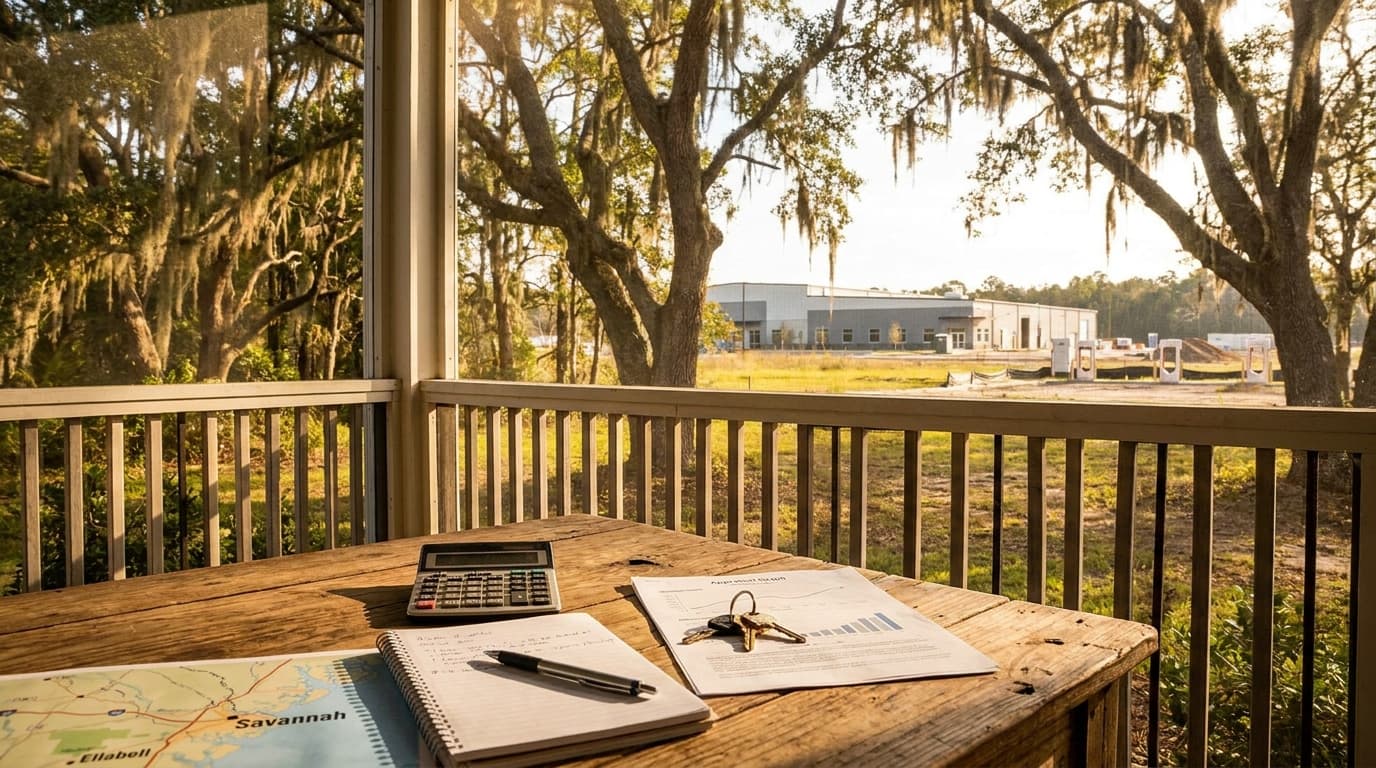
Payroll is moving to Ellabell, and the mortgage map is following. Hyundai Motor Group's $7.6 billion Metaplant America (HMGMA) — an EV assembly plant about 25 miles west of Savannah in Bryan County — reached full production of the Ioniq 5 in October 2024, targeting more than 500,000 vehicles a year. Around it, a supplier cluster is spreading paychecks across Bryan, Bulloch, Effingham and Chatham counties. For homebuyers and the lenders who serve them, that payroll is the real story: it is a demand engine, and it is already bending prices in some towns while barely touching others.
If you are relocating for one of these jobs — or you already live nearby and are watching your local market tighten — the practical questions are where demand is concentrating, what it is doing to prices, and how to finance a home without over-leveraging on a hiring ramp that still has years to run. Here is a plain-English map.
The jobs picture: a 5-to-7-year hire-up, not an overnight boom
The scale is genuinely large, but the timeline matters as much as the headline. Metaplant headcount rose from about 1,400 workers in October 2024 to roughly 3,200 a year later, and Hyundai plans to reach about 8,100 jobs at the plant by 2031. Regional officials describe it as a five-to-seven-year hire-up rather than a single hiring wave.
Add the affiliated ecosystem — an LG battery joint venture plus 17-plus announced suppliers — and the combined project is projected at roughly 14,476 jobs: about 8,500 at Hyundai and the battery operation, and nearly 6,000 across suppliers spread over nine-plus counties, per local reporting from the Statesboro Herald. Total Hyundai investment in the area approaches roughly $10 billion.
The affordability tailwind is the pay. Metaplant production workers average about $58,105 a year — roughly 29% above Bulloch County's average wage of about $45,032. Wages meaningfully above the regional norm are what turn an industrial project into sustained mortgage demand: more households clearing lender income thresholds, and more of them buying rather than renting.
But because the hiring is staged over years, the housing surge is staged too. That is good news for anyone worried about a one-time price spike — and a caution against assuming today's bidding pressure is permanent.
Where demand is concentrating: a real price gradient
Demand is not landing evenly. It is concentrating along a clear price gradient, from a premium seller's market near the plant to a much cheaper supplier town to the west.
Bryan County / Richmond Hill (the premium tier). Bryan County is Georgia's fastest-growing county — and the sixth-fastest in the nation per recent Census estimates — up roughly 48% since 2010, according to WSAV. Richmond Hill, its established bedroom community, is the closest polished suburb to the plant and behaves like a seller's market. Median sale prices there run roughly $375,000 to $445,000 depending on the source and month, per market data from Rocket Homes.
Bulloch County / Statesboro (the affordable tier). West on I-16, Statesboro and the rest of Bulloch County sit far cheaper — a county median around $290,000 to $302,000, with Statesboro itself near $289,000, per Redfin. This is where much of the supplier investment is landing (more on that below), which makes it the value play for workers willing to trade a shorter commute for a lower payment.
Pooler / Chatham County (the middle). Between the two, Pooler runs roughly $350,000 to $391,000, per Zillow — a compromise on price and location for buyers who want Savannah-side amenities.
The takeaway: the same job can support very different mortgages depending on which county you buy in. A ~$58,000 production salary stretches a lot further in Statesboro than in Richmond Hill.
What the suppliers are building — and why it feeds Statesboro
The reason Bulloch County belongs in this conversation is the supplier plants clustering there. Ajin USA / Joon Georgia is investing about $317 million for roughly 630 jobs off I-16; Ecoplastic America is putting in about $205 million for roughly 456 jobs on Highway 301 South; and Hanon Systems is adding about $40 million and 160 jobs at a Gateway-area park, confirmed by the Development Authority of Bulloch County. Coverage of the first suppliers to commit is in the Statesboro Herald. All told, Bulloch supplier jobs top about 1,500 with roughly $937 million invested.
That concentration of supplier payroll in a lower-cost county is exactly why builders are turning to entry-level product and rate buydowns aimed at plant and supplier workers, and why new supply — spread across several towns rather than piled into one — helps keep any single market from overheating. New subdivisions are, in effect, spreading the demand out.
The financing decision: USDA vs. conforming/FHA
For a relocating worker, the financing choice often comes down to geography as much as income. Georgia's USDA Rural Development guaranteed loan offers zero down payment, which is powerful for a household that hasn't built savings, but it comes with two hard constraints.
First, income. The 2026 Georgia USDA guaranteed-loan income limit is about $119,850 for one-to-four-person households (roughly $158,250 for five-to-eight), per USDA Mortgage Source. A single ~$58,000 production income sits comfortably under that cap; two plant incomes in one household may not.
Second — and this is the one that trips people up — the property must sit in a USDA-designated rural area. That eligibility map excludes much of denser Richmond Hill and Pooler, but includes large parts of rural Bulloch, Effingham and west Bryan. In practice, the zero-down USDA option and the premium Richmond Hill market often don't overlap. Workers who want USDA financing frequently end up looking at the more rural, more affordable side of the gradient — which lines up with where the supplier jobs are anyway.
Watch the program caps, too. The USDA Single Family Direct area loan limit for Effingham County is $324,700 (effective February 10, 2026), per the USDA area loan-limit map. When local list prices climb faster than those caps, the program can quietly price out the very homes buyers want. If USDA doesn't fit — because of the area, the income cap, or the price — conforming and FHA loans remain the fallback, with FHA's lower down payment and more flexible credit standards a common choice for first-time buyers who don't qualify for zero-down.
The appraisal trap in brand-new subdivisions
There is one financing hazard that is specific to boom towns full of new construction, and it catches buyers off guard: the appraisal can come in below the builder's contract price.
In a brand-new subdivision, there are few completed, comparable sales for an appraiser to lean on. Thin comps can produce a valuation under the price you agreed to pay, as The Federal Savings Bank explains. Because your lender bases the loan on the appraised value — not the contract price — a low appraisal creates an "appraisal gap" that is your problem to solve.
You generally have three moves. You can cover the gap in cash on top of your down payment; you can renegotiate the price with the builder (harder when the builder holds pricing power in a hot market); or you can lean on an appraisal contingency to walk away or force a second look. Buyers relocating on a tight timeline sometimes waive that contingency to win a home — a real risk in a market where new-subdivision appraisals are the norm. Know your gap tolerance in cash before you sign, not after.
The cautious close: stress-test against one income
Job-anchored booms are powerful, but they can cool during a multi-year ramp. Hiring targets are targets, not guarantees, and the run from ~3,200 workers today to ~8,100 by 2031 leaves plenty of room for the pace — and local price momentum — to soften along the way.
Two practical guardrails follow from that. First, stress-test the payment against a single income even if you are buying on two, so a layoff, a shift change, or one partner leaving a plant job doesn't put the house at risk. Second, don't buy on projected future pay — bonuses, raises, or a second household income you are counting on but don't yet have. Borrow against what you earn now, in a county whose price you can defend if the boom pauses. In a market this new, that discipline is worth more than any rate buydown.
Related reading
-
[Your 2026 Tax Cap Isn't Coming Yet: Why Fulton, Gwinnett, Cobb, DeKalb and Chatham Opted Out of Georgia's Homestead Freeze — and What SB 33 Changes in 2027](/article/georgia-homestead-cap-opt-outs-2026-sb-33-2027)
-
The Quiet 2026 Tax Change Letting Some Georgia Veterans Write Off the VA Funding Fee
Sources
-
As Metaplant rises in Ellabell, regional officials expect a 5- to 7-year hire-up — Statesboro Herald
-
First Hyundai Metaplant supplier will build plant in Bulloch — Statesboro Herald
-
Hanon Systems to Create 160 New Jobs in Bulloch County — Development Authority of Bulloch County
-
Census: Bryan County is fastest-growing county in Georgia, 6th in nation — WSAV
-
[Richmond Hill, Georgia Housing Market Report — Rocket Homes](https://rocket.com/homes/market-reports/ga/richmond-hill)
-
Single Family Housing Direct Home Loans — Area Loan Limit Map (USDA)
-
How Appraisals Work for New Construction Homes — The Federal Savings Bank
This article contains AI-assisted content and has been reviewed in our publication workflow. It is general information, not mortgage, financial, or legal advice; loan terms, income limits, and eligibility maps change, so verify current figures with a licensed lender before making decisions.