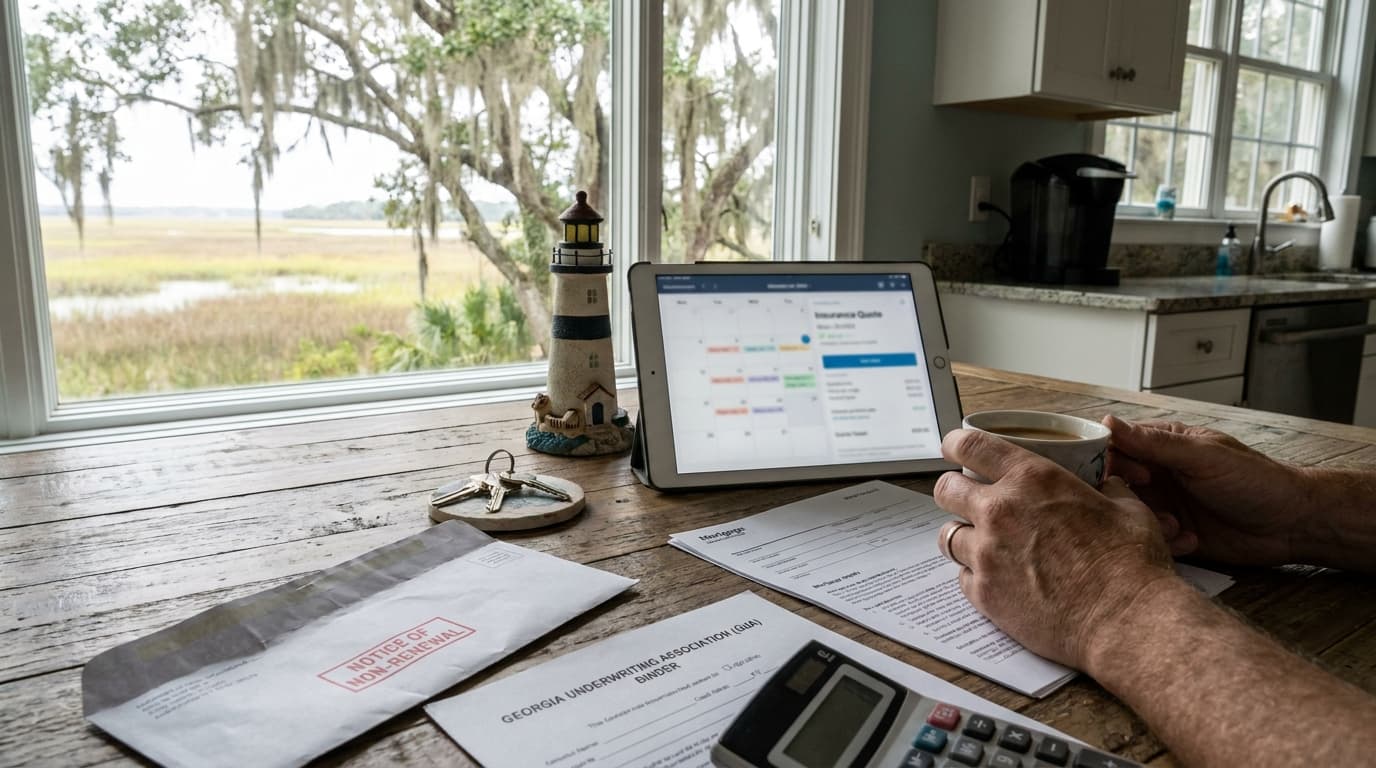
A Glynn County buyer can do everything right — locked rate, clean appraisal, clear title, movers booked — and still watch the deal stall 21 days from closing because a non-renewal letter or a re-quote lands in their inbox and the homeowners premium suddenly doesn't fit inside the debt-to-income ratio the underwriter already approved. In the six coastal counties that make up Georgia's wind belt, that scenario has stopped being rare. It is the new failure mode of a coastal closing, and it is driven by a hard insurance market that mortgage timelines were never built to absorb.
This article walks through what is happening in the market, what the new Georgia notice law does and doesn't do, and the practical sequence Brunswick and Savannah buyers should run from offer to clear-to-close so a late carrier decision doesn't kill a deal.
Why coastal Georgia turned into a hard market
Hurricane Idalia in 2023 and Hurricane Helene in September 2024 reset carrier appetite across the Southeast. Moody's RMS pegged insured losses from Helene at roughly $11 billion, making it one of the costliest storms ever to hit Georgia. Reinsurance costs followed the loss curve up, and admitted carriers tightened where they would write — particularly in coastal ZIPs with treefall exposure and limited mitigation.
Georgia's rate filings move more slowly than Florida's, so the post-Helene shock is still being absorbed into renewal pricing. Insurify projects roughly a 10% Georgia homeowners premium increase in 2026 on top of about 9% in 2025, with cumulative 2023–2025 increases near 24%. Local reporting from 13WMAZ and WTOC in Savannah has documented the resulting non-renewal complaints in coastal communities, and The Current GA has tracked the affordability and availability data into 2026.
The practical effect for buyers in Chatham and Glynn — which carry the steepest homeowner premiums in the state according to local agency data — is fewer admitted carriers willing to quote, separate (percentage-based) wind deductibles as the standard rather than the exception, and a higher chance that whatever quote you bind at application gets re-rated or non-renewed before the policy goes final.
What SB 35 (Act 277) actually changed on January 1, 2026
Georgia SB 35, enacted as Act 277, was signed in May 2025 and took effect January 1, 2026. The headline change: insurers must now give at least 60 days' written notice before non-renewing a homeowners policy, up from 30, and the notice must state the specific reason. The bill tracker confirms the chronology, and the legal-trade summaries from MMM Law and Taft walk through the notice content requirements.
What the 60-day rule does not change matters just as much for a buyer in the middle of a closing:
-
It governs non-renewal, not mid-term cancellation for material misrepresentation or non-payment.
-
It applies once you have a policy. During the binder period — typically 30 to 90 days while the carrier finishes underwriting, as explained by Better — the carrier can still come back with a re-rate, a wind exclusion, or a refusal to issue the final policy.
-
Industry commentary in Insurance Journal has flagged that the reforms may push some carriers further out of the coastal market, not back into it.
Translation for a buyer 30 days from close: the new statute helps you in year two of ownership. It does not protect the closing itself.
The wind belt, on a map
The Georgia Underwriting Association's Plan of Operation — the residual market authorized under O.C.G.A. § 33-33-1 — defines the Windstorm & Hail Area as the six coastal counties plus the offshore islands:
-
Bryan
-
Camden
-
Chatham (including Tybee Island)
-
Glynn (including St. Simons, Jekyll, Sea Island)
-
Liberty
-
McIntosh
Inside that footprint, expect separate wind deductibles stated as a percentage of Coverage A and, increasingly, a requirement that wind be carried on a standalone policy if the HO carrier excludes it. Local agency guidance ties the current underwriting posture directly to the Idalia and Helene experience.
Who is still writing — and where GUA is the only door
Coverage in the wind belt now comes from three layers:
-
Admitted standard carriers still write some inland and well-mitigated coastal risks, but with higher minimum deductibles, roof-age restrictions, and wind sublimits.
-
Excess & surplus (E&S) markets — Lloyd's syndicates and similar specialty writers — pick up risks that admitted carriers decline, usually at higher cost and with broader exclusions.
-
The Georgia Underwriting Association (GUA), the state's FAIR plan, is the backstop when private markets won't write.
For some Tybee, downtown Savannah, St. Simons, and Jekyll properties, GUA is realistically the only path to a bindable wind policy at closing.
GUA in plain English
The GUA policy menu covers three forms relevant to coastal buyers:
-
HO-8 — a modified homeowners form. Settles dwelling losses on a modified replacement basis (functional replacement cost), not full replacement.
-
DP-1 — named-peril dwelling fire. Narrower than a standard HO; commonly used for rentals or where HO-8 isn't available.
-
Standalone Wind & Hail — paired with a private HO that excludes wind on the coast.
Two settlement details to internalize before you bind anything at GUA:
-
Wind losses settle on Actual Cash Value (ACV), not Replacement Cost. That means depreciation comes out of the check. Consumer-side summaries spell out the trade-off — GUA is a residual market, not a premium product.
-
FORTIFIED mitigation credits apply. Per producer-side guidance, GUA recognizes the IBHS designations with posted wind-peril credits of 5% Bronze, 7.5% Silver, and 10% Gold. On a coastal premium running $4,000 to $8,000 or more, those credits are real money — and the inspection cost typically pays back inside one renewal cycle.
One more operational detail that drives the entire playbook: GUA has a Hurricane Underwriting Restriction. When the National Hurricane Center issues watch/warning parameters for the Georgia coast, GUA pauses binding new business until the restriction lifts. If you wait to get a GUA quote until a storm shows up on the cone, you are too late.
The backup-carrier playbook
Treat insurance like title — something you start at offer, not at clear-to-close.
-
At binding the contract, request two parallel quotes: a primary admitted HO with a coastal carrier that's actually writing the ZIP, and a GUA quote (or a wind-only quote priced through an E&S market) as Plan B.
-
If the home qualifies, order a FORTIFIED inspection. Bronze, Silver, or Gold all carry posted credits at GUA and often unlock private capacity that otherwise wouldn't quote.
-
Document the underwriting story up front: roof age and shape, opening protection, distance to coast, prior claims. Carriers re-rate when they discover those details late.
-
Get the binder into the lender's hands 30 to 45 days before close. Lender-side explainers from Chase and Better describe what underwriting expects to see and when.
-
Confirm the wind deductible math against your escrow. A 2% or 5% wind deductible on Coverage A is a number you want to see in writing — and your monthly payment should reflect the premium you actually bound, not the estimate on the loan estimate.
-
Verify flood separately. Per lender-requirement summaries, where flood is required (SFHA zones AE/VE common to Brunswick, St. Simons, Tybee, and downtown Savannah), it's an NFIP or private policy on its own track.
-
Keep the GUA quote alive until the private policy is issued, not just bound. A binder isn't a final policy; the carrier can still walk during the underwriting window.
Lender mechanics — why the timing got tighter
Lenders require evidence of bound coverage before funding. That has not changed. What has changed is the asymmetry on the coast: a binder issued at application can be replaced by a non-renewal notice or a wind-exclusion endorsement before the policy goes final, and the new premium may push the borrower's DTI past the threshold that earned the original approval.
Two friction points to watch:
-
Escrow analysis has to absorb the actual bound premium, not a placeholder. A premium that doubles between loan estimate and closing disclosure can require a redisclosure and may push the closing past the rate-lock expiration.
-
Wind deductibles stated as a percentage of Coverage A change the out-of-pocket math after a loss. Lenders don't typically object, but borrowers should know they're now self-insuring the first several thousand dollars of any wind claim.
30-day action checklist
-
Confirm the binder is in lender hands and that it names the lender as mortgagee with the correct loan number.
-
Confirm the wind/hurricane deductible in writing — percentage or flat — and re-run the monthly payment.
-
Verify flood: zone, NFIP vs private, effective date before closing.
-
Ask the carrier (in writing) whether underwriting is complete or whether the policy is still subject to inspection.
-
Keep the backup quote (GUA or E&S wind-only) priced and available — do not let it expire.
-
Build a written contingency into the purchase contract with your agent: what happens if a non-renewal or material re-rate lands inside the closing window.
-
Watch the tropical outlook. If a named system enters the Atlantic basin and could threaten the coast, get any pending GUA application bound before the Hurricane Underwriting Restriction triggers.
Sidebar: state-level consumer resources
The Georgia Office of Commissioner of Insurance and Safety Fire publishes a consumer guide, Insurance Before and After a Disaster, that covers documentation, claim filing, and complaint procedures. If a carrier's conduct during a non-renewal or claim looks out of line with the policy or with Georgia law, the OCI complaint process is the formal channel.
The bottom line
SB 35 raised the non-renewal notice window to 60 days, which helps existing homeowners more than buyers under contract. Inside the wind belt, the only reliable protection for a closing is sequencing: a primary quote and a GUA (or wind-only) backup running in parallel from offer, a binder in the lender's hands 30 to 45 days out, and a deductible and escrow number that have been reconciled in writing before the rate lock burns off. The market is going to keep absorbing the Helene loss cycle through 2026. The buyers who close on time are the ones who treat insurance as a closing path, not a closing-day errand.
Related reading
Sources
Editor's note: This article contains AI-assisted content and has been reviewed in our publication workflow.