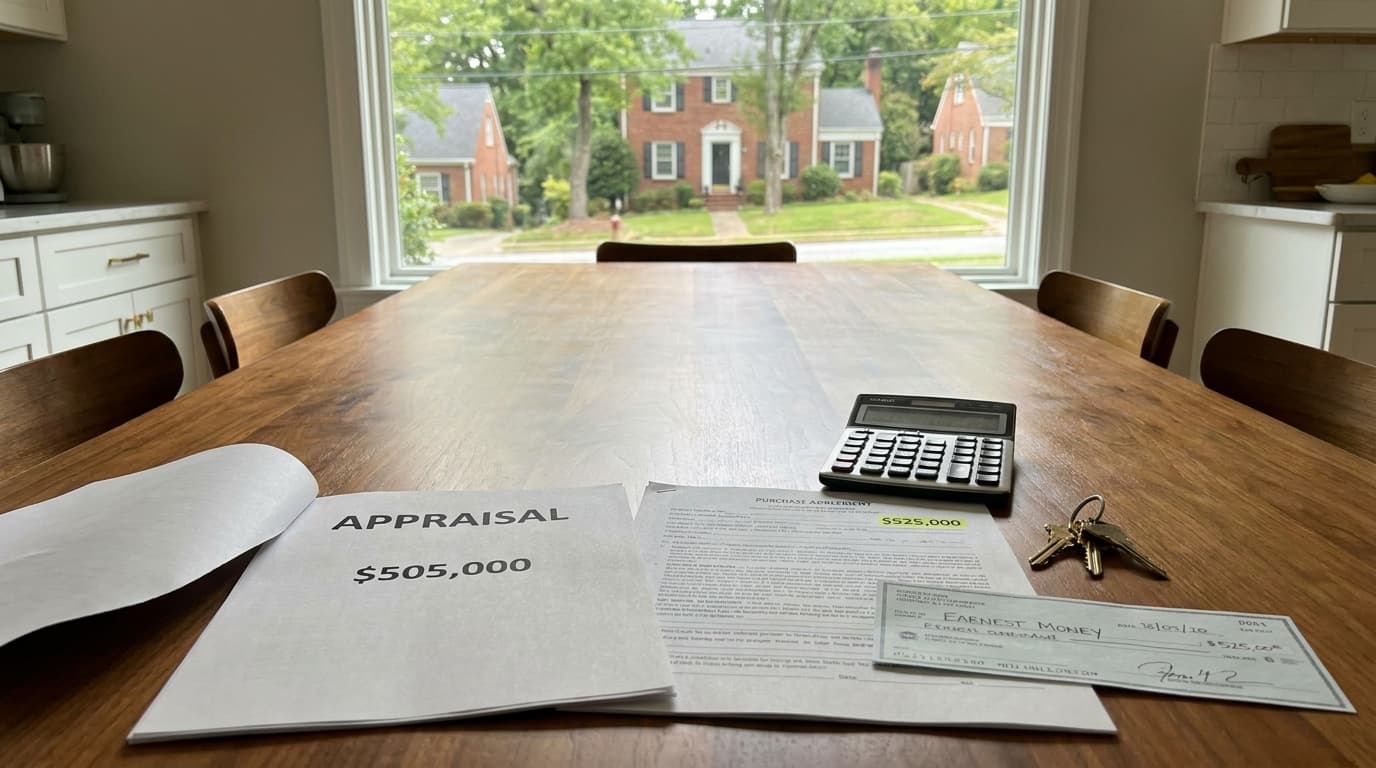
A familiar scene is playing out across metro Atlanta this spring: a buyer agrees to $525,000 on a Brookhaven townhouse, waives or weakens the appraisal contingency to win the contract, and then the appraisal lands at $505,000. Twenty thousand dollars short. The lender will lend on the appraised value, not the contract price. The buyer now has roughly two weeks to bring cash, renegotiate, dispute the value, or walk — and depending on what the contract says, walking can mean losing the earnest money.
Low appraisals are not new. What is new this spring is the mismatch driving them: list prices firmed up faster than the closed-sale data appraisers are required to use. The result is a structural lag that is catching buyers, listing agents, and loan officers off guard.
Why the gap opened this spring
Appraisers in metro Atlanta build their opinion of value primarily from closed sales — not active listings, not pending contracts. Standard practice is to pull the most relevant closed comparables from First Multiple Listing Service (FMLS) and Georgia MLS (GAMLS), typically within the prior 90 days and a one-mile radius, tightened or widened based on the subject property and neighborhood. Those rules of thumb come out of the Uniform Standards of Professional Appraisal Practice (USPAP), the framework every licensed appraiser must defend their work against.
The mechanical problem is simple. If a market firms up quickly, the closed sales from 30, 60, and 90 days ago reflect the slower environment that produced them. Appraisers can apply a time adjustment to bring older sales forward, but those adjustments are conservative by design and must be supported by paired-sales or trend analysis — they rarely keep pace with a sharp move in list prices. Public time-series data on the Atlanta metro shows the list-versus-closed spread that appraisers are now navigating; Atlanta REALTORS Association market briefs track the same shift in monthly closed sales and median price.
That lag plays out differently across submarkets. Intown neighborhoods with thinner inventory — Inman Park, Grant Park, Kirkwood — often have only a handful of qualifying comps inside a one-mile, 90-day window, which gives a single outlier sale outsized weight. Outside the Perimeter, subdivisions with high turnover and consistent product (think Forsyth or south Cherokee) produce deeper comp pools, but those pools also reset faster when the market moves. Neither environment is immune.
The four options after a low appraisal
When the number comes in under contract, buyers in Georgia have four practical paths:
-
Bring cash to close the gap. The lender funds based on the appraised value; the buyer covers the difference at closing. This is the cleanest path if the buyer has the liquidity and still believes the price is justified.
-
Renegotiate. Sellers in a softer micro-market often accept a reduction to the appraised value rather than restart the listing. In tighter pockets, they push back and dare the buyer to walk.
-
Dispute the appraisal via a Reconsideration of Value (ROV). More on this below — it is a real option, not a long shot, but only with the right evidence.
-
Terminate under the appraisal contingency. Available only if the contingency is in the contract and has not been waived. The Georgia Association of REALTORS (GAR) F23 Appraisal Contingency Exhibit is the standard mechanism; without it, exit rights narrow sharply.
Reconsideration of Value — what changed in 2024
The ROV pathway used to vary lender by lender. That changed when Fannie Mae updated its Selling Guide effective August 29, 2024, requiring lenders to maintain a formal ROV process and disclose it to borrowers; Freddie Mac adopted parallel requirements for its eligible loans. Both moves followed pressure from the Federal Housing Finance Agency and the interagency PAVE task force, which had flagged inconsistent ROV access and appraisal bias as policy problems.
An ROV is not a do-over. It is a structured request asking the appraiser to reconsider their value in light of specific, verifiable information the borrower or lender supplies. The submissions that move the needle generally share three traits:
-
Factual errors in the report — wrong square footage, missed bedroom, incorrect lot size, wrong condition rating.
-
Omitted superior comparables — closed sales inside the standard window the appraiser did not include, especially ones that are more similar in style, size, or condition than the comps used.
-
Mis-adjustments — for example, a market-conditions (time) adjustment that does not match the trend the closed-sale data actually supports.
Industry guidance generally puts ROV success rates in the rough range of one in three when the submission is properly formatted and identifies specific errors or better comps. Vague disagreement with the value does not qualify. The appraiser remains the decision-maker, and any change has to be defensible under USPAP. The Appraisal Institute publishes guidance on how residential appraisers select and adjust comps, which is useful background when assembling an ROV package.
The contract language that decides earnest money
In Georgia, the contract is the GAR F20 Purchase and Sale Agreement, and the appraisal protection sits in the F23 exhibit. Three pieces of language matter most in a low-appraisal market:
-
F23 Appraisal Contingency. Included, it gives the buyer a defined right to terminate and recover earnest money if the appraisal comes in below contract price and the parties cannot agree on a path forward. Waived, that exit is gone.
-
Appraisal gap (shortfall) clause. A buyer can keep the appraisal contingency but commit to cover a specified dollar amount of any shortfall — say, the first $10,000 — in cash. This is the middle path: stronger than a full waiver to the seller, but with a known ceiling on the buyer's exposure.
-
Escalation clauses tied to appraised value. When escalation language is used, capping the escalated price at or near appraised value protects the buyer from winning the bidding war and then losing the appraisal.
The financing contingency is separate. A buyer can clear financing in the sense that the lender will lend — just at the lower appraised value — which means a buyer who relied on the financing contingency alone to escape a low appraisal can find themselves with no exit and earnest money at risk.
FHA and VA wrinkles
For FHA and VA buyers, a low appraisal is harder to shake than on a conventional loan. Under the FHA Single Family Housing Policy Handbook 4000.1, the appraisal is tied to the property's FHA case number and remains valid for 120 days. VA appraisals, governed by the VA Lenders Handbook, produce a Notice of Value tied to the property for 180 days. In practical terms, a buyer cannot simply switch lenders and order a new appraisal hoping for a higher number — the existing value sticks to the property for that window. FHA and VA buyers who want to dispute a value generally have to work the agency-specific reconsideration process and bring strong evidence; the bar is high.
Earnest money mechanics, plainly
Earnest money in Georgia is held by the broker or closing attorney named in the contract, not by the seller. It is released according to the terms the parties signed. If the appraisal contingency is in place and properly exercised within its timeline, the standard outcome is return of earnest money to the buyer. If the contingency has been waived and the buyer cannot close at contract price, the seller can pursue the earnest money as the contractual remedy. A gap clause limits this exposure: it lets the buyer commit to cover a defined shortfall in cash while preserving the right to terminate if the shortfall exceeds that cap.
Practical checklist for the spring market
For buyers:
-
Do not waive the F23 appraisal contingency without a specific gap-coverage cap you can actually fund.
-
Confirm with your loan officer how their lender's ROV process works before you need it — Fannie's 2024 update requires they have one and disclose it.
-
Have your agent identify two or three closed comps inside the standard 90-day, one-mile window that support contract price, so an ROV package is ready if needed.
-
FHA and VA buyers: assume the appraised value is sticky for 120 or 180 days. Plan accordingly.
For listing agents:
-
Pre-screen the comp pool before pricing. If list price relies on pendings or actives that have not closed, expect appraisal friction.
-
Be prepared to share supporting closed sales with the appraiser through the standard channel at the time of inspection.
For loan officers:
-
Set expectations on the ROV timeline up front. It is days to weeks, not hours, and the appraiser is the final decision-maker.
-
Walk buyers through the difference between the financing contingency and the appraisal contingency before they waive anything.
None of this makes a low appraisal disappear. What it does is convert a surprise into a known set of options — which, in a spring market where the comp window is lagging the list price, is the difference between a renegotiated close and a forfeited earnest money check.
Related reading
-
Hurricane Season Just Opened. Coastal Georgia Mortgages Now Need Pricier Flood Coverage.
-
Trigger-Lead Spam Calls Still Hit Georgia Borrowers — Here's the Free Step That Stops Them
Sources
-
Federal Housing Finance Agency — Appraisal Modernization and PAVE
-
Georgia Association of REALTORS — Forms and contracts (F20, F23)
This article contains AI-assisted content and has been reviewed in our publication workflow. It is general information, not legal, tax, or financial advice. Consult a licensed Georgia real estate attorney or your loan officer about your specific transaction.