In 2024, Georgia voters ratified a statewide cap on how fast the taxable value of a homesteaded property can rise. It was supposed to be the big structural fix for homeowners watching assessments outrun their paychecks. Then the legislature let local governments opt out — and opting out became the norm, not the exception.
According to a Tax Foundation analysis, 64.8% of Georgia counties — containing nearly 83% of the state's population — had their school system, their general government, or both opt out of the new exemption. In 2026 the General Assembly closed the door: SB 33, the Homeownership Opportunity and Market Equalization (HOME) Act of 2026, signed by Gov. Brian Kemp on May 11, 2026, makes the cap mandatory for every county, city and school district.
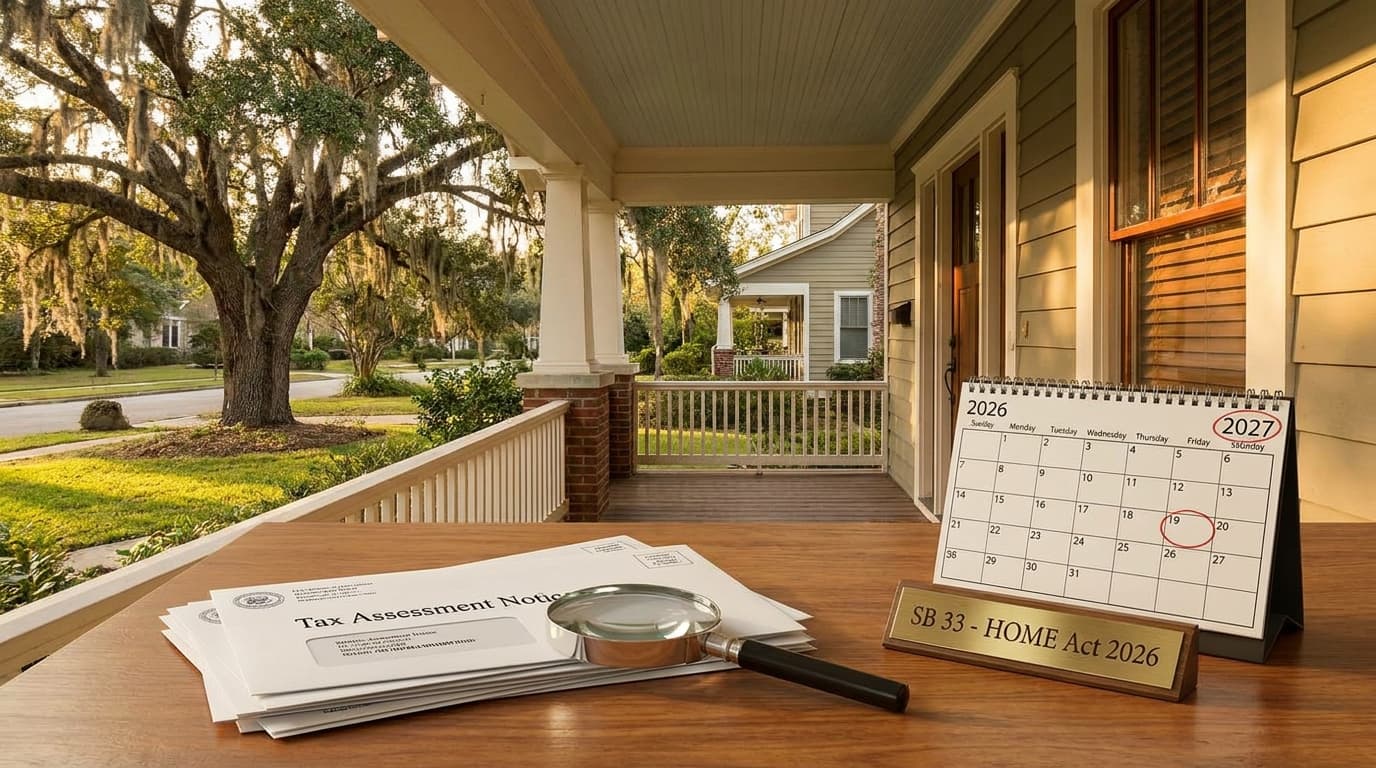
But not until tax year 2027. Which means the assessment notice sitting in an opt-out homeowner's file right now — the 2026 one — is the last fully uncapped valuation before the cap switches on. Whatever number lands there is the number the inflation cap is expected to compound from. That is a different kind of stake than a normal appeal year.
First, a headline correction worth making
The 83% figure is real, but it is routinely misstated — including in the way this story is usually headlined. It does not mean 83% of Georgians live in a county whose county government opted out. It means 83% of Georgians live in a county where at least one major taxing authority — the school district, the county government, or both — opted out. Many of the largest opt-outs were school-district-only.
The Georgia Budget and Policy Institute puts the split a second way: roughly 68% of school districts and 30% of counties opted out. Both figures describe the same lopsided pattern: school boards balked far more often than county commissions did.
That distinction is not academic. It determines which lines on your tax bill are protected and which are not — and we come back to it at the end.
What HB 581 actually did
HB 581 (2024), sometimes called the Save the Homes Act, created a statewide floating homestead exemption. It limits the annual increase in a homesteaded property's taxable value to the rate of inflation as measured by CPI. The base year is 2024, and the cap first applied in tax year 2025. Voters ratified it by statewide referendum.
The word "floating" is doing the work. The exemption is not a fixed dollar amount. It is the arithmetic difference between your property's current fair market value and your adjusted base-year value — so it grows automatically to absorb any appreciation above inflation.
The mechanics, in plain numbers: if your base-year taxable value is $300,000 and CPI comes in at 2%, your adjusted base-year value the following year is $306,000. If the market says your home is now worth $340,000, the floating exemption absorbs the $34,000 gap. You are taxed on $306,000.
Two limits matter. First, this caps assessed value, not your bill. Second, it applies only to owner-occupied primary residences with a homestead exemption. Rentals, second homes, commercial property and vacant land stay at full fair market value — which, as Capitol Beat News Service notes, shifts a growing share of the local tax burden onto them over time.
Why the opt-out swallowed the rule
The opt-out was deliberately made possible but procedurally annoying. A jurisdiction had to hold three advertised public hearings, adopt a resolution, and file it with the Georgia Secretary of State by March 1, 2025. Doing nothing meant you were opted in automatically, per ACCG's guidance to local governments.
Hundreds of jurisdictions went through with it anyway. All five of Georgia's largest counties — Fulton, Gwinnett, Cobb, DeKalb and Chatham — have school systems that opted out. County governments in Gwinnett and Cobb opted out as well. All five of the largest cities opted out.
One frequently cited caveat about the timeline: the opt-out itself was a one-time election, not something jurisdictions get to redo annually. What runs through 2029 is the reverse right. HB 92 (2025) let a government that opted out rescind that election by April 30, 2025 if the opt-out applied to tax year 2025, and for tax years 2026 through 2029 a jurisdiction wanting to rescind must file a resolution with the Secretary of State by March 1 of that year. If you have read that Georgia governments "can opt out each year through 2029," that is backwards — it is a rescission window.
The caveat most readers get wrong: opting out doesn't always mean unprotected
This is the part that trips people up, and it changes what you should do next.
A number of jurisdictions opted out of HB 581 precisely because they already had more generous local protections and did not want to be pulled down to the state floor. Gwinnett County, Cobb County, the City of Marietta, Alpharetta, Johns Creek (which has had an exemption since 2018), Sandy Springs, Dunwoody (an assessment freeze) and Milton all fall into this category. Fulton County Schools cited its existing 3%-or-CPI cap as better for taxpayers in years when inflation runs above 3%.
So there are two very different populations inside that 83%:
-
Opted out and unprotected — no local floating exemption or freeze, assessments rise with the market until 2027.
-
Opted out and separately capped — a local exemption or freeze is already doing the job, sometimes better than HB 581 would.
You cannot tell which you are in from a statewide statistic. You have to look at your own bill.
The money reason school boards said no
School districts were not being obstinate. Gwinnett County Public Schools estimated the gap between CPI-limited growth and actual assessment growth at roughly $35 million in FY2025-26, and more than $100 million over three years.
The structural problem is that Georgia school districts run into a constitutional 20-mill ceiling. They cannot simply raise the millage rate indefinitely to make up lost assessment growth. The statewide average sits around 15 mills, but by 2024 at least five districts — Clayton, Fayette, Gwinnett, Dublin City and Wilkinson County — were already between 19 and 20 mills, with essentially no headroom. Across Georgia's 180 districts, John Zauner, executive director of the Georgia School Superintendents Association, warned the practical outcome would be layoffs, since personnel is roughly 90% of a typical school budget.
Whatever you think of that argument, it explains the pattern in the data: the jurisdictions with a hard ceiling opted out; the ones with room to maneuver mostly did not.
What SB 33 does
SB 33 arrived with strange provenance — it began the session as a hemp bill and was repurposed on the final day to carry the property tax package. What it does, per the Georgia Municipal Association's post-passage summary and the GMA bill tracker:
-
Makes the HB 581 inflation cap on homestead taxable value mandatory for every county, city and school district beginning with tax year 2027.
-
Eliminates the opt-out and extends the exemption to every jurisdiction that previously opted out.
-
Creates a Local Homestead Option Sales Tax (LHOST) of up to 1%, split between counties and cities, requiring a local act plus a voter referendum.
-
Adjusts how existing FLOST revenue is applied and opens FLOST eligibility to all local governments.
-
Defines an eligible homestead as a primary residence plus up to five contiguous acres.
-
Prohibits retroactively billing a homeowner when a homestead exemption was applied improperly through no fault of the taxpayer.
-
Increases school reserve fund caps and restricts special election dates for local revenue proposals, which affects SPLOST and TSPLOST scheduling.
What SB 33 does not do
This is the section worth reading twice, because a lot of April 2026 coverage got ahead of the final bill text.
It does not lower anyone's current bill. The cap limits future growth in taxable value. It does not roll anything back.
It does not cap millage rates. Nothing in the assessment cap stops a taxing authority from raising its rate.
It does not cap total local property tax revenue. You may have read that SB 33 requires voter approval when revenue grows more than 3% or the rate of inflation. The weight of post-signing sources says that is not law. GMA's 2026 session review states flatly that "the final bill does not impose caps on city revenues or budgets." GBPI's sine die analysis agrees that SB 33 "doesn't include harmful caps on total property tax revenues." ACCG confirms the Senate voted down HB 1116, the vehicle that carried the budget revenue caps and new millage rollback requirements; SB 382 also failed. The revenue-cap claim traces to Atlanta News First's April 2, 2026 passage coverage, which noted in the piece itself that the full bill text was not yet available at publication.
The practical consequence is the thing to hold onto: a jurisdiction that loses assessment growth can still raise millage, and where budgets are tight, some will. A cap on the assessment side with no cap on the rate side is a cap on one variable in a two-variable equation.
LHOST: the pressure valve
SB 33's answer to that pressure is a sales tax. LHOST lets a county and its cities levy up to 1% — after a local act and a voter referendum — and use the proceeds to fund homestead exemptions.
The mechanism, as described in the Atlanta News First coverage: county tax commissioners calculate how much homestead assessed value can be exempted each year based on the sales tax proceeds available as of Aug. 1 and the adopted millage rates. If collections exceed what is needed, the excess reduces millage rates districtwide by an equal percentage.
On timing, sources vary — some describe referenda as early as November 2027 with collections beginning Jan. 1, 2028; others describe ballot eligibility beginning in 2028. The enrolled bill text is the controlling answer and is posted as a scanned PDF, so confirm the date against it rather than against secondary coverage. Either way, the window is 2027–2028, and whether LHOST passes locally is what determines if the cap actually reduces bills or just reshuffles where the money comes from.
Why the 2026 appeal carries unusual leverage
Here is the timing problem, stated simply.
In an opt-out jurisdiction, 2026 is the last assessment year with no inflation cap in place. From 2027 forward, growth in your taxable value is limited to CPI — compounding off a base. The 2026 value is the number that base is expected to be set from.
That flips the math on appealing. In a normal year, an inflated assessment costs you one year of extra tax and you can fight it again next year. In 2026, an assessment that is $40,000 too high does not cost you one year — it raises the floor that every future capped year compounds from. The cap will faithfully protect a number that was wrong when it was set.
One caution: because SB 33's base-year mechanics for newly-covered jurisdictions live in the enrolled text, confirm with your county tax commissioner which year your base will be drawn from before you build a strategy around it. The direction of the incentive does not change, but the specific year is worth verifying locally.
How to appeal in Georgia
Under O.C.G.A. § 48-5-311, a written appeal must be filed with your county Board of Tax Assessors within 45 days of the date the Annual Notice of Assessment was sent — not the date you opened it. You can use DOR Form PT-311A or a letter.
A few mechanics that matter:
-
You must elect your trier of fact at filing: Board of Equalization, hearing officer, or nonbinding arbitration. Choose deliberately; it is part of the initial written dispute.
-
The appeal goes to the county board, not to the Department of Revenue.
-
There is no single statewide deadline. Counties mail notices on their own schedules — metro Atlanta counties typically send them April through June. Watch your mail; the clock starts without you.
Some appeal-service blogs assert that a value established on appeal is frozen for the two following tax years under O.C.G.A. § 48-5-299(c). We have not confirmed that against the statute, so we are not going to rest an argument on it here. If it holds, it strengthens the case for appealing in 2026 considerably — ask your county assessor's office or a Georgia property tax attorney directly rather than taking a marketing page's word for it.
The buyer's trap
If you are shopping for a home in Georgia, this is the paragraph to save.
The floating exemption does not travel with the house, and it does not travel with you. When a homesteaded property changes hands, the base year and base-year value reset for the new owner — set to the year prior to acquisition and the actual value for that prior year. The exemption is not transferable between properties. Each new owner must apply and establishes their own base.
So a seller who has been capped for years may be paying tax on a value well below what the house is actually worth. You will not inherit that. You inherit a reassessment at market value.
Budget from the reassessed number, not from the listing's tax history. A property tax figure on a listing sheet describes the seller's situation, not yours, and in a fast-appreciating neighborhood the gap between the two can be large enough to change what you can afford.
How to check your own status
There is no single public statewide lookup, which is genuinely inconvenient. Work through it in this order:
-
Read the exemption lines on your current tax bill. Your status is per-taxing-authority. The county line may be capped while the school line is not — Fulton County is the cleanest example: the Board of Commissioners voted to opt in on Jan. 8, 2025, while Fulton County Schools opted out. Forsyth County Schools opted out while the county government was recommended to opt in, per Appen Media.
-
Check your county tax commissioner's and school district's HB 581 pages. Many counties published plain-English explainers; Newton County's is a decent model of what to look for.
-
If you get conflicting answers, the filed opt-out resolutions at the Secretary of State are the authoritative record.
-
Separately, ask whether a local floating exemption or freeze already applies. If you are in Gwinnett, Cobb, Marietta, Alpharetta, Johns Creek, Sandy Springs, Dunwoody or Milton, an opt-out may mean you were already better protected — not that you were unprotected.
What to watch through 2027
Three things.
Millage rate hearings, this summer and next. With the assessment cap arriving in 2027 and no statutory ceiling on revenue growth, rate decisions are where the real budget adjustment happens. These hearings are advertised and public, and they are poorly attended.
LHOST referenda. Whether your county and cities pursue the sales tax option — and whether voters approve it — largely decides whether the cap shows up as a lower bill or just a different mix of taxes.
Early rescissions. A previously opted-out jurisdiction can rescind by filing with the Secretary of State by March 1 of tax years 2026 through 2029. Since SB 33 pulls everyone in for 2027 anyway, a rescission now is mostly a signal about local budget confidence — but for a homeowner in an uncapped jurisdiction, an early rescission would mean the protection starts a year sooner.
None of this changes what to do in the next 45 days after your notice arrives. Read the value. Compare it to what your house would actually sell for. If it is high, appeal — because in 2026, in an opt-out jurisdiction, you are not arguing about one year's tax bill. You are arguing about the floor.
Related reading
Sources
-
Localities Opt Out of Georgia's New Homestead Tax Exemption — Tax Foundation
-
SB 33: The Homeownership Opportunity and Market Equalization Act of 2026 — Georgia Municipal Association
-
The 2026 Session in Review: What Passed, What Didn't, and What It Means — Georgia Municipal Association
-
Property Taxes: Homeownership Opportunity and Market Equalization Act of 2026 (SB 33) — GMA Bill Tracker
-
SB 33 official bill text — Georgia General Assembly
-
Sine Die 2026: Georgia Rejects Property Tax Caps — Georgia Budget and Policy Institute
-
Gov. Kemp signs Georgia tax relief bills — CBS Atlanta
-
Property tax overhaul passes after back-and-forth in House, Senate — Atlanta News First (April 2, 2026; published before final bill text was available)
-
Schools could lose most if property tax legislation becomes law — Capitol Beat News Service
-
2026 Property Tax Reform Update — ACCG
-
How Metro Atlanta cities, counties will handle new state homestead exemption — Appen Media
-
GA SB33 bill detail — BillTrack50
-
PT-311A Appeal of Assessment Form — Georgia Department of Revenue
-
House Bill 581 — Save the Homes Act — Newton County, GA
-
HB 581 Homestead Exemption Opt-Out Guidance and Model Resolution — ACCG
This article explains general Georgia property tax law and is not tax or legal advice. Assessment and appeal specifics vary by county; confirm deadlines and exemption status with your county tax commissioner or Board of Tax Assessors.