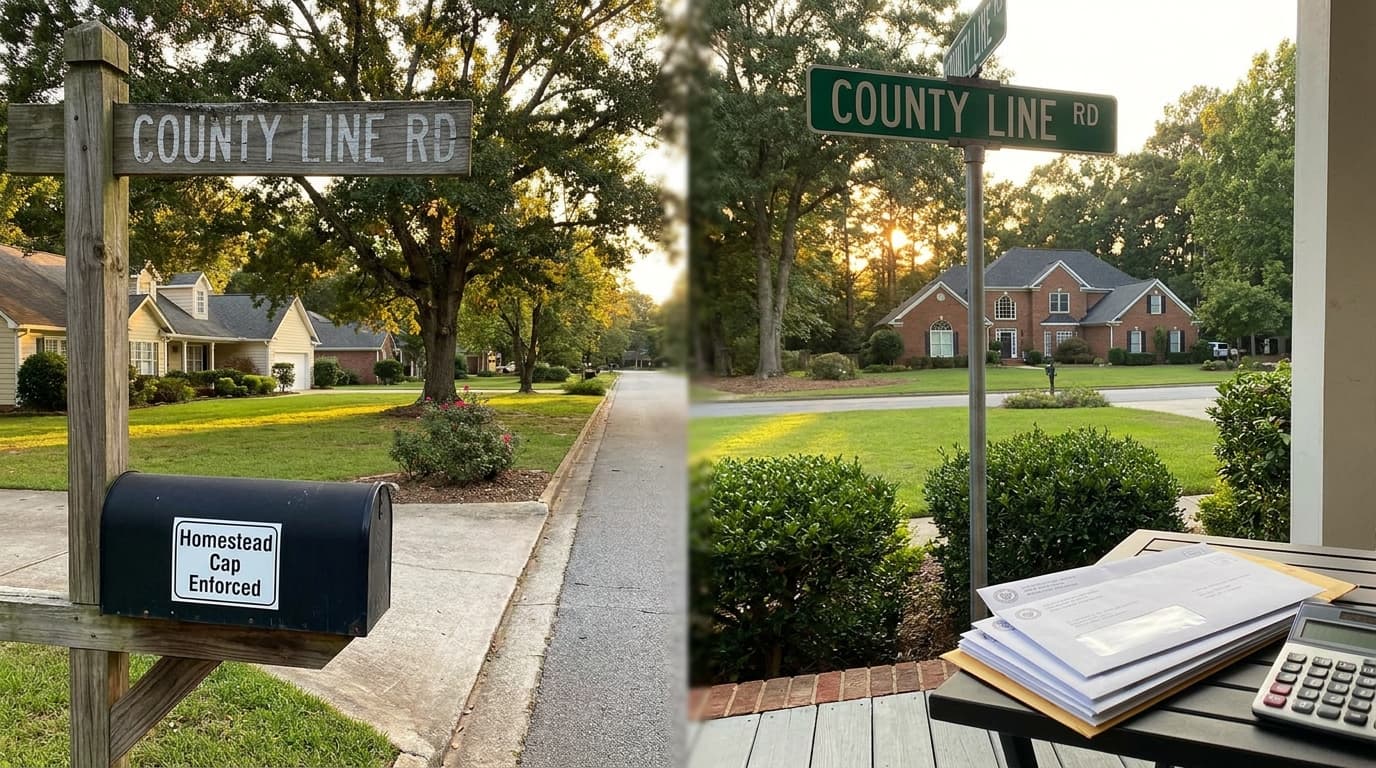
Picture two Georgia homeowners on the same street, with nearly identical houses. One has watched their property tax bill held in check by a new statewide cap. The other — a few hundred feet away, but across a county or school-district line — gets no such protection at all. Same state, same law, two very different outcomes. That patchwork is the defining feature of Georgia's new "floating" homestead exemption, and if you're buying a home in 2026, it has direct consequences for how your lender sets up your escrow account.
What HB 581 actually does
House Bill 581 — informally the "Save Our Homes Act" — was signed into law on April 18, 2024, and took effect after Georgia voters approved the accompanying constitutional referendum on November 5, 2024. It created a statewide "floating" homestead exemption for owner-occupied primary residences.
Here's the mechanism. Georgia assesses property at 40% of fair market value, and millage rates are applied to that assessed value after exemptions. HB 581 uses your 2024 assessed value as a base year and limits how fast the taxable portion of that value can grow each year — capping annual growth to the rate of inflation as measured by the Consumer Price Index for All Urban Consumers (CPI-U, U.S. City Average, published by the Bureau of Labor Statistics). If your home's market value climbs faster than inflation, the exemption "floats" upward to absorb the excess, so the taxable value stays tethered to the inflation rate rather than the hot housing market.
Importantly, the cap applies to county, city, and school-district taxes on qualifying homesteads — the three pieces that usually make up the bulk of a Georgia property tax bill.
Timing reality check: 2026 is the first year the cap actually bites
The headlines made it sound like relief arrived immediately. It didn't. According to the Georgia Department of Revenue, no inflation index rate was published for the 2025 digest year. The first published rate applies to the 2026 digest year, based on December 2025 CPI data. In practical terms, 2026 is effectively the first year the cap constrains anyone's bill.
So if you assumed your taxes were already being held down in 2025, they weren't — there was simply no index to apply. Manage your expectations accordingly: the floating exemption is a 2026-and-forward story.
Why so many counties opted out — and how
HB 581 let local governments and school districts opt out of the exemption, but the process was deliberately public. Per guidance from the Association County Commissioners of Georgia (ACCG), a jurisdiction wanting out had to advertise its intent, hold at least three public hearings (one of them scheduled between 6 and 7 p.m.), issue a press release, adopt a resolution, and file that resolution with the Secretary of State — originally by March 1, 2025.
Then the rules shifted. HB 92, passed in 2025, made the opt-out an annual process for tax years 2026 through 2029, meaning a jurisdiction that opts out has to renew that decision each year. HB 92 also adjusted the deadlines (extending the window toward late March) and clarified that a homestead includes up to five acres surrounding the residence.
The annual-renewal piece matters for buyers: a jurisdiction's status can change from year to year, so last year's answer isn't guaranteed to be this year's.
Who opted out: the urban/rural split
Most large metro jurisdictions opted out, which is why so many Georgia homeowners may see no benefit at all. The opt-outs include:
-
Fulton — county, Fulton County Schools, and most cities
-
Gwinnett — county and schools
-
Cobb — county, schools, and Marietta, Kennesaw, and Acworth
-
DeKalb — the school district
-
Chatham (Savannah)
Many rural counties, by contrast, opted in. Monroe County, for example, publicly documented its commissioners' decision to opt out in February 2025 — a concrete reminder that these are local choices made jurisdiction by jurisdiction, often splitting along school-district lines. Because school taxes are typically the largest line on the bill, a school district's opt-out can erase most of the practical benefit even if the county itself opted in.
The takeaway: don't assume. Verify your specific county, your city, and your school district before you bank on any cap. And remember the status can be renewed — or dropped — annually.
The escrow angle: why buyers don't inherit the seller's capped bill
This is the part that catches new buyers off guard. The capped value resets to current fair market value when a property is sold or transferred. The cap protects a homesteaded owner over time; it does not transfer to the next owner.
So if a seller has owned their home for years in an opted-in jurisdiction, their taxable value may have been held well below current market value. The moment you buy, that value resets to today's fair market value, and your bill is calculated on the higher reassessed number — at 40% of fair market value, times the local millage. The gap between the seller's long-capped bill and your reassessed bill can be substantial.
For escrow, the practical risks are:
-
Don't budget off the seller's bill. A listing or disclosure that shows the seller's capped taxes can dramatically understate what you'll owe. Ask for both the seller's current bill and an estimate of the reassessed bill on the new value.
-
First-year escrow shortages are common. If a lender sets up your escrow account using the seller's lower figure, you can face a shortage once the property is reassessed — leading to a catch-up payment and a higher monthly escrow portion at the first annual analysis.
-
The cap rebuilds slowly from your new base. After purchase, your protection starts fresh from the reassessed value as the new base; it doesn't restore the seller's accumulated savings.
The safest approach is to budget escrow on the reassessed value, not the seller's historical bill, and to ask your lender explicitly how they're calculating the first year's escrow.
FLOST: the optional 1% sales tax tied to the exemption
HB 581 also authorized a new tool called FLOST — a Floating Local Option Sales Tax. It's an optional 1% countywide sales tax, leviable for up to five years and renewable, whose proceeds must be used exclusively to reduce property taxes.
There's an important catch in the eligibility. According to the Georgia Tech Center for Economic Development Research (CEDR), a county qualifies for FLOST only if it — and all of its property-taxing cities — opted into the floating exemption. If any property-taxing city opts out, the entire county becomes ineligible for FLOST. That coupling is part of why opt-in and opt-out decisions ripple across a county.
Adoption has been brisk: CEDR reports that 34 counties had adopted FLOST, with 32 of 36 November referendums passing at an average "yes" vote of 71%. For buyers in opted-in counties, the trade-off is straightforward to understand even if the math is local: you may pay a slightly higher sales tax in exchange for property-tax relief.
Who is NOT protected
The exemption applies only to owner-occupied homesteaded primary residences. If you're buying a rental, an investment property, or a second or seasonal home, there is no cap — those properties get no floating-exemption protection at all. Investors and second-home buyers should budget property taxes on full reassessed value with no annual growth limit.
Your action checklist before closing
-
Confirm all three layers. Check your county, your city, and your school district's opt-in/opt-out status for the current tax year — not just the county. School-district status often drives the outcome.
-
Ask for two numbers. Request the seller's current bill and an estimate of the likely reassessed bill on your purchase price.
-
Budget escrow on the reassessed value. Tell your lender you want the escrow account sized to the reassessed figure to reduce first-year shortage risk.
-
Watch the annual renewal. Because HB 92 made opt-out an annual process for 2026–2029, a jurisdiction's status can change year to year — re-check it.
-
If it's not your primary residence, assume no cap. Investment and second homes don't qualify.
HB 581 is real relief for many long-term Georgia homeowners in opted-in jurisdictions, but it's narrower and slower than the headlines suggested — and for buyers, the reset-on-sale rule means the cap is something you build over time, not something you inherit at closing. Going in with a reassessed-value estimate and an honest escrow setup is the best way to avoid a surprise in your first year of ownership.
Related reading
-
[Georgia's Intangible Recording Tax: The $1.50-per-$500 Closing Charge Most Buyers Don't See Coming](/article/georgia-intangible-recording-tax-explained)
Sources
-
Georgia Senate seeking to make floating homestead exemption opt out an annual process — Decaturish
-
House Bill 581: Homestead Exemption 'Opt-Out' Guidance and Model Resolution — ACCG
-
Monroe County Commissioners Decide to Opt Out of House Bill 581 — Monroe County, GA
Related reading
- Assumable VA and FHA Mortgages Are Georgia's Quiet 2026 Hack — How Atlanta Buyers Are Inheriting 3% Rates Without a Refinance
- Klarna and Affirm Balances vs. a Georgia FHA Buyer's DTI: What Actually Happens Today
- Recasting Your Georgia Mortgage Could Beat Refinancing at 6.5% — The $300 Move Most Borrowers Don't Know Their Lender Offers