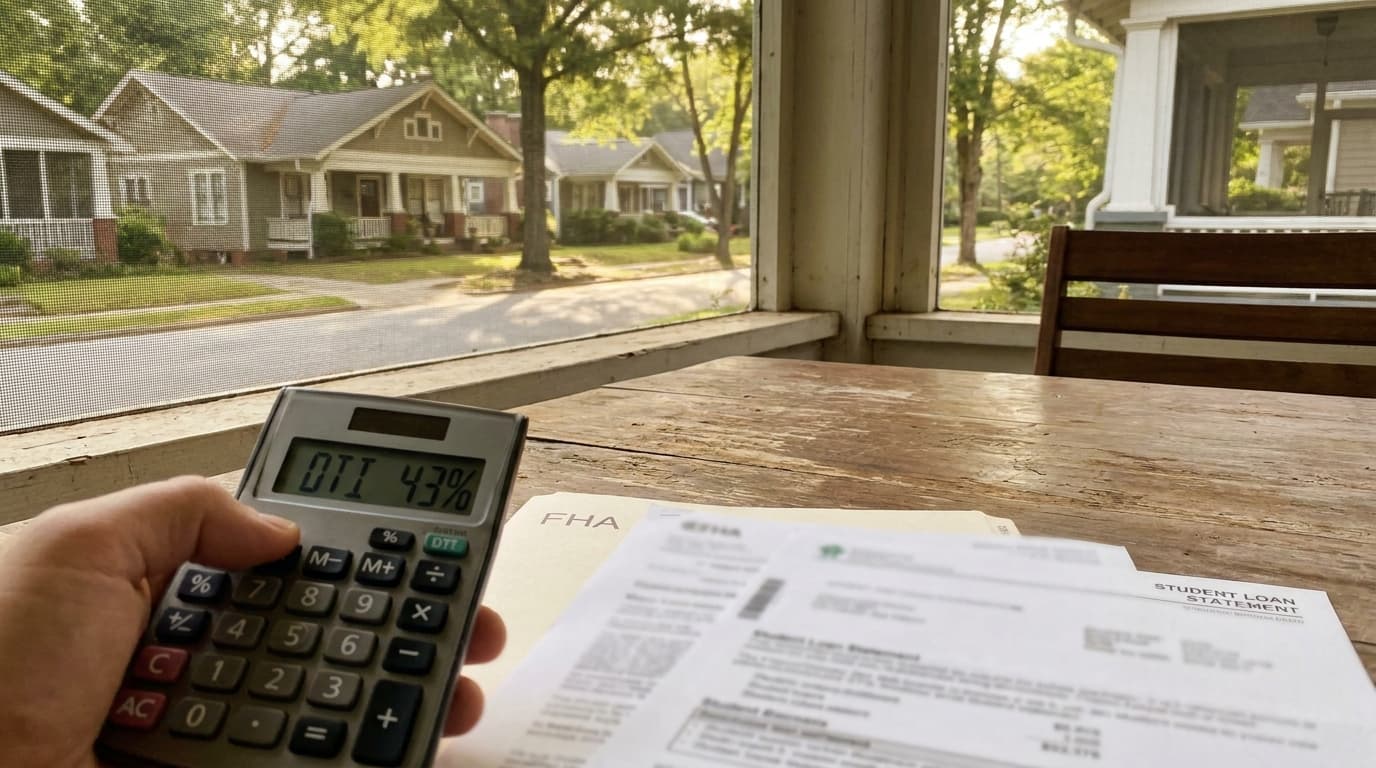
For a few years, a federal student loan could sit quietly in the background while you saved for a house. Payments were paused, interest was frozen, and a lender pulling your credit might see a $0 monthly obligation. That window has closed. The relief programs have fully unwound — and for Georgia first-time buyers trying to qualify for an FHA loan in 2026, the consequences are landing in a place most people never think about: the debt-to-income ratio that sizes your mortgage.
The change isn't always something you feel in your checking account. You can still have a paused or low monthly bill and discover that, on paper, your loan is now counted against you anyway. This article walks through exactly how that happens, why it matters more in a metro-Atlanta market where the median existing home runs around $402,200, and the two practical moves that can get a borderline buyer back to a yes.
The relief is over — and the timeline matters
Two separate dominoes fell in 2025. First, on May 5, 2025, the U.S. Department of Education [resumed collections on defaulted federal student loans](https://www.ed.gov/about/news/press-release/us-department-of-education-begin-federal-student-loan-collections-other-actions-help-borrowers-get-back-repayment), restarting the Treasury Offset Program — which can seize tax refunds, Social Security, and other federal payments — with administrative wage garnishment notices set to follow later in the year.
Second, interest started accruing again. For the roughly 7.7 million borrowers parked in the blocked SAVE plan's forbearance, interest restarted on August 1, 2025. Payments for that group were still paused, but balances began growing again — by roughly $300 a month for a typical borrower, per Student Borrower Protection Center estimates. So even borrowers who don't yet owe a monthly payment are watching their balances climb, and that growing balance is exactly what a mortgage underwriter may use against them.
The point for homebuyers: the reportable payment — the number that flows into your loan application — is back even when the bill in your inbox still feels paused.
What 'back-end DTI' is, and why one line item moves the needle
Your back-end debt-to-income ratio is the share of your gross monthly income that goes toward all your recurring debt — the proposed mortgage payment plus car loans, credit card minimums, and, yes, student loans. Lenders use it as a ceiling. FHA loans commonly allow a back-end DTI up to around 43%, with higher ratios — often into the high 40s or low 50s — possible when an automated underwriting system finds compensating factors. Conventional loans backed by Fannie Mae and Freddie Mac allow up to 50%.
Here's why a single reactivated student-loan payment can be decisive. At roughly 6.5% on a 30-year fixed, about $200 a month of payment supports somewhere in the range of $31,000 to $32,000 of additional loan principal. Flip that around: a reactivated student-loan payment of about $200 doesn't just nibble at your budget — it can erase tens of thousands of dollars of buying power, or push a back-end DTI that was sitting just under the limit straight over the line.
How FHA counts student loans
FHA's rules here are specific, and they're the crux of the problem. Under HUD Mortgagee Letter 2021-13 (effective for case numbers assigned on or after August 16, 2021), an underwriter uses the actual documented monthly payment — or the payment shown on your credit report — when that figure is above zero. When the reported payment is $0, the lender instead counts 0.5% of the outstanding balance. That replaced an older, harsher rule that used 1% of the balance.
The critical trap: a deferred or forbearance loan is not treated as a $0 obligation. A loan that reports $0, or doesn't report a payment at all, still gets counted. Here's the worked example: a $30,000 balance reporting a $0 payment is counted as $150 a month — 0.5% of the balance — in your DTI, even though you currently pay nothing. As plain-language summaries of the current FHA mechanics confirm, that phantom payment is real to the underwriter.
So the borrower who assumes a paused loan is invisible can be blindsided. The pause may protect your cash flow this month, but it does not protect your DTI.
How conventional loans differ — and why product choice matters
If FHA's math doesn't work, a conventional loan sometimes will, because the two agencies treat non-repaying student loans differently. Per a 2025 comparison of Fannie Mae and Freddie Mac guidelines: Freddie Mac uses 0.5% of the balance when no payment is available, while Fannie Mae uses the actual payment, or 1% of the balance if the loan isn't in repayment or no payment is listed. For deferment or forbearance, the figure used is generally the greater of the documented payment or the program's percentage.
Freddie's 0.5% is usually more favorable than Fannie's 1% for loans that aren't being repaid. On that same $30,000 balance, Freddie's approach lands at $150 a month while Fannie's 1% fallback lands at $300 — a $150 monthly swing that, by the rule of thumb above, is worth more than $20,000 in buying power. For a borderline applicant, the choice of loan product and which agency's automated underwriting reviews the file can be the difference between an approval and a denial.
The Georgia angle
This collides with a metro-Atlanta market that already strains first-time buyers. The median existing-home price in metro Atlanta sat around $402,200 in mid-2025, with the average first-time-buyer down payment in Atlanta near $52,367 for the year; statewide, Georgia's median was roughly $367,000. Affordability topped Atlanta residents' concerns in a 2025 Atlanta Regional Commission survey, and local coverage has captured the squeeze on the exact demographic most likely to carry student debt — younger Atlanta professionals buying near the margin. Broader metro-Atlanta market commentary tells the same story of affordability pressure.
State assistance helps with cash, but not with qualification. The [Georgia Dream program](https://www.lendingtree.com/home/mortgage/georgia-first-time-homebuyer-programs/), administered by the Georgia Department of Community Affairs, pairs a below-market first mortgage with $10,000 to $12,500 in down-payment and closing-cost assistance for eligible first-time buyers. But Georgia Dream applicants must still clear the same DTI underwriting — where your student debt now counts. Assistance can solve the down-payment problem and do nothing for a DTI that's over the line.
Fix #1 — Get a documented IDR payment reporting before you apply
This is the central lever. A documented income-driven repayment (IDR) payment — even a low one — can be used in your DTI for both FHA and conventional loans, as long as it appears on your credit report or is documented by your servicer. And it is frequently lower than the 0.5% or 1% fallback the lender would otherwise impose. Guidance on FHA and income-based repayment confirms a documented IDR figure can be used and can beat the percentage fallback.
Consider that $30,000 balance again. Left in forbearance reporting $0, FHA counts $150 a month. But if you enroll in an IDR plan and your income produces, say, a $40 monthly payment that is documented and reporting, the underwriter can use $40 instead. For a buyer with a large balance, the gap between a real low IDR payment and the percentage fallback can be the whole ballgame. The key is timing: get the lower payment documented and reporting before the file goes to underwriting.
Fix #2 — Pay down or pay off a single trade line
If you carry several student loans, the counted payment is driven by your balances. Aggressively paying down — or fully paying off — one trade line lowers the balance the percentage is applied to, which lowers the counted payment. In some cases, eliminating a loan entirely removes it from the DTI calculation altogether. A buyer who is a few hundred dollars of monthly obligation away from the limit may find that retiring one smaller loan is a more direct fix than trimming anywhere else in the budget. It's a targeted move: don't drain your reserves, but understand that one well-chosen payoff can do more for your approval than the dollar amount alone suggests.
Action checklist and timeline cautions
-
Pull your own credit early. See what monthly student-loan payment is reporting today. A $0 or missing payment is a warning sign, not a free pass — it triggers the percentage fallback.
-
Know your back-end DTI before you house-hunt. Add the proposed mortgage plus all debts, including the student-loan figure your lender will actually use. Compare it against FHA's ~43% (with room higher via compensating factors) and conventional's 50% ceilings.
-
Document an IDR payment ahead of time. If you can get a real, low payment reporting, you may beat the 0.5%/1% fallback for both FHA and conventional.
-
Consider a strategic payoff. Retiring one trade line can lower — or remove — a counted payment.
-
Mind the plan-transition calendar. SAVE is being wound down. Borrowers need to move to another plan — IBR, PAYE, or ICR — or the new Repayment Assistance Plan (RAP), which is available by July 1, 2026; SAVE enrollees auto-convert to RAP after July 1, 2028. Which plan you land on determines the payment that reports, so factor it into your timing.
-
Talk to a lender before you shop, not after. A loan officer can tell you which payment figure your file will use and whether an FHA or conventional path treats your student debt more kindly — before a contract is on the line.
None of this is a reason to give up on buying in Georgia. It's a reason to map your student-loan situation onto your DTI early, while you still have time to change the number that reports. The borrowers who get caught are usually the ones who assumed a paused loan was an invisible one. The borrowers who get approved are the ones who treated that reactivated payment as the qualification variable it now is.
This article is general information, not personalized mortgage or financial advice. Program rules and figures change; confirm current guidelines with a licensed lender and your loan servicer for your specific situation.
Related reading
-
[Georgia's Intangible Recording Tax: The $1.50-per-$500 Closing Charge Most Buyers Don't See Coming](/article/georgia-intangible-recording-tax-explained)
-
[Assumable VA and FHA Mortgages Are Georgia's Quiet 2026 Hack — How Atlanta Buyers Are Inheriting 3% Rates Without a Refinance](/article/assumable-va-fha-mortgages-georgia-2026-atlanta-buyers-inheriting-3-percent-rates)
Sources
-
HUD Mortgagee Letter 2021-13 — Student Loan Payment Calculation Policy
-
U.S. Department of Education — Department to Begin Federal Student Loan Collections
-
CNBC — Interest Is Accruing Again for Student Loan Borrowers on the SAVE Plan
-
NSMN — Fannie Mae vs. Freddie Mac Guidelines: Key Differences for 2025 Borrowers
-
[Neighbors Bank — FHA Student Loan Guidelines: What Borrowers Should Know](https://www.neighborsbank.com/learn/fha-student-loan-guidelines/)
-
Tate Esq. — FHA Student Loan Guidelines & Income-Based Repayment
-
BHHS Georgia Properties — Metro Atlanta Market Update: Affordability in Focus
-
Atlanta Magazine — Can Young Atlantans Still Afford to Buy a Home?
-
LendingTree — Georgia First-Time Home Buyer Programs in 2025