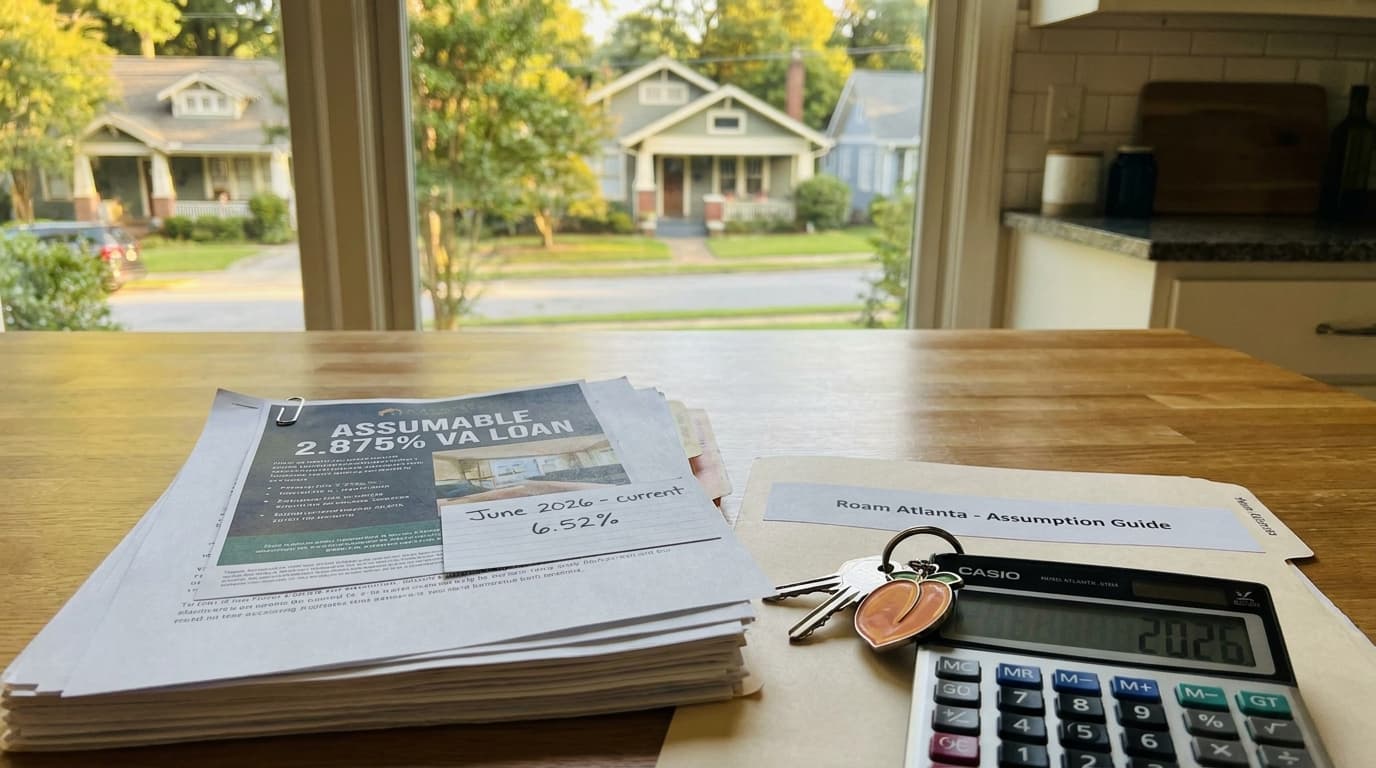
Drive through Marietta, East Cobb, or south Fulton this spring and you will start to notice a new line on listing flyers: "Assumable 2.875% VA loan." A year ago that phrasing was a curiosity. In June 2026, with Freddie Mac's Primary Mortgage Market Survey showing the 30-year fixed at 6.52% for the week of June 11 and Bankrate quoting 6.57% on June 12, it is the single largest hidden affordability lever in metro Atlanta. The gap between today's market rate and the sub-3% loans originated in 2020-2021 is roughly 350 basis points — enough to swing the monthly payment on a typical Atlanta home by hundreds of dollars.
This guide walks through how Georgia buyers are actually pulling these assumptions off: what the law says, what it costs, which servicers process the paperwork, and the two traps — the cash equity gap and VA entitlement — that quietly kill most of the deals that fall apart.
Why assumable loans suddenly matter in Georgia
Assumable financing is not new. What is new is the rate spread. The cohort of FHA, VA, and conventional loans written in 2020 and 2021 carried note rates often between 2.75% and 3.5%. When the borrower keeps the same loan and a new buyer takes it over, the buyer inherits that rate — no refinance, no requalification at today's pricing. Against the Freddie Mac PMMS 6.52% benchmark and Bankrate's 6.57% daily quote, that gap is the entire economic story.
Three marketplaces have emerged to surface this inventory for Atlanta buyers:
-
Roam — the largest dedicated assumable-listings platform, which raised $11.5M in 2025 to expand. Roam charges buyers a 1% fee at closing, and its Atlanta map currently shows roughly 299 to 463 assumable homes depending on filters. Local TV coverage by Atlanta News First earlier this year highlighted Roam as a workaround for affordability in the metro.
-
Assumable.io — a national platform with no buyer fee, useful as a free cross-check on Roam's inventory.
-
AssumeList — a $29/month subscription that covers Georgia among 20+ states and publishes a clear step-by-step timeline for buyers.
Beyond the platforms, broader housing analytics coverage from ResiClub has framed assumable loans as one of the few real affordability levers left in markets like Atlanta.
How an FHA assumption actually works
Every FHA-insured mortgage is legally assumable, subject to the new buyer meeting the same creditworthiness standards a regular FHA applicant would. For any FHA loan originated after December 15, 1989, the lender must approve the buyer — there is no "simple" assumption that skips underwriting. The framework lives in HUD Handbook 4155-1, Chapter 7, and the credit and DTI bar mirrors a standard FHA purchase (roughly a 580 FICO floor and 43% DTI as a practical benchmark, as summarized in lender explainers like SoFi's 2026 FHA overview).
The fee math changed in 2024. HUD Mortgagee Letter 2024-02 raised the maximum allowable processing fee from $900 to $1,800, effective August 19, 2024 — the first adjustment since 2016, as Sandler Law Group's regulatory summary notes. Realistic timelines run 30 to 60 days inside the servicer, with 60 to 90 days end-to-end once title work, inspections, and the equity gap financing are coordinated.
How a VA assumption actually works
VA assumptions follow a tighter procedural script. VA Circular 26-23-10 (May 22, 2023), updated by Change 1 in February 2024, sets the ground rules:
-
$300 cap on the servicer's processing fee.
-
0.5% funding fee on the remaining loan balance, unless the assumer is exempt.
-
Servicers must submit the closing package to VA within 45 days of closing.
-
Servicers must report Transfer of Ownership and Release of Liability to VA's VALERI system within 7 days of closing.
If you want to confirm the cited circular is still current, VA maintains an index of all Home Loans circulars from 2021 to present. Lender-published explainers from Veterans United and Amerisave walk through the same flow from the buyer side.
The down-payment gap is the deal killer
The single most common surprise for first-time assumable shoppers is that you do not just take over the monthly payment — you also have to pay the seller for the equity that has built up since 2020 or 2021.
Picture a $475,000 Atlanta home where the seller's remaining VA balance is $290,000. The buyer must fund the $185,000 spread. That money can come from cash, from a subordinate second lien, or from a combination. VA explicitly permits a second mortgage behind the assumed VA first, as long as the borrower receives no cash back and the second is subordinate. VA Loan Network documents how the secondary financing stack is typically built, with CLTV generally capped near 85% to 90% and the second's payment folded into the buyer's DTI and residual-income tests.
Servicers know this is the bottleneck. Carrington Mortgage publishes a buyer guide that pairs the assumption with a simultaneous HELOC up to 80% CLTV specifically to bridge the gap — one of the few packaged solutions in the market.
The VA entitlement trap
The other quiet trap is unique to VA: entitlement substitution. If you are a qualified veteran with sufficient entitlement and you assume another veteran's VA loan, your entitlement substitutes for the seller's, and the seller walks away with their full entitlement restored. If you are a civilian assuming a veteran's loan, the seller's entitlement stays attached to that property until the loan is paid off or refinanced out of VA. The seller cannot use it on a new VA purchase.
This is not a footnote. VA Loan Network's 2026 guide spells out the encumbrance, and AssumeList's coverage of the 2026 entitlement-acknowledgement form notes that servicers must now hand that form to the veteran seller when the assumption application is received, so the seller knows exactly what they are giving up. If the seller is a veteran planning to buy again, this single issue can override the rate advantage entirely.
Where the inventory actually sits in metro Atlanta
Assumable inventory clusters in the 2020-2021 build-out belt: Fulton, DeKalb, Cobb, Gwinnett, and Clayton counties dominate, with older-stock pockets in Decatur, Marietta, Roswell, Smyrna, Brookhaven, and Sandy Springs surfacing on the platforms. Roam's Atlanta map is the most granular live view; Opendoor's 2026 Atlanta guide gives the broader submarket framing for buyers who are not familiar with the metro's geography. VA Loan Network's 2026 listings overview is a useful cross-reference for VA-specific inventory sources.
The servicer is the bottleneck — pick wisely
The assumption is run by the current servicer, not a new lender of your choice. In Georgia, that usually means one of three names:
-
Lakeview Loan Servicing — the largest Ginnie Mae (FHA/VA) servicer in the country, with LoanCare handling subservicing. Their FAQ is the closest thing to a plain-English process document for buyers.
-
Carrington Mortgage Services — publishes both a buyer guide and a separate agent guide, and offers the simultaneous HELOC product mentioned above.
-
Newrez — runs a dedicated assumption intake portal.
Servicer behavior has been bad enough that VA issued Circular 26-23-27 specifically targeting noncompliance in processing assumptions — flagging delays and improper denials as an enforcement priority. Alston & Bird's legal analysis of that circular is a useful read if you find yourself in an escalation. If a file stalls, escalate to the servicer's assumption manager first, then to VA's regional loan center, citing 26-23-10's 45-day submission window and 26-23-27's noncompliance posture.
Timeline expectations and how to structure the offer
Realistic Georgia timelines are 45 to 90 days from contract to close, per AssumeList's step-by-step timeline. Structure the purchase contract accordingly:
-
Use a financing contingency that explicitly references the assumption, not a new mortgage origination.
-
Build in an extension addendum from day one — assume at least one servicer-side delay.
-
Coordinate the second lien lender or HELOC provider in parallel with the assumption package, not after.
-
Define walk-away triggers: a specific date by which servicer underwriting must clear, and a specific dollar ceiling on the equity gap financing rate.
Practical buyer checklist
-
Get the seller's loan type, current rate, and remaining balance from the original note or a recent statement — not from the listing.
-
Identify the servicer and pull their assumption package and fee schedule before you write an offer.
-
Model the cash gap carefully: purchase price minus remaining balance, plus closing costs, plus the $1,800 (FHA) or $300 + 0.5% funding fee (VA) — minus any seller credits.
-
Line up secondary financing in parallel and confirm CLTV will fit.
-
If the seller is a veteran, confirm in writing whether entitlement will be substituted (you are also a veteran with entitlement) or encumbered (you are not).
-
If you are the seller, demand the formal Release of Liability from the servicer at closing — without it, the loan stays on your credit.
When NOT to assume
The math does not always work. Walk away when:
-
The remaining balance is small and the equity gap is enormous — the blended cost of the second lien may erase the rate savings.
-
The servicer has a documented pattern of assumption delays and you cannot extend closing.
-
You are a non-veteran assumer who plans to use a VA loan yourself within the next two years — you will tie up the seller's entitlement, not your own, which does not help you.
-
The seller is a veteran who needs their entitlement back to buy their next home and you cannot substitute yours.
Bottom line
Assumable VA and FHA mortgages are the closest thing metro Atlanta has to a real affordability shortcut in 2026 — but the savings only materialize if the buyer plans for the equity gap, picks deals at servicers that actually process assumptions, and reads the VA entitlement consequences before signing. The rate is the headline. The cash, the second lien, and the entitlement form are the deal.
Related reading
-
Klarna and Affirm Balances vs. a Georgia FHA Buyer's DTI: What Actually Happens Today
-
[Recasting Your Georgia Mortgage Could Beat Refinancing at 6.5% — The $300 Move Most Borrowers Don't Know Their Lender Offers](/article/recasting-georgia-mortgage-beats-refinancing-2026)
Sources
-
Bankrate — Today's mortgage and refinance rates, June 8, 2026
-
VA Circular 26-23-27 — Noncompliance in Processing Assumptions
-
Sandler Law Group — FHA Increases Maximum Allowable Assumption Fee
-
[Atlanta News First — Home Affordability with Roam](https://www.atlantanewsfirst.com/2025/05/07/home-affordability-with-roam/)
-
[Veterans United — VA Loan Assumption](https://www.veteransunited.com/valoans/va-loan-assumption/)