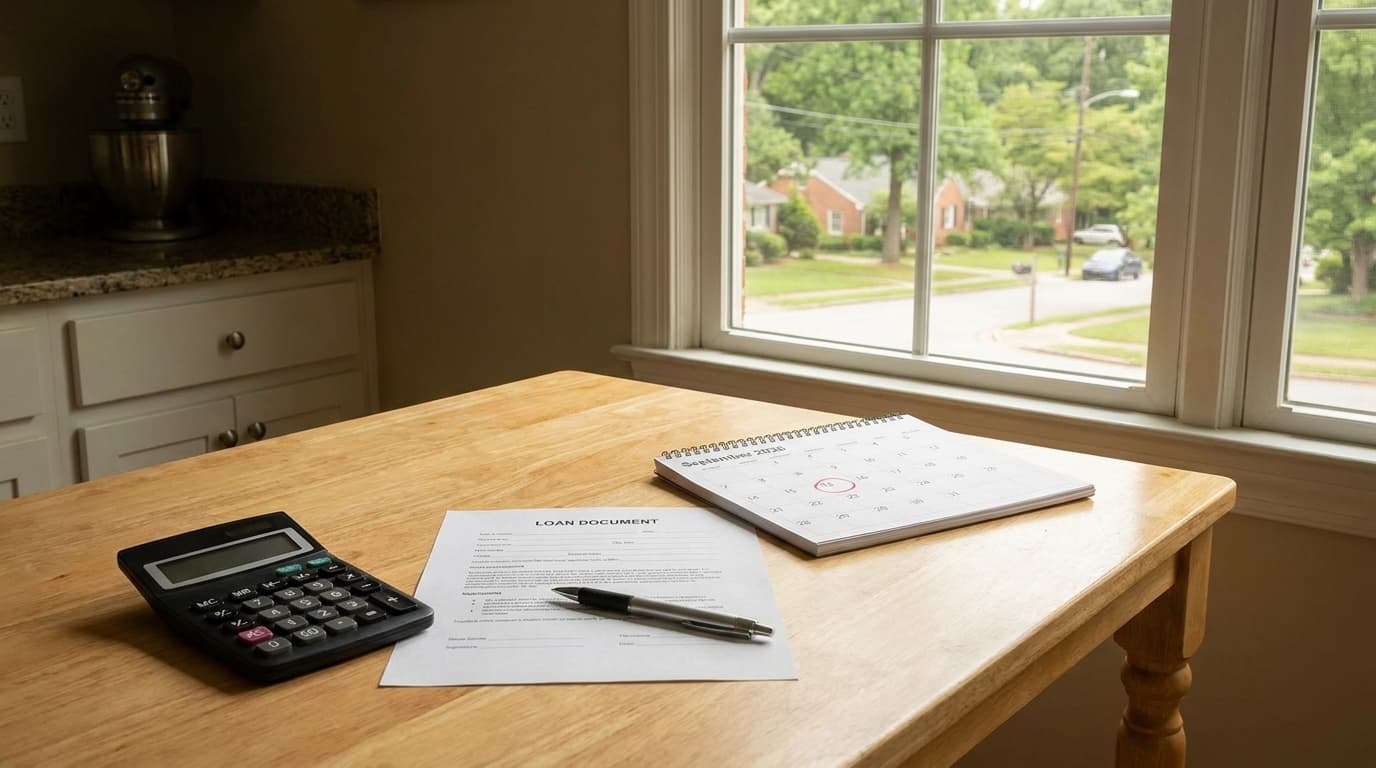
If you are under contract on a house in Georgia right now, you are being asked to make a call that the bond market has not made for itself. The Federal Open Market Committee meets September 15–16, and in the space of about two weeks the odds of a rate increase went from a fringe scenario to the base case. CME FedWatch showed roughly a 35% chance of a hike on August 27. After Fed Chair Kevin Warsh spoke at Jackson Hole on August 28, that reading jumped to about 60%, and by August 31 it sat at 66% for a move to a 3.75%–4.00% target range (The Motley Fool, CME FedWatch via KuCoin).
Your lock desk has already repriced for that. Your seller has not. And the question in front of you — lock, buy a float-down, or float into the meeting — is not really a forecasting question. It's a pricing question, and the numbers below are the ones that matter.
What Warsh actually said
It's worth reading the Chair's own words rather than the coverage of them. From the [Federal Reserve's published transcript](https://www.federalreserve.gov/newsevents/speech/warsh20260828a.htm) of the August 28 keynote:
"Inflation is running above our 2 percent target. So the Fed's predominant focus right now should be on prices."
He put numbers behind it: PCE inflation running 3.7% on a 12-month basis and 4.1% annualized over six months — meaning the recent trend is worse than the year-long average, not better. And he removed the usual dovish counterweight: "Labor markets are quite stable. The jobless rate, at 4.1 percent, remains low by historical standards," describing conditions "consistent with full employment." When unemployment isn't the problem, the committee has fewer reasons to tolerate 4% inflation.
Then the line that did the damage:
"We must be confident that underlying inflation is moving to our objective, clearly and at sufficient speed. Otherwise, we have work to do."
Crucially, Warsh refused to tell anyone what happens next. "I stand here today committed to a discipline, not to a decision," he said, adding that forward guidance as a regular practice has "overstayed its welcome." That is the honest explanation for everything that follows. The market cannot converge on September because the Chair deliberately declined to give it a signal.
This is not coming out of nowhere. At the July 28–29 meeting the FOMC held the range at 3.50%–3.75% on a 9–3 vote, with all three dissents in favor of a 25-basis-point increase (U.S. Bank). The hawkish bloc already exists on the committee. Warsh just gave it cover.
Why the market still can't agree
Here is where a lot of the commentary has gotten sloppy, so let's be precise about who thinks what.
-
Fed funds futures (CME FedWatch): roughly 66% odds of a 25bp hike as of August 31.
-
Prediction markets, volume-weighted across Kalshi, Polymarket, Gemini and ForecastEx: about 56.8% hike, 42.0% hold, with another ~4.5% pricing a hike of 50bp or more, on roughly $75.7 million of volume. Kalshi is at 58.5% hike / 40.5% hold; Polymarket at 56.5% / 42.5% (DeFiRate live tracker).
So the gap between the futures market and the prediction-market aggregate is about nine percentage points. That is real and it is tradeable, but be clear-eyed about what it is: ordinary venue divergence. Different participants, different liquidity, different fee structures, different contract mechanics. It is not a historically unusual split, and anyone selling you a lock decision on the theory that futures and prediction markets are at war is overselling. In fact the divergence ran the other direction six weeks ago — on July 29, Polymarket priced a September hike at 53% while futures sat at 32% (KuCoin, July 29, 2026). Venues disagree. That's normal.
The genuinely striking number is the one from eleven days before the speech. On August 17, prediction markets were clustered around a 75% chance the Fed would hold — Polymarket 74% no-change, Kalshi 73.5% hold, Myriad about 75% (Decrypt, BiggoFinance). Two weeks later the same complex leans hike. That is a violent repricing, and if you locked in mid-August you locked into a very different world than the one you're standing in now.
Bottom line for a borrower: somewhere between one-third and four-tenths of the money still expects no move. That's not a consensus you can build a floating strategy on.
The part that will save you the most money: short rates are not mortgage rates
This is the single most expensive misunderstanding in home financing, and it costs Georgia buyers real dollars every cycle.
The federal funds rate is an overnight rate between banks. Your 30-year mortgage is priced off the 10-year Treasury yield plus a mortgage-backed-securities spread. The Fed influences the long end, but it does not set it. The long end trades on inflation expectations and growth data.
If you want proof rather than theory, look at September 2024. The Fed cut by a full 50 basis points on September 18, 2024 — the largest single cut in years. The 30-year mortgage rate was 6.09% on September 19, the day after the cut. By November 21 it was 6.84% (CNN). The Fed cut aggressively and mortgage rates rose three-quarters of a point over two months, because the 10-year climbed on stronger economic data. Borrowers who floated into that cut expecting relief got the opposite.
Run the same logic forward. The 10-year Treasury closed at 4.73% on August 28 and 4.709% on August 30. Against a 30-year mortgage in the high 6s, that puts the spread at roughly 1.9 to 2.2 percentage points versus a long-run average nearer 1.7. There is already cushion in that spread. It can absorb a Fed move or amplify one, entirely independent of what the funds rate does.
Why a hawkish surprise can hit the long end less than you'd expect
Counterintuitively, a hike read by the market as credible inflation-fighting can anchor or even lower long-term inflation expectations — and long-term inflation expectations are precisely what the 10-year prices. Under that scenario the Fed raises short rates and the 30-year mortgage moves sideways or slightly down.
The reverse is equally available: a hike paired with projections showing more tightening ahead can push the 10-year up and take mortgage rates with it. We do not know which one happens, and neither does anyone quoting you a rate. Treat any lender who tells you confidently which way the 30-year moves on September 16 as someone guessing with your money.
The risk almost nobody is covering: September 16 is a dot-plot meeting
The Fed's official 2026 calendar marks September 15–16 with an asterisk: it carries a Summary of Economic Projections. The rate decision lands at 2:00 p.m. ET, the press conference at 2:30 p.m. ET.
That matters more than the 25 basis points. The SEP includes the dot plot — each participant's projection for the path of rates through 2027 and beyond. A single 25bp move is largely priced. The 2027 path is not. If the dots show this hike is the first of several, the 10-year can move materially more than the decision itself justifies. If the dots show a one-and-done, the long end may barely flinch.
So if you are floating into September 16, understand what you are actually exposed to: not the rate line, but the projections and whatever Warsh says at 2:30 p.m. from a Chair who has publicly disavowed forward guidance.
Where Georgia rates actually stand right now
You have probably seen two different numbers this week and assumed one of them was wrong. Both are correct; they measure different things.
-
Freddie Mac's Primary Mortgage Market Survey put the 30-year at 6.66% and the 15-year at 5.98% for the week of August 27 (prior week: 6.65% / 5.95%; a year ago: 6.56%). See the PMMS. But this survey is collected Thursday to Thursday and publishes Thursday at noon ET — meaning it largely predates the Warsh selloff.
-
Mortgage News Daily's daily average was 6.87% on August 31, up 6 basis points on the day and the highest reading since June 2025 (MND). MND attributed that specific day's move partly to mechanical month-end bond trading, and had separately flagged "Warsh Speech at Jackson Hole Prompts Heavy Selling" on August 28.
The weekly survey is a lagging benchmark. The daily average is closer to what a Georgia lock desk will actually quote you this morning. When a headline says rates are at 6.66% and your loan officer says 6.9%, neither one is lying to you.
The Georgia market you're deciding inside
Statewide numbers for July 2026, from the Georgia Association of REALTORS:
-
Median sales price: $370,000, up 2% year over year
-
New listings: 17,789 — down 13%
-
Pending sales: 8,626 — down 23%
-
Closed sales: 9,482 — down 21%
-
Inventory: 55,469 units — up 4%, or 5.2 months of supply
Atlanta metro is running a median around $429,000–$435,000 with roughly 54 to 55 median days on market.
Read that combination carefully, because it changes your negotiating position: transactions are down roughly a fifth while inventory is up and supply has stretched to 5.2 months. Prices are holding, but sellers are waiting longer and losing more deals. That is the environment in which sellers agree to pay for things. Hold that thought — it becomes the cheapest of the three options below.
Option 1: Lock now
A 30-day lock is typically priced into your rate with no separate fee. It buys you certainty through roughly the end of September, which covers the meeting.
What it does not buy you is immunity. The CFPB is explicit that a lock holds your rate only if you close inside the window and nothing material changes on the application. Any of these can void it:
-
A change in the loan amount
-
A change in the down payment
-
A change in your credit score
-
Income documentation problems that surface in underwriting
If closing slips, extensions typically run in 15-day increments at roughly 0.125%–0.25% of the loan amount each, usually capped at three (AmeriSave). Longer initial locks are priced up front: about 0.125% for 60 days, 0.375%–0.50% for 90, and 0.75%–1% for 120.
Georgia dollar math. On the statewide median of $370,000 with 20% down — a $296,000 loan — a single 15-day extension runs roughly $370 to $740. On an Atlanta metro purchase around $435,000 (a $348,000 loan), it's roughly $435 to $870. The CFPB's word for extensions is that they "can be costly," and on a deal that slips twice, they are.
Option 2: Lock with a float-down
A float-down lets you capture a lower rate if the market improves after you lock. It typically costs 0.25%–0.50% of the loan amount, paid up front or at closing — roughly $740 to $1,480 on a $296,000 Georgia loan, or $870 to $1,740 on a $348,000 Atlanta loan.
Two conditions decide whether that money does anything:
-
A trigger threshold. Rates generally have to fall by a set amount — commonly 0.25% to 0.375% — before you're allowed to exercise at all. A 10-basis-point improvement earns you nothing.
-
An exercise deadline. This is the catch that matters most right now. Float-downs typically must be exercised 7 to 10 days before closing.
Do the calendar arithmetic on that second one. If you're closing in late September on a 30-day timeline, a September 16 decision can land inside the blackout window — meaning the option you paid $1,000 for is unusable on the exact day it was supposed to protect you. That is not a hypothetical edge case; it is the most likely way this specific product fails this specific month.
Before you pay for a float-down, ask your lender in writing for the exact exercise deadline on your file and compare it to September 16. If the deadline falls before the meeting, the option is worthless for this purpose and you should not buy it.
Option 3: Float into the 16th
If you float, name your actual exposure honestly: you are not betting on the rate decision, you are betting on the dot plot and the press conference.
Here's the arithmetic ceiling on the gamble. On a $296,000 Georgia loan:
-
At 6.87% — principal and interest of roughly $1,943/month
-
At 7.12% — roughly $1,993/month
That's about $50 a month, or somewhere near $18,000 across the full 30-year term if you never refinance. Set that against a float-down fee: a $1,000 option costs you about 20 months of that difference.
But read the ceiling correctly. That 25-basis-point gap is what happens if the Fed's 25bp move passed straight through to your note rate — and as the 2024 precedent shows, it does not work that way. A 25bp Fed hike could show up as 10bp on your rate, as zero, or as a decline if the long end reads the move as inflation-credible. The $50 is the outer bound of the bet, not its expected value.
The fourth option nobody lists: make the seller pay for it
With pending sales down 23%, closed sales down 21%, and inventory up to 5.2 months of supply, Georgia sellers are in a materially weaker position than they were a year ago. Median prices are still up 2% — this isn't a crash — but the transaction slowdown is where your leverage lives.
Two asks are worth more than a float-down and cost you nothing:
-
Seller-paid closing costs, which can absorb the lock extension fees if your close slips past September.
-
A seller-funded temporary buydown, which reduces your rate in the early years and is frequently cheaper for the seller than a price cut — a point they'll often recognize once a listing has sat past the metro's ~54-day median.
Before spending $1,000 of your own money on an option that may be locked out on exercise-deadline mechanics, ask whether the seller will spend it instead. In this market, on a house that's been listed a while, that conversation is very much worth having.
Questions for your Georgia lock desk — ask all five, in writing
-
What does a 15-day extension cost, in dollars, on my exact loan amount? Not a percentage range — a number.
-
What is the float-down trigger, the fee, and the exercise deadline? Specifically: is that deadline before or after September 16?
-
Does my lock survive an appraisal or underwriting delay, or does the clock run regardless of whose fault the delay is?
-
What happens if my lock expires on September 17? Do I re-lock at the worse of the two rates, at current market, or is there a worst-case-pricing rule?
-
How many extensions will you grant before you make me re-lock at market?
The CFPB flags a real disclosure gap here: your Loan Estimate tells you whether your rate is locked, but it does not disclose extension pricing or float-down cost. Those terms exist only in what your lender tells you — so get them in email, not on a phone call.
The honest close
Nobody knows what happens on September 16. The futures market puts a hike near 66%; prediction markets put it near 57% with 42% still expecting a hold. Two weeks ago, three-quarters of that same money expected nothing to happen. The Chair has explicitly declined to tell anyone which way he's leaning, and the projections released that afternoon may move your rate more than the decision does.
The right posture for a Georgia borrower isn't to predict the meeting. It's to price the trade: know what an extension costs in dollars, know whether your float-down can actually be exercised in time, know that a Fed move doesn't pass through one-for-one to a 30-year note, and check whether the seller will fund the protection before you do. If the certainty of a lock is worth more to you than roughly $50 a month of upside, lock. If it isn't, float with your eyes open about what you're exposed to.
What you should not do is float on the theory that a Fed hike means higher mortgage rates or a Fed hold means lower ones. September 2024 settled that question, and it cost a lot of borrowers three-quarters of a point to learn it.
Related reading
Sources
-
Primary Mortgage Market Survey — Freddie Mac (week of Aug 27, 2026)
-
Federal Reserve holds rates at 3.50%–3.75% in July 2026 — U.S. Bank
-
The odds of a September rate hike have nearly doubled — The Motley Fool (Sept 1, 2026)
-
CME FedWatch: 66% probability of a 25bp hike in September — KuCoin (Aug 31, 2026)
-
September Fed rate predictions and odds — DeFiRate prediction-market tracker
-
Prediction markets give the Fed 74% odds of standing pat in September — Decrypt (Aug 17, 2026)
-
Polymarket, Kalshi and Myriad converge on 74%–75% odds of a September hold — BiggoFinance
-
Polymarket prices 53% odds of a September hike vs. 32% in futures — KuCoin (July 29, 2026)
-
New listings, sales decrease while prices remain stable in July — Georgia Association of REALTORS
-
Mortgage rate locks: timing, costs, and protection strategies — AmeriSave
-
What is a lock-in rate and should I get one? — Consumer Financial Protection Bureau
-
Here's why mortgage rates rose after the Fed's rate cut — CNN (Oct 24, 2024)
Rate and odds figures are current as of September 1, 2026. Prediction-market and futures probabilities move daily; lock pricing, extension fees, and float-down terms vary by lender and are not standardized. This article is general information, not financial advice — confirm all terms with your own lender in writing before deciding.