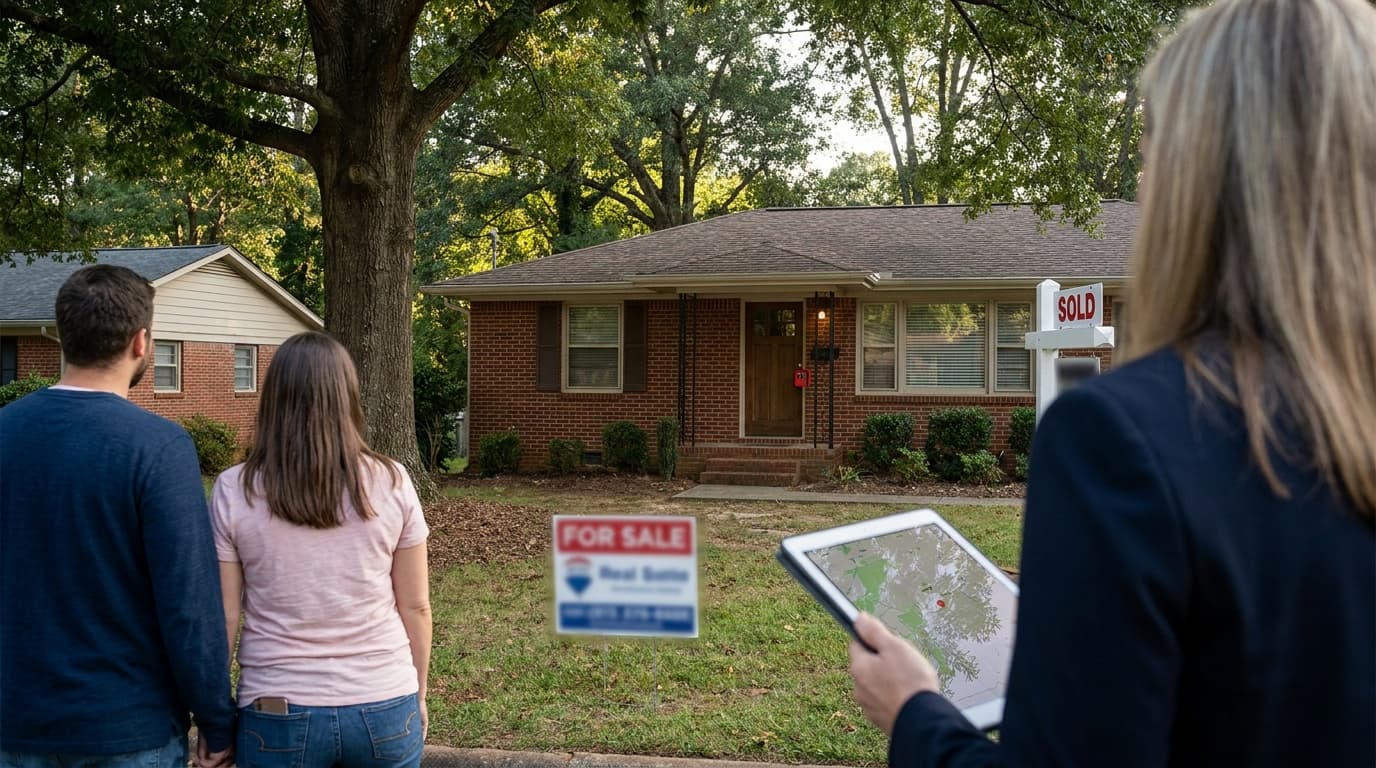
Picture a 1,700-square-foot ranch in Paulding or Henry County listed at $325,000. Built in the early 2000s, decent roof, needs paint. It is the exact house that gets invoked every time someone says Wall Street bought up Georgia's starter homes — and it is the house a real buyer is trying to win this fall.
On July 11, 2026, the 21st Century ROAD to Housing Act (H.R. 6644) became law without a presidential signature, the first comprehensive federal housing package in decades. Its Title X, titled "Homes Are for People, Not Corporations," bars large institutional investors from buying additional single-family homes beginning January 7, 2027. So the question worth answering, in plain terms, is narrow: does that date change your odds on that ranch?
The short version is that it changes them less than the headlines imply, later than you'd expect, and in a direction most coverage has gotten backward.
What the law actually says
Title X defines a "large institutional investor" as a for-profit entity engaged in investing in, owning, renting, managing, or holding single-family homes that, in the statute's words, "alone or in concert with one or more other entities, directly or indirectly has investment control of not less than 350 single-family homes in the aggregate."
The mechanics, per legal analysis published by The National Law Review and a client alert from Goodwin:
-
Effective date: January 7, 2027, 180 days after enactment.
-
Sunset: the prohibition is repealed January 7, 2042 — a 15-year window, not a permanent regime.
-
Penalties: a civil penalty of the greater of $1 million per violation or three times the purchase price of the property involved.
-
Rulemaking: the Treasury Department writes the implementing rules, in consultation with HUD, FHFA, and the SEC.
-
Tenant support: the Act also directs HUD to create a renter outreach resource for tenants in disputes with institutional landlords.
The bill cleared both chambers with lopsided bipartisan majorities. Specific vote tallies circulating in secondary coverage vary, so we're not printing them here; check congress.gov if you need the roll call.
The correction that matters most: this is a purchase restriction, not a divestiture order
This is where most of the public conversation goes wrong, and it's worth being blunt about it.
Title X prohibits new purchases. It does not require any covered investor to sell a single-family home it purchased before the enactment date. Portfolios held on July 11, 2026 face no forced sale, no wind-down clock, and no mandated listing. There is no mechanism in the statute that puts an existing investor-owned house in Stockbridge or Dallas, Georgia onto the MLS.
So if you have been waiting for a flood of institutional inventory to hit the market in January — houses dumped by Invitation Homes or Progress Residential, competition evaporating, prices easing — that flood is not in the law. Any "what if they're forced to divest" scenario is a hypothetical Congress declined to create. In fact, the final enacted text dropped the Senate version's mandatory seven-year divestiture requirement for build-to-rent programs, a meaningful late concession. Build-to-rent holdings now face no holding-period limit at all.
Why metro Atlanta is the test case — and why the counts disagree
By every available measure, metro Atlanta is the most concentrated institutional single-family rental market in the country. The measures themselves, though, are not interchangeable, and it's more useful to show the disagreement than to pick the biggest number.
-
~72,000 homes. The American Economic Liberties Project's report "The New Rent Seekers," by research manager Laurel Kilgour (May 1, 2026), puts institutional ownership at roughly 72,000 single-family rentals in metro Atlanta — about double the next-largest market, Phoenix — as reported by the Atlanta Journal-Constitution. The report also claims roughly $5 billion in lost home equity for Georgia families and cites 415,000 institutional single-family rentals nationwide as of 2022. This is the broadest definition of "institutional."
-
51,252 homes, seven landlords. An Atlanta Regional Commission analysis of Parcl Labs data (published November 2024) counted 51,252 corporate-owned single-family rentals across the 21-county region held by seven firms: Invitation Homes, AMH, Tricon Residential, Home Partners of America, Progress Residential, FirstKey Homes, and Amherst. Gwinnett led by raw count at 9,680, followed by Cobb (5,284), Fulton (4,150), DeKalb (3,859), and Clayton (3,444). Henry had the highest concentration relative to its housing stock — about 7.4% of all single-family homes owned by those seven companies, per the AJC's writeup.
-
~19,000 homes. John Burns Research (July 2025), cited by the Georgia Public Policy Foundation, counts owners of 100+ properties and lands at 27.9% of metro Atlanta single-family rentals — roughly 19,000 homes, or about 0.6% of the metro's approximately 3 million homes.
Those three figures are not contradictory so much as differently drawn: different owner thresholds, different geographies, different vintages. They point the same direction. Georgia State University geographer Dr. Taylor Shelton, speaking to Georgia Public Broadcasting, found large companies own more than 30% of single-family rentals in metro Atlanta — roughly ten times the national rate — after acquiring more than 70,000 properties over 15 years. At the county level his figures are stark: 78% of single-family rentals in Paulding, 64% of single-family rental units in Henry, with some state house districts running as high as 99.6%.
If the 350-home cap is going to change anything anywhere, it should show up here first.
Calibration: nationally, this is a thin slice
Keep one national number in view so the local ones stay honest. BofA Global Research (2025), cited by CBS News, found that investors owning 1,000 or more homes held about 500,000 properties nationally — roughly 0.34% of total U.S. housing stock and about 3% of single-family rentals.
Atlanta is the outlier, not the norm. That is precisely what makes it the test case. It also means national forecasts about this law will not describe Georgia, in either direction.
The carve-outs are the actual story
Read the exemption list and the law's likely effect comes into focus. Covered investors may still acquire:
-
Newly constructed homes to be managed as rentals under a build-to-rent program
-
Newly constructed or renovated homes offered for sale
-
Homes under renovate-to-rent programs
-
Homes in homeownership programs with rent-to-own features
-
Homes in age-restricted (55+) communities
-
Homes purchased from other covered institutional investors
-
Homes purchased from non-covered investors within a two-year window
Add the removal of the Senate's seven-year build-to-rent divestiture requirement, and the shape is clear: institutional capital is not being pushed out of Georgia housing. It is being channeled toward purpose-built rentals.
Follow the capital: build-to-rent
That reallocation is already visible on the ground. Bisnow Atlanta reports more than 6,800 build-to-rent homes under development in metro Atlanta, with the development pace doubling year over year and 100,000-plus in the national pipeline. Brad Hunter of Hunter Housing Economics put it plainly: "BTR is suddenly the chief way institutional capital can still participate in the single-family rental space." Quinn Residences CEO Richard Ross was blunter — "This will now be the future of single-family rental housing" — citing a 1,500-home pipeline over 12 months, including 500 in Georgia.
The AJC's figures are consistent: roughly 8,100 build-to-rent units in Atlanta, a 1,300% inventory increase since 2019, 11% of residential construction last year, and the fourth-largest BTR market in the country.
For a buyer shopping the exurbs, that means new rooftops going up nearby — but rental rooftops. It adds housing supply, which is not nothing. It does not add for-sale supply in your price band.
What the cap does and does not do to your $325,000 offer
What it does: starting January 7, 2027, it removes one class of bidder — investors with control of 350+ homes — from future scattered-site purchases of existing single-family homes, subject to the exemptions above.
What it does not do:
-
It does not remove a single existing investor-owned home from the rental pool.
-
It does not lower your mortgage rate.
-
It does not touch the buyer most likely to outbid you.
That last point deserves its own section.
Why cash competition persists
Cotality's Home Investor Report found investors bought 30% of U.S. single-family homes over calendar 2025, up from 29% in 2024. The composition is what matters: small investors (fewer than 10 properties) and medium investors (10–99) together account for nearly a quarter of all U.S. home purchases, while large (100–999) and mega (1,000+) investors together are only about 5%. Atlanta ranks third nationally for investor activity.
Nearly every one of those small and medium buyers sits well below the 350-home threshold and is entirely unaffected by the cap. The local LLC with 14 rentals in Rockdale County will still be at the showing, still able to close in 12 days, still willing to waive the appraisal contingency.
Redfin chief economist Daryl Fairweather, quoted by CBS News, is skeptical the cap frees up starter inventory at all, and warns institutions could subdivide holdings across smaller entities to stay under 350. That is exactly what the statute's "alone or in concert with one or more other entities" language is written to catch — and exactly what Treasury will have to define with enough precision to be enforceable.
What is still unsettled
Goodwin flags a genuine compliance gap: Treasury's implementing regulations may not be finalized before the January 7, 2027 effective date, meaning the prohibition could become operative before the rules explaining it exist. The open questions worth watching:
-
How "investment control" is defined, and how affiliated entities get aggregated
-
What "in concert with" requires as proof
-
How compliance gets verified at closing — and whether title companies or lenders end up as de facto screeners
-
Who audits, who reports violations, and how the $1 million-or-3x penalty is actually assessed
None of these are academic. They determine whether the cap binds or leaks.
The market backdrop that may matter more than the law
While everyone argues about Title X, the Georgia market is softening on its own. The Georgia MLS 12-county report for July 2026 — Cherokee, Clayton, Cobb, DeKalb, Douglas, Fayette, Forsyth, Fulton, Gwinnett, Henry, Paulding, and Rockdale — shows:
-
Units under contract: 3,902, down 32% year over year and 3.7% month over month
-
Active listings: 22,972 (+1.3% YoY)
-
Closed sales: 5,158 (-1.1% YoY)
-
Median sales price: $420,000 (+1.2% YoY)
-
New listings: 9,081 (-3.2% YoY)
GAMLS chief marketing officer John Ryan: "The market has shifted from one defined by scarcity and urgency to one where choice and value are taking center stage."
Importantly, this predates the law. April 2026 Georgia MLS data showed pending sales down 21.8% year over year and closed sales down 5%, with Ryan describing a "structural change in buyer behavior" where "seasonality alone is no longer driving activity." Pending sales have now declined for several consecutive months. Don't let anyone attribute that softening to the ROAD Act.
One housekeeping note on medians: two circulate for "Atlanta" and they are different markets. The Atlanta REALTORS® June 2026 brief (FMLS, 11 counties) reported a $442,500 median (+0.6% YoY), $569,000 average (+2.6%), 20,453 active listings, 4.6 months of supply, 21 days average on market, and 9,036 new listings (+1.5%). GAMLS's 12-county July median was $420,000. Always ask which MLS and which counties before quoting a number.
Either way, a $325,000 resale sits well below both metro medians. It is the entry-level and exurban band — the place where FHA buyers, Georgia Dream borrowers, and investor demand actually overlap. It is the contested band, not the typical Atlanta house.
How to compete at $325,000 in Henry, Paulding, Douglas, or Rockdale
Practical notes for the next two selling seasons:
Program eligibility is probably not your problem. Georgia DCA's current Georgia Dream limits (effective July 8, 2026) allow a maximum sales price up to $625,000 for Georgia Dream and Peach Select VA, and up to $725,000 for Peach Plus and Peach Advantage. Income limits are $137,555 (1–2 persons) and $158,188 (3+) for Georgia Dream and Peach Select VA; $206,333 / $237,282 for Peach Plus; and up to 150% of AMI for Peach Advantage. At $325,000, neither the price cap nor the income cap is the binding constraint for most buyers. Use the DCA page rather than third-party blogs — several still publish outdated, lower limits.
Your problems are appraisal gaps, repair requests, and speed. That's where a financed offer loses to a cash offer, and no ownership cap changes it. Get fully underwritten before you shop, keep your inspection window tight but real, and decide your appraisal-gap tolerance in dollars before you write.
Watch the small-dollar pilot. Beyond Title X, the Act creates an FHA small-dollar mortgage pilot for loans under $100,000 — a category lenders have largely abandoned, and one that matters for Georgia's lowest-priced stock outside the metro. It also includes a $200 million-per-year Innovation Fund for local supply reforms, streamlined environmental review and infill exemptions, guidance allowing single-stair point-access buildings up to six stories, manufactured housing reforms (eliminating the permanent chassis requirement and raising FHA manufactured-home loan limits), appraisal licensing improvements, and reauthorization of HOME and Rural Housing Service programs. The Bipartisan Policy Center's section-by-section is the cleanest neutral rundown. Over five years, those supply provisions may move Georgia affordability more than the cap does.
One caution: we are not printing a 2026 FHA loan limit for the Atlanta metro here. Secondary sources give conflicting figures for Fulton and Cobb, and we could not resolve the discrepancy. Check HUD's official lookup or ask your lender to pull it.
The fair counter-case
Not everyone thinks the cap addresses the actual problem. The Georgia Public Policy Foundation (November 6, 2025) argues that owner-occupancy rates in metro Atlanta counties have risen since 2017; that during the 2014–2017 peak of investor buying, prices stayed below pre-recession levels; and that NYU's Joshua Coven (May 2025) found most of the observed link between institutional investors and rising housing costs comes from investors selecting areas already likely to appreciate. Their recommendation is supply-side zoning and permitting reform rather than ownership caps.
The implicit risk in their argument is worth stating: restricting investor purchases could trim rental supply without improving for-sale affordability, leaving renters worse off and buyers no better off. Reasonable people read the same Atlanta data and reach different conclusions. You should know that before you form an expectation about January.
The honest timeline
Nothing changes at a Georgia closing table before January 7, 2027. When the prohibition does take effect, it may arrive before Treasury's compliance rules do. And the visible change in Georgia will most likely be new rental subdivisions in the collar counties rather than new resale listings in them.
If you want a single indicator to track over the next 18 months, it isn't investor sell-offs — the statute doesn't require any. It's the build-to-rent permit count in Henry, Paulding, Douglas, and Rockdale. That's where the capital is going, and that's what this law actually redirected.
For the buyer on that $325,000 ranch: the more consequential fact is that pending sales are down 32% year over year and there are nearly 23,000 active listings. As Ryan framed it, buyers are choosing rather than chasing. That's a bigger lever on your odds than anything in Title X.
Related reading
Sources
-
21st Century ROAD to Housing Act Becomes Law: Implications for Large Institutional Investors — The National Law Review
-
Insights on the Impact to Institutional Investment in the Single-Family Residential Rental Market — Goodwin
-
Inside the Deal: What's in the Final 21st Century ROAD to Housing Act — Bipartisan Policy Center
-
Institutional investors own about 72,000 metro Atlanta homes, report says — The Atlanta Journal-Constitution
-
Metro Atlanta has highest rate of corporate home ownership, says Georgia State researcher — Georgia Public Broadcasting
-
Gwinnett tops Atlanta region for most corporate-owned rental homes, analysis shows — The Atlanta Journal-Constitution
-
New Housing Law To Send Institutional Investors Flocking To Build-To-Rent — Bisnow Atlanta
-
Could the ROAD to Housing Act actually lower home prices? — CBS News
-
Home Investor Report Q4 2025 — Cotality
-
GAMLS: Atlanta's market continues move into buyer's territory — Atlanta Agent Magazine
-
Metro Atlanta home sales down as inventory climbs, data shows — Atlanta News First
-
Georgia Dream Mortgage Products — Georgia Department of Community Affairs
-
Institutional Investors and Housing Affordability in Metro Atlanta — Georgia Public Policy Foundation