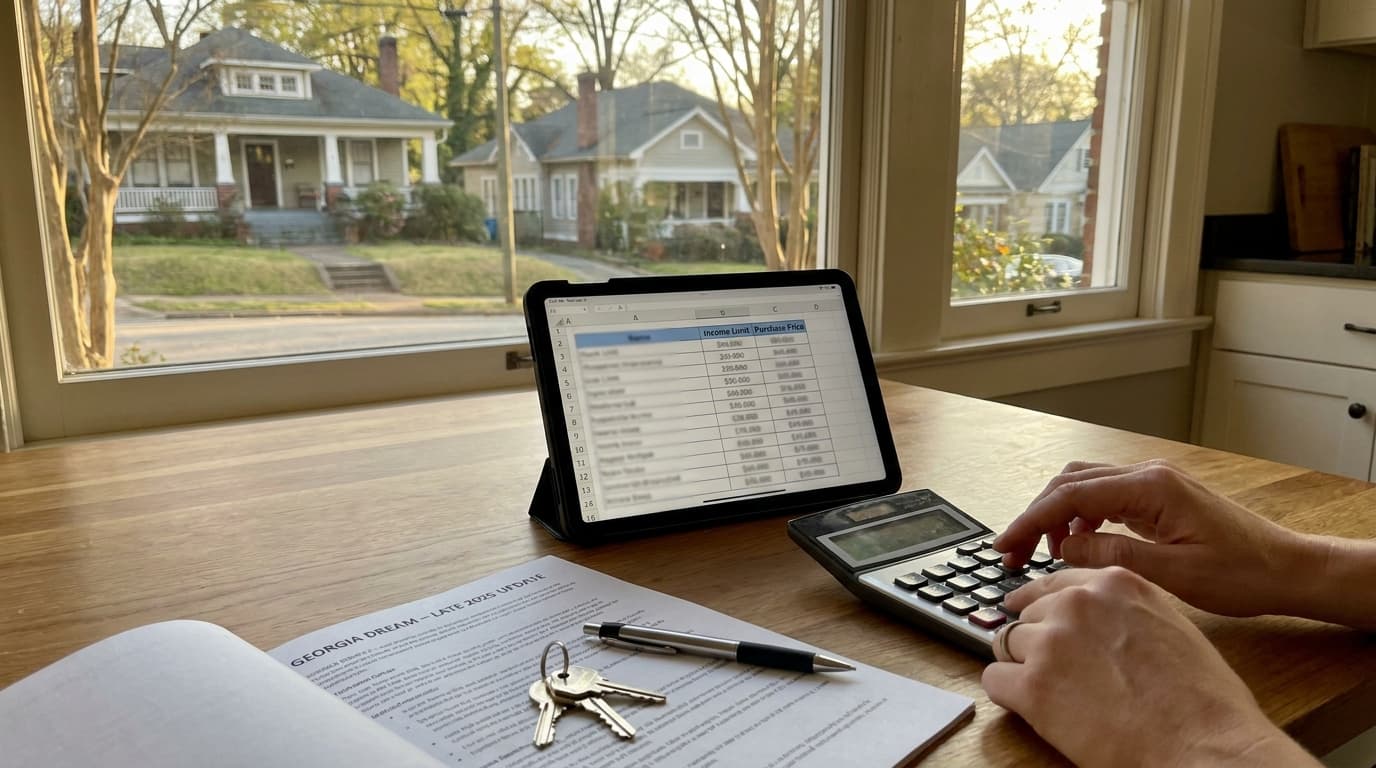
If you tried to qualify for Georgia's marquee down-payment assistance program a year or two ago and came up just over the line on income or purchase price, here's the practical takeaway: the math may have changed, so check the published limits again before you assume you're out. The Georgia Department of Community Affairs (DCA) refreshed its Georgia Dream loan matrices in late 2025 — the program's Standard matrix PDF was created on October 17, 2025 and carries a "2025-10-23" version stamp — and the eligibility figures DCA currently publishes are considerably more generous than many third-party "first-time buyer" blog summaries still report.
We want to be straight with you about one thing up front, because it matters. As of this writing, the eligibility table on DCA's own Georgia Dream page still carries an "effective February 8, 2024" date. The late-2025 matrix refresh is real and verifiable, but DCA's published copy does not independently confirm that any specific income or price cap was raised in 2026 versus the prior year. So treat the figures below as the currently published limits worth confirming — not as a year-over-year increase we can prove. Either way, the more useful exercise for a buyer is the same: pull the current numbers and see where you land.
What Georgia Dream actually is
Georgia Dream is run by DCA through the Georgia Housing and Finance Authority. It pairs a first mortgage with a second mortgage that covers down payment and closing costs. The eligible first-mortgage loan types are FHA, VA, USDA-RD, and Conventional.
The assistance piece is the part people misunderstand. It is not a grant. It's a 0%-interest, deferred second mortgage with no monthly payment. Because it's a lien, you repay it — but not on a monthly schedule. Repayment is triggered when you sell the home, refinance, or stop using it as your primary residence. In plain terms: the help sits quietly behind your first mortgage until one of those events happens, then it comes due.
The three assistance tiers
Georgia Dream offers three levels of assistance. A critical mechanic runs through all of them: you receive the lesser of the stated percentage or the dollar cap — not both, and not whichever is larger.
| Tier | Who it's for | Assistance | | --- | --- | --- | | STANDARD | General eligible buyers | 5% of the purchase price, up to $10,000 | | PEN | Protectors, Educators & Nurses — including public protectors, educators, healthcare workers, and active military | 6% of the purchase price, up to $12,500 | | CHOICE | Households that include a family member living with a disability | 6% of the purchase price, up to $12,500 |
A quick worked example so the "lesser of" rule is concrete: a $300,000 home under the STANDARD tier calculates 5% as $15,000 — but the cap is $10,000, so you'd get $10,000. Under PEN on the same home, 6% is $18,000, but the cap is $12,500, so you'd get $12,500. On lower-priced homes the percentage is often the binding number instead of the cap. Run both figures and take the smaller one.
Who qualifies
The eligibility rules are where deals quietly fall apart, so it's worth walking through them.
-
Credit score: a minimum middle credit score of 640. Per DCA's FAQ, this is a hard program floor — not merely a lender overlay you might shop around.
-
Liquid-asset cap: after closing, you can hold no more than $20,000 or 20% of the sales price, whichever is greater, in liquid assets. Watch this one: large gifts count toward that liquid-asset total, while retirement accounts do not.
-
First-time-buyer rule, with two carve-outs: you generally must be a first-time buyer — but you also qualify if you have not owned a home in the past three years, or if you're buying in a designated targeted area. Targeted-area buyers are exempt from first-time status, but they cannot own other real estate at closing.
Metro Atlanta vs. Athens vs. the rest of Georgia
Income and purchase-price ceilings vary by area, and the Atlanta figures are the headline reason this program reaches further than many buyers assume. These are the limits DCA currently publishes (verify against the live matrices before relying on them — see the box below):
| Area | Income limit (1–2 persons) | Income limit (3+ persons) | Max sales price | | --- | --- | --- | --- | | Atlanta Metro | $130,290 | $149,833 | $550,000 | | Athens MSA | $113,160 | $132,020 | $450,000 | | All other Georgia counties | $98,400 | $113,160 | $400,000 |
This is the gap that matters. A number of "first-time buyer" summaries circulating online still list Georgia Dream income ceilings in the ~$79,000–$92,000 range. DCA's published figures are substantially higher — a $130,290 income ceiling for a one-or-two-person Atlanta household and a $550,000 price ceiling. If you wrote the program off based on an old blog post, that's precisely the kind of buyer who should look again. Treat DCA as the authoritative source here.
The two requirements that trip buyers up
1. Mandatory homebuyer education. You must complete housing counseling — classes, workshops, or one-on-one sessions — through a HUD-approved Housing Counseling Agency. Budget roughly $50 to $100 and, more importantly, schedule it early. It's a hard requirement, and a missing certificate can stall an otherwise-ready file.
2. The assumption that funds are always available. They aren't necessarily. Georgia Dream assistance is committed in cycles against an allocation, and that pool can run low. This is the program's real timing risk — not the eligibility rules, but the calendar.
Timing risk: why "eligible" doesn't always mean "funded"
Because the assistance is allocated cyclically, applying when an allocation is nearly exhausted can stall a deal even if you check every eligibility box. There's no way to game this from a blog post — availability moves. The practical move is to confirm current funding status with a participating lender or DCA before you build your offer and timeline around the assistance. If you're depending on the second mortgage to cover your down payment, you want to know the pool is open before you go under contract.
How to apply
Georgia Dream runs through participating lenders, not directly through a state web portal for the loan itself. The path is: complete your HUD-approved homebuyer education, get pre-qualified with a Georgia Dream participating lender, and go through standard mortgage underwriting on one of the eligible loan types (FHA, VA, USDA-RD, or Conventional). The state's official overview at georgia.gov walks through the eligibility summary and the participating-lender route.
Verify before you rely on these numbers. Every dollar limit in this article reflects DCA's currently published Georgia Dream figures, whose table carries an "effective February 8, 2024" stamp; the loan matrices were most recently refreshed in late 2025. Caps, income limits, and debt-to-income rules can change between refreshes. Before you make a decision or write an offer, pull the current Standard, PEN, and CHOICE matrices directly from dca.georgia.gov and confirm the figures with a participating lender. When the official numbers and a third-party summary disagree, the official DCA matrix wins.
The bottom line
We can't tell you that 2026 specifically lifted a cap that personally disqualified you — DCA's own copy doesn't confirm a year-over-year increase, and we won't pretend otherwise. What we can tell you is that the program refreshed its matrices in late 2025, that the limits DCA publishes today reach further than a lot of recycled online guidance suggests, and that the cost of re-checking is one conversation with a participating lender. For an Atlanta first-timer who was a few thousand dollars on the wrong side of the line, that's a worthwhile hour.
Related reading
Sources
-
Georgia Dream — Georgia Department of Community Affairs (program page)
-
Georgia Dream Loan Program FAQs — Georgia Department of Community Affairs
-
Georgia Dream Standard Matrix (PDF) — Georgia Department of Community Affairs
-
Georgia Dream Mortgage Products — Georgia Department of Community Affairs
-
Apply for the Georgia Dream Homeownership Program — Georgia.gov