If you are trying to buy your first home in metro Atlanta, you are not just competing with other families. You are competing with corporations that own homes by the tens of thousands — and with a newer kind of housing that was built on the assumption it would never be sold to anyone at all.
A May 2026 report from the American Economic Liberties Project, The New Rent Seekers by Laurel Kilgour, estimates that institutional investors own roughly 72,000 single-family rental homes across metro Atlanta — the most of any U.S. metro, about double second-place Phoenix. Just three corporations control nearly 20,000 of those homes across the core counties. That concentration shapes the entry-level market in ways that headline rate-and-price stories tend to miss. Below is what the data actually says, where it bites hardest, and — just as important — where the trend has quietly reversed.
The numbers, and where they come from
Two independent sources point in the same direction. The American Economic Liberties Project report puts institutional ownership at about 72,000 single-family rentals metro-wide, with Invitation Homes and Progress Residential each reportedly holding 10,000-plus homes in the region. Separately, Georgia State University research led by geographer Taylor Shelton, using January 2024 ownership data, finds that institutions own roughly 30% of metro Atlanta's single-family rental stock — about 70,000 homes — close to ten times the national average.
For scale: a ResiClub Analytics review notes that institutional firms own roughly 0.73% of single-family stock nationally, but about 4.4% in Atlanta — roughly six times the national rate. Atlanta isn't a typical market with a few corporate landlords. By these measures it is the national epicenter of institutional single-family ownership.
Where it's concentrated: the suburban ring
The pressure is not spread evenly. It clusters in the metro's outer counties, where homes have historically been cheapest — exactly the price tier first-time buyers shop. According to the Georgia State data, large companies own about 64% of single-family rentals in Henry County and roughly 78% in Paulding County. More than 300 census tracts across the metro have corporate single-family-rental ownership reaching up to 50%.
The practical takeaway is that "metro Atlanta" is the wrong unit of measurement for a buyer. Investor saturation in a tract on the periphery can look nothing like a tract closer to the core. If you are house-hunting, the county — and ideally the ZIP code or tract — is the number that matters.
Build-to-rent: homes built never to be sold
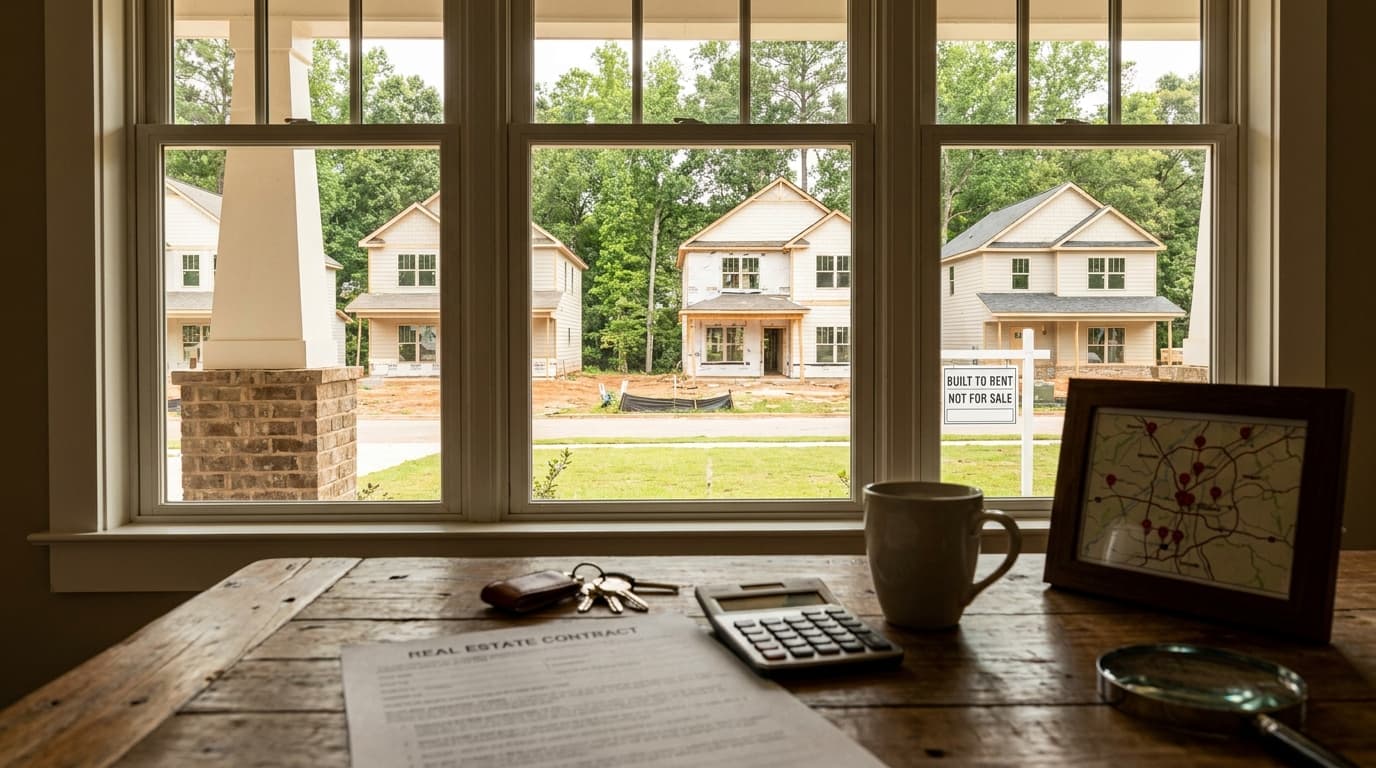
The most consequential shift for first-time buyers may not be investors buying existing homes — it is investors building homes that will never reach the for-sale market. Build-to-rent (BTR) means single-family houses constructed specifically to be rented, not listed for individual sale.
The growth has been dramatic. Per HousingWire, build-to-rent inventory in metro Atlanta is up roughly 1,381% since 2019. Atlanta ranks among the top metros for BTR homes under construction, with about 3,035 single-family rental completions in 2024 — up 15% year over year — and thousands more units in the pipeline.
Why does this matter distinctly? Because a build-to-rent home doesn't cycle back into the resale market the way an investor-owned existing home eventually might. It is removed from the for-sale channel by design. Even in a stretch when investors slow their purchases of existing homes, BTR keeps adding net-new housing that owner-occupant buyers will, in practice, never get a shot at.
The buyer's odds on an entry-level home
Concentration at the bottom of the price ladder does two things to a first-time buyer. It thins the supply of starter homes available to purchase, and it raises the odds that the competing bid on the one you want comes from a cash-backed institution rather than another family with a mortgage. A cash offer can close faster and carries no appraisal or financing contingency — advantages a typical first-timer can't match dollar-for-dollar.
The drivers behind Atlanta's status, as cited in the reporting, are structural: post-2008 federal policy that let investors scale up, historically low Georgia home prices, and comparatively weak tenant-protection laws. Those conditions made the metro unusually attractive to large operators.
The counter-trend worth knowing
Here is the part that rarely makes the headline: the institutional buying wave has cooled sharply. After mid-2022, as mortgage rates climbed and for-sale inventory stayed tight, institutional acquisitions collapsed. ResiClub's analysis finds that only about 3% of Atlanta's institution-owned homes were acquired in 2023, compared with roughly 52% bought during the 2020–2022 pandemic surge.
Some of the largest operators have also shifted from net buyers toward sellers. Invitation Homes' 2025 activity emphasized acquiring through homebuilder relationships while selling existing homes — often to owner-occupant families. That is a partial relief on the resale market: a slice of corporate-held existing homes is flowing back to individual buyers.
But notice the limit. The pullback is largely on existing homes. Build-to-rent keeps net-new rental supply out of for-sale channels regardless of how the resale math shifts. The cooling is real and meaningful, but it does not undo the build-to-rent dynamic.
Practical takeaways for Georgia first-time buyers
-
Shop by county and tract, not by metro headline. Investor saturation tops 50–78% in some peripheral counties like Henry and Paulding, but is far lower elsewhere. Targeting lower-saturation areas and price tiers improves your odds.
-
Strengthen your offer against cash. A full mortgage pre-approval (not just a pre-qualification), flexibility on closing timing, and a clear appraisal strategy can help a financed offer compete with an investor's speed.
-
Watch operator dispositions. As major landlords sell existing homes — sometimes specifically to owner-occupants — those listings are an opening. Some operators frame these sales as going to families rather than other investors.
-
Use the programs built for you. Down-payment assistance and first-look programs (which give owner-occupants a window before investors) exist to level exactly this kind of playing field. They are worth researching before you start touring.
Bottom line
The concentration is real, and in parts of metro Atlanta it is severe — this is, by the available data, the most institution-heavy single-family market in the country. But the story is not static. The buying wave cooled hard after 2022, and some big players are now selling existing homes back to families. The lasting structural change is build-to-rent, which permanently routes new houses away from the for-sale market. For a first-time buyer, the move is to act on county-level data rather than the scary metro-wide number — and to lean on pre-approval, offer strategy, and assistance programs where institutional competition is thinnest.
Related reading
-
[Georgia's New 'Floating' Homestead Cap (HB 581) Hits Its First Full Tax Year — Why Some Counties Opted Out and What It Means for Your Escrow](/article/georgia-hb-581-floating-homestead-cap-2026-opt-out-escrow)
Sources
-
Institutional investors own about 72,000 metro Atlanta homes, report says — Atlanta Journal-Constitution
-
Investors now own 30% of metro Atlanta's single-family rental homes, data shows — Atlanta Journal-Constitution
-
This regional housing market is the epicenter of institutional home buying — ResiClub Analytics
-
Build-to-rent explodes in Atlanta — and agents are taking notice — HousingWire