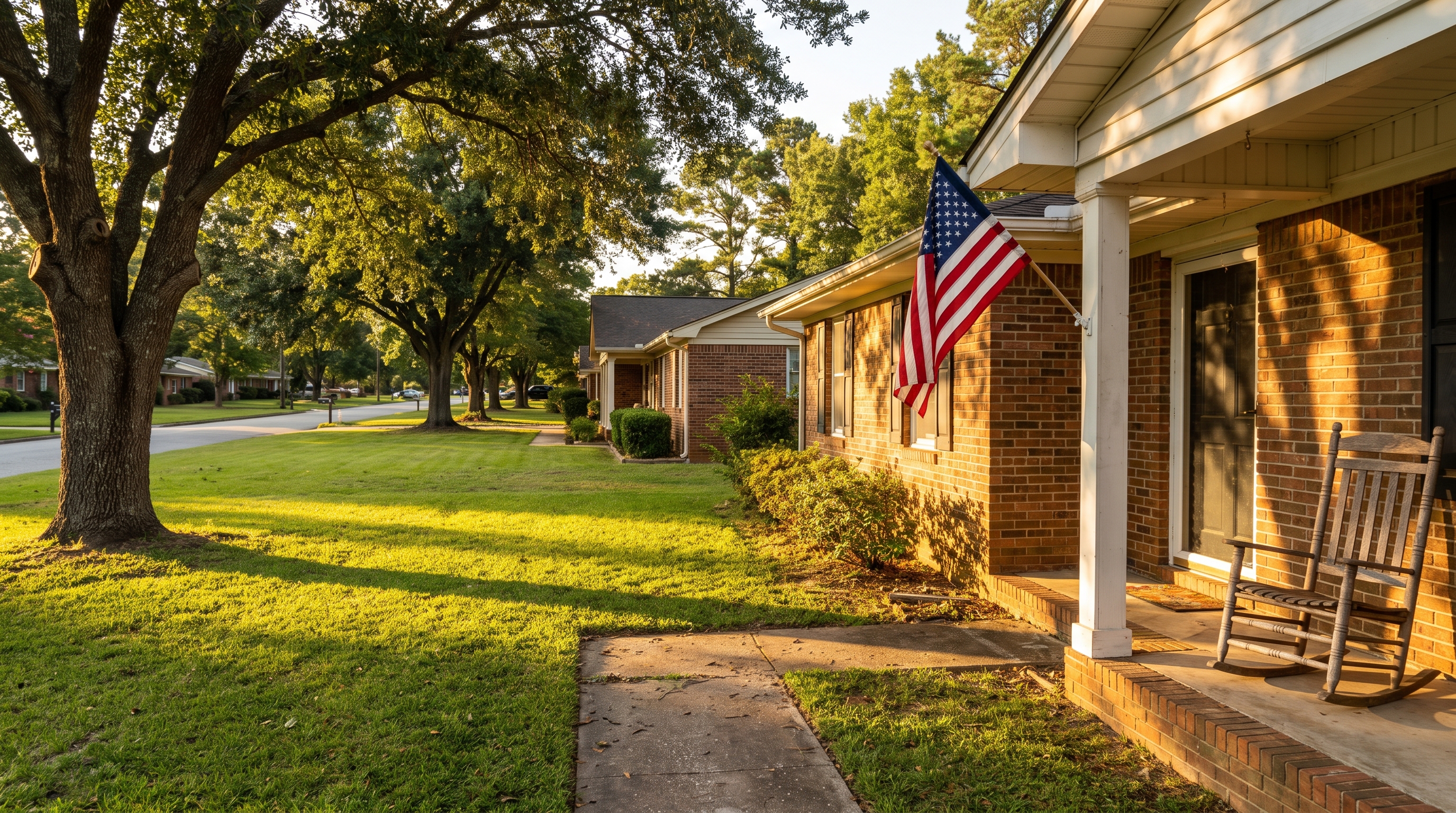
USDA Loans in Georgia: Zero Down Payment Financing for Rural and Suburban Homes
If you've been told you need 20% down to buy a house, or even 3.5% for an FHA loan, there's a mortgage option you might not know about that requires absolutely zero down payment: USDA loans. And despite the name, you don't need to buy a farm. Many Georgia suburbs, small towns, and even some areas near Atlanta qualify for this program.
The U.S. Department of Agriculture's Rural Development loan program (commonly called USDA loans) helps moderate-income buyers purchase homes in eligible rural and suburban areas with no down payment, competitive interest rates, and flexible credit requirements. For Georgia buyers in qualifying areas, it's one of the most powerful homeownership tools available in 2026.
What Is a USDA Loan?
A USDA loan is a zero-down-payment mortgage guaranteed by the U.S. Department of Agriculture. Like FHA loans, the USDA doesn't lend money directly (in most cases). Instead, it backs loans made by approved private lenders, which reduces their risk and allows them to offer favorable terms.
USDA loans are designed to promote homeownership and economic development in rural areas. The definition of "rural" is broader than most people think. Many Georgia communities within 30-45 minutes of Atlanta, Savannah, Augusta, and Macon qualify.
There are two types of USDA loans:
USDA Guaranteed Loan (Section 502 Guaranteed): The most common type. Private lenders make the loan, and USDA guarantees it. This is what most buyers use.
USDA Direct Loan (Section 502 Direct): The USDA lends directly to very low-income buyers in specific areas. Income limits are much lower, and availability is limited. This guide focuses on guaranteed loans.
USDA Loan Benefits for Georgia Buyers
100% Financing
The most significant benefit: no down payment required. On a $250,000 home purchase, that's $250,000 financed with zero cash out of pocket for the down payment (you still pay closing costs, though some can be financed or covered by the seller).
For Georgia buyers who haven't saved a large down payment but have stable income and decent credit, USDA loans open doors that would otherwise stay closed.
Competitive Interest Rates
USDA loan interest rates are typically 0.125% to 0.25% lower than conventional rates and similar to FHA rates. Because the loan is government-backed, lenders can offer attractive pricing.
Lower Mortgage Insurance Than FHA
USDA loans require two types of mortgage insurance, similar to FHA:
-
Upfront Guarantee Fee: 1% of the loan amount, typically rolled into the loan
-
Annual Fee: 0.35% of the loan balance, paid monthly
This is significantly cheaper than FHA's annual mortgage insurance (0.55% for most loans) and much more affordable than conventional PMI for buyers with less than 20% down.
On a $250,000 loan, USDA's annual fee costs about $73/month compared to $114/month for FHA. That's $41/month or nearly $500/year in savings.
Flexible Credit Requirements
USDA loans accept credit scores as low as 640 for most lenders, though some go down to 580 with manual underwriting. If you've been building or rebuilding credit, USDA can work when conventional loans won't.
Seller Concessions Allowed
Sellers can contribute up to 6% of the purchase price toward your closing costs. For a $250,000 home, that's up to $15,000 in seller-paid costs. In Georgia's current market, where some areas still favor buyers, negotiating seller concessions is realistic and can dramatically reduce your upfront cash requirement.
Where in Georgia Do USDA Loans Work?
USDA eligibility is based on location, not just income. The property must be in an area designated as rural by the USDA. In Georgia, this includes:
Eligible Areas:
- Most of North Georgia (mountains and foothills)
- Much of Middle Georgia
- South Georgia
- Many suburbs and exurbs around Atlanta, Savannah, Augusta, Macon, Columbus, and other cities
Generally NOT Eligible:
- Atlanta city limits and most of Fulton County
- Core areas of Sandy Springs, Roswell, Alpharetta
- Savannah city proper
- Downtown Augusta, Macon, Columbus, Athens
But here's the surprise: many areas you wouldn't think of as "rural" actually qualify. For example:
-
Canton (Cherokee County)
-
Parts of Forsyth County
-
Loganville (Walton County)
-
Winder (Barrow County)
-
Senoia (Coweta County)
-
Newnan outskirts (Coweta County)
-
Jefferson (Jackson County)
-
Monroe (Walton County)
-
Cartersville area (Bartow County)
-
Much of Henry, Paulding, and Fayette Counties outside city centers
-
Most of Hall County outside Gainesville city limits
You can check eligibility at the USDA's official website: eligibility.sc.egov.usda.gov/eligibility. Enter any Georgia address to see if it qualifies.
In practice, if you're looking 20+ miles outside a major Georgia city, there's a good chance USDA is an option. Many Georgia buyers in growing suburban communities like Dawsonville, Dahlonega, Blue Ridge, Ellijay, Carrollton, Jackson, and Thomaston qualify.
USDA Loan Eligibility Requirements in Georgia
Income Limits
USDA loans are income-restricted. Your household income cannot exceed 115% of the area median income (AMI). The limit varies by county and household size.
For most Georgia counties in 2026, the limits are approximately:
1-4 person household: $110,650 5-8 person household: $146,150
Higher-income counties (some Atlanta suburbs) have higher limits, sometimes reaching $125,000-$135,000 for smaller households.
The income calculation includes all adults living in the home, not just those on the loan. If you're buying with a spouse and your adult child lives with you and works, their income counts too.
Check exact limits by county at the USDA website. For many Georgia buyers, especially young families, teachers, trades workers, and single-income households in eligible areas, income is well within limits.
Credit Score
-
Minimum 640 for streamlined automated underwriting at most lenders
-
580-639 possible with manual underwriting and compensating factors
-
Below 580: difficult but not impossible with strong income, low debt, and a thorough explanation of past credit issues
USDA guidelines are more flexible than conventional loans and often easier to qualify for than FHA if your income is within limits.
Debt-to-Income Ratio
USDA allows debt-to-income (DTI) ratios up to:
-
29% front-end DTI (housing payment only)
-
41% back-end DTI (all monthly debts)
With strong compensating factors (high credit score, cash reserves, stable employment), DTI can stretch to 45% or higher. If your income is within USDA limits but you have student loans, car payments, or other debts, USDA's DTI flexibility often makes qualification easier.
Property Requirements
The home must be:
-
Your primary residence (no second homes or investment properties)
-
Located in a USDA-eligible area
-
Modest in size and design (no luxury homes, income-producing farms, or properties over a certain acreage)
-
Safe, sound, and sanitary (similar to FHA standards)
Homes on large parcels (multiple acres) can still qualify, but there are limits. If the property has significant acreage, the USDA may require that the excess land be excluded from the appraisal and loan.
Citizenship or Legal Residency
You must be a U.S. citizen, U.S. non-citizen national, or qualified alien with legal residency.
Occupancy
You must occupy the home as your primary residence. USDA loans do not allow rental properties or second homes.
How USDA Loans Compare to FHA and Conventional Loans
| Feature | USDA | FHA | Conventional | |---------|------|-----|--------------| | Down Payment | 0% | 3.5% | 3-20% | | Minimum Credit Score | 640 (580 possible) | 580 | 620-640 | | Mortgage Insurance | 1% upfront + 0.35% annual | 1.75% upfront + 0.55% annual | 0.3%-1.5% annual (PMI) | | Income Limits | Yes (115% AMI) | No | No | | Geographic Limits | Rural/suburban only | None | None | | Seller Concessions | Up to 6% | Up to 6% | 3-9% depending on down payment |
When USDA wins: You're in an eligible area, income is within limits, and you have little to no down payment savings. Lower mortgage insurance than FHA and zero down payment beat conventional financing.
When FHA wins: You're buying in an urban area (Atlanta city, Savannah downtown) or your income exceeds USDA limits.
When Conventional wins: You have good credit (720+), at least 5% down, and no income/location restrictions.
USDA Loan Costs in Georgia
Here's a full cost breakdown for a Georgia buyer purchasing a $275,000 home with USDA financing:
-
Down payment: $0
-
Upfront Guarantee Fee (1%): $2,750 (rolled into loan)
-
Loan amount: $275,000 + $2,750 = $277,750
-
Monthly principal & interest (at 6.25%): ~$1,710
-
Monthly annual fee (0.35%): ~$81
-
Property tax estimate (1% annual in Hall County): ~$229/month
-
Homeowners insurance: ~$100/month
-
Total PITI + mortgage insurance: ~$2,120/month
Closing costs (appraisal, title, lender fees, etc.) would add another $6,000-$10,000. With a 6% seller concession, the buyer could cover most or all of these costs and close with minimal cash.
The USDA Loan Process in Georgia
Step 1: Check Eligibility Verify the property location qualifies and your income is within limits before you start shopping.
Step 2: Get Pre-Approved Work with a USDA-approved lender (most major lenders and many local Georgia lenders offer USDA loans). Pre-approval shows sellers you're serious.
Step 3: Find a USDA-Eligible Property Use the USDA eligibility tool to search for homes in qualifying areas. Work with a real estate agent familiar with USDA loans.
Step 4: Make an Offer USDA buyers are often competitive in eligible markets because they're well-qualified with government backing. Request seller concessions to minimize your out-of-pocket costs.
Step 5: Appraisal and Underwriting The lender orders a USDA appraisal to verify the home's value and condition. USDA underwriting reviews your income, credit, and debts.
Step 6: USDA Conditional Commitment After the lender approves, the file goes to the USDA for final approval. This adds a few days to the timeline but is usually straightforward.
Step 7: Close Georgia USDA closings are similar to any other mortgage. You'll sign documents, pay remaining closing costs (if any), and receive keys.
USDA loans typically take 30-45 days to close, slightly longer than conventional loans due to the extra USDA review layer.
Common USDA Loan Myths Debunked
Myth: You have to buy a farm. Reality: Most USDA loans go to single-family homes in suburban and small-town areas, not working farms.
Myth: USDA loans take forever to close. Reality: 30-45 days is typical, only a week or two longer than FHA or conventional loans.
Myth: Only very low-income buyers qualify. Reality: Income limits vary by county and household size. Many middle-class Georgia families qualify. A household earning $100,000 in many Georgia counties is within limits.
Myth: You can't buy a nice home with USDA. Reality: The home must be modest and in an eligible area, but "modest" includes most standard suburban homes. You can buy a new 3-bedroom, 2-bath house in a subdivision with a USDA loan.
Myth: Credit has to be perfect. Reality: 640 is the typical minimum, and 580 is possible with manual underwriting. USDA is more forgiving than conventional loans.
Georgia-Specific USDA Loan Considerations
North Georgia Mountains
USDA loans are extremely popular in North Georgia. Towns like Dahlonega, Blue Ridge, Ellijay, Young Harris, Clayton, and Jasper have strong USDA eligibility. Buyers relocating from Atlanta or buying vacation-turned-primary-residence properties often use USDA financing.
Atlanta Exurbs
Many fast-growing communities outside the I-285 perimeter qualify: Canton, Loganville, Monroe, Senoia, and more. Georgia buyers priced out of Fulton or Gwinnett County can often buy more house for less in a USDA-eligible area 30-40 minutes out.
South Georgia and Coastal Areas
Most of South Georgia qualifies for USDA loans. If you're relocating to Georgia for work in Albany, Valdosta, Tifton, or Waycross, USDA financing is a strong option. Coastal areas outside Savannah's city limits, like Richmond Hill or Pooler outskirts, may also qualify.
Georgia Dream + USDA
Georgia's state down payment assistance program, Georgia Dream, does not work with USDA loans because USDA already offers zero-down financing. You don't need down payment assistance when you already have 100% financing.
However, Georgia Dream's homebuyer education course is still valuable for first-time buyers, and you can take it even if you end up using USDA instead of an FHA or conventional loan.
Tips for Georgia USDA Loan Buyers
Shop in the right areas. Use the USDA eligibility tool early in your search. Don't fall in love with a house only to discover it's not eligible.
Get pre-approved early. USDA pre-approvals require income verification, so start gathering pay stubs, W-2s, and tax returns as soon as possible.
Request seller concessions. Up to 6% can be used for closing costs. In Georgia markets where inventory is higher and competition is lower, sellers often accept these requests.
Understand income limits. If you're near the income cap, be strategic about timing. Bonuses, overtime, and raises can push you over. A large one-time bonus might disqualify you temporarily.
Use a USDA-experienced agent. Not all Georgia real estate agents are familiar with USDA loans. Work with one who has closed USDA deals before and understands the process.
Budget for upfront costs. Even with zero down payment, you'll need money for earnest deposits, inspections, and any closing costs not covered by seller concessions.
Plan for appraisal requirements. USDA appraisals are stricter than conventional appraisals. Peeling paint, missing handrails, roof issues, and other defects must be repaired before closing.
When USDA Makes Sense in Georgia
USDA loans are ideal if you:
-
Want to buy in a suburban, small-town, or rural Georgia area
-
Have little to no down payment savings
-
Have income within USDA limits
-
Have a credit score of 640+
-
Want lower mortgage insurance costs than FHA
-
Are a first-time homebuyer or haven't owned in the last 3 years
If you're looking in metro Atlanta's core, Savannah city, or other urban areas, USDA won't work. But for the tens of thousands of Georgia buyers in smaller communities, USDA is one of the smartest ways to become a homeowner with minimal cash upfront.
Learn more about your total home-buying costs in our guide to closing costs in Georgia, and see how USDA compares to other loan types in our FHA Loans in Georgia guide.