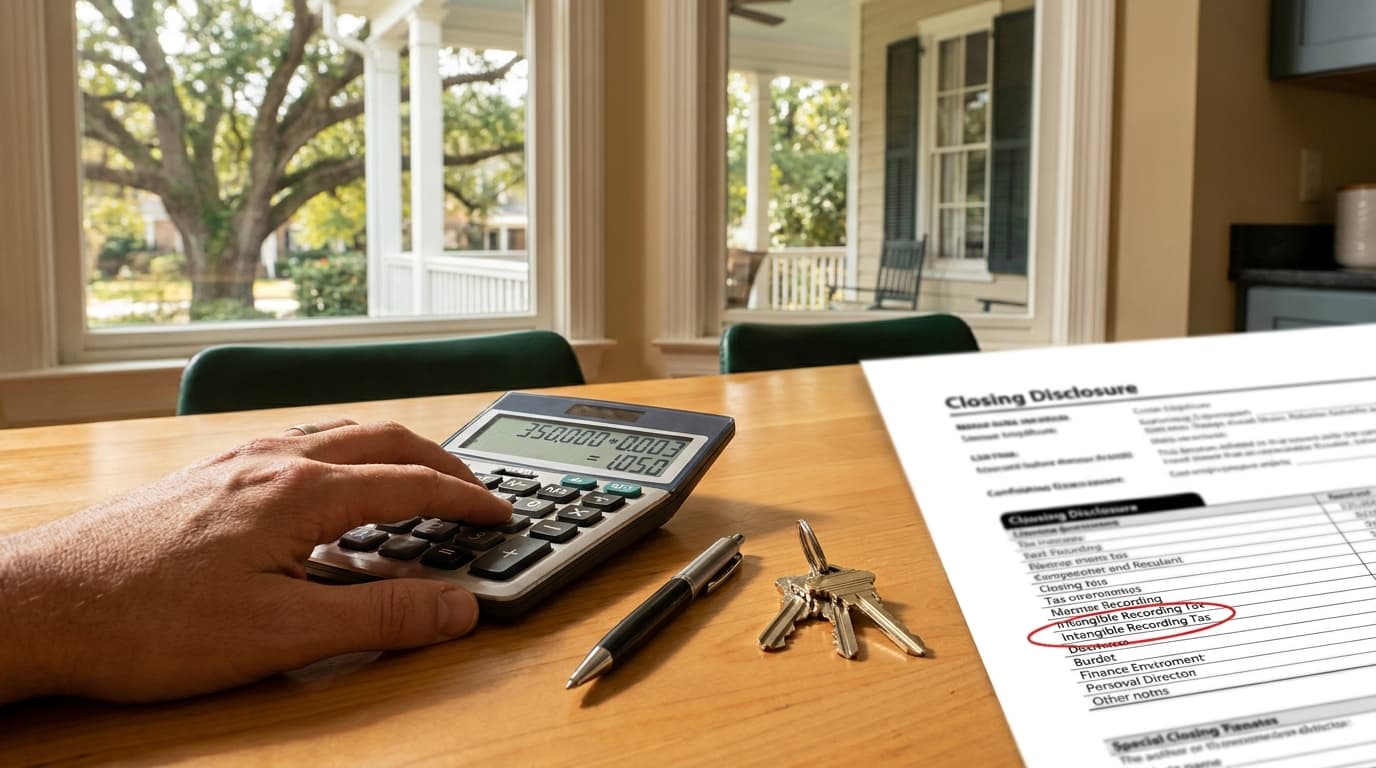
If you're buying a home in Georgia and reviewing your Closing Disclosure for the first time, there's a good chance you'll spot a line you've never seen on any cost worksheet: the intangible recording tax. It's not a junk fee, and it's not negotiable. It's a state tax tied to recording the document that secures your loan, and on a typical purchase it can run a little over a thousand dollars. Out-of-state buyers and first-time Georgia homebuyers are the ones most often caught off guard, because nothing in the early shopping process tends to flag it.
This is a plain-English guide to what the intangible recording tax is, what it costs, who actually pays it, the handful of situations where it's waived — including a refinance exemption that can save real money — and how to check the math before you sign.
What it actually costs: the $1.50-per-$500 formula
Georgia's intangible recording tax is charged at $1.50 for each $500.00 (or fractional part of $500) of the face amount of the note. That works out to roughly 0.3% of your loan amount. It's a state tax, so the rate is the same whether you're closing in Atlanta, Savannah, or a small town in between — there's no county-by-county variation in the rate itself.
Here's the math on a common loan size. On a $350,000 loan:
-
$350,000 ÷ $500 = 700 increments
-
700 × $1.50 = $1,050
Because the tax is calculated on the loan (note) amount and not the purchase price, a larger down payment lowers the tax along with the loan. One more thing to know if you're financing a high-value home: the tax is capped at $25,000 per single note under O.C.G.A. § 48-6-61. That cap is reached at a note of roughly $8.33 million, so any loan at or above that figure pays the same $25,000 maximum. For the vast majority of residential buyers, the cap is academic — but it's there.
What's being taxed, and when
The intangible recording tax isn't a tax on your house or even directly on your loan. It's a tax on recording the security instrument — in Georgia, the security deed (the document that pledges the property as collateral) — when that instrument secures a long-term note secured by real estate. When the security deed is recorded in the county land records, the tax is due.
There's also a deadline baked into the rules: the security instrument generally must be recorded within 90 days of the date the instrument is executed. In a normal purchase closing handled by a closing attorney, recording happens promptly, so this timing rarely becomes the borrower's problem — but it's part of why the charge is collected at closing.
Who pays: the lender is liable on paper, you pay in practice
Technically, the note holder — the lender — is the party responsible for the intangible recording tax. In practice, the borrower customarily bears the cost as a closing charge. That's why it shows up on the buyer/borrower's Closing Disclosure rather than disappearing into the lender's overhead.
You'll find it in the recording and government-fees section of your Loan Estimate and Closing Disclosure, usually labeled something like "intangible tax" or "intangibles recording tax." Treat it as a fixed, known cost — like transfer taxes — rather than something you can shop or talk down.
When it's exempt: short-term notes (and the 2025 HB 586 change)
Georgia exempts notes where the entire principal falls due within a short-term window — these aren't treated as "long-term" notes, so the recording tax doesn't apply. This is where a recent change matters.
As of HB 586, effective July 1, 2025, that short-term window was extended from 36 months (3 years) to 62 months (a little over 5 years). On its face that sounds like good news for borrowers, but read the fine print on what it actually helps.
The expanded 62-month exemption mainly benefits construction loans (often structured on roughly 3-year terms with extensions), bridge and commercial loans, and short credit lines. It does not help a standard 15- or 30-year residential purchase mortgage, because those notes don't come due within 62 months — they remain fully taxable. So if you're a typical homebuyer, HB 586 is worth knowing about, but it almost certainly doesn't change your bill.
When it's exempt: the same-lender refinance exemption
This is the exemption most likely to put money back in a homeowner's pocket. Under O.C.G.A. § 48-6-65, when the original lender refinances its own existing long-term note, no new intangible recording tax is collected on the portion of the new instrument that represents unpaid principal already taxed (or that was previously exempt). Tax is owed only on the "new money" — any amount advanced above the existing balance.
A simplified example: say you have an existing balance of $250,000 with your current lender, and you refinance with that same lender into a new $300,000 loan. The tax would generally apply only to the $50,000 of new money — roughly $150 — rather than the full $300,000 (which would be about $900). The new instrument has to identify the refinanced amount for this treatment to apply.
Now the catch worth emphasizing, because it's a frequent source of confusion: the exemption is strict about the "original lender" condition. If you refinance with a different lender, you generally lose the exemption, and the full new loan amount is taxed again. That doesn't mean you should never switch lenders — a lower rate elsewhere can easily outweigh the tax — but the intangible tax is a real cost to factor into a refinance comparison. Ask both your current lender and any competitor how the intangible tax will be calculated on your specific deal.
How to spot and verify the charge before the closing table
You don't have to take the number on faith. Here's how to check it:
-
Find the line. Look in the recording/government-fees section of your Loan Estimate first (you get this early), then confirm it carries through to the Closing Disclosure.
-
Check the math. Take your loan amount, divide by 500, round up to the next whole increment, and multiply by $1.50. That's your expected tax. On $350,000 you should see about $1,050.
-
Ask about exemptions. If you're refinancing, ask your closing attorney directly whether the same-lender refinance exemption applies and whether you're being charged only on new money. If it's a short-term or construction-type loan, ask whether the 62-month exemption applies.
Bottom line
For a standard Georgia home purchase, plan on the intangible recording tax as a built-in closing cost of roughly 0.3% of your loan amount — about $1,050 on a $350,000 loan — unless a clear exemption applies. Most buyers won't qualify for one. But if you're refinancing with your current lender, the same-lender exemption can cut the tax down to just the new money you're borrowing, which is worth hundreds. Either way, the smart move is the same: find the line on your Loan Estimate, run the simple math yourself, and ask your closing attorney to confirm whether any exemption is in play before you get to the table.
Related reading
-
Klarna and Affirm Balances vs. a Georgia FHA Buyer's DTI: What Actually Happens Today
-
[Recasting Your Georgia Mortgage Could Beat Refinancing at 6.5% — The $300 Move Most Borrowers Don't Know Their Lender Offers](/article/recasting-georgia-mortgage-beats-refinancing-2026)
Sources
-
[Georgia Transaction Taxes — Transfer Tax, Intangibles Tax & HB 586 62-Month Rule — Georgia Title & Escrow Company](https://georgiatitle.com/Real-Estate-Taxes/GA-Transaction-Taxes/index.html)
-
O.C.G.A. § 48-6-65 — Exemption for amount of note refinanced (Justia)
-
Georgia Intangible Tax: Rates, Exemptions, and Deadlines — LegalClarity
-
Rules of the Georgia Department of Revenue — Subject 560-11-8 Intangible Recording Tax