USDA Loans in Georgia: Which Counties Qualify and How Rural Buyers Are Closing with Zero Down
USDA Loans in Georgia: Which Counties Qualify and How Rural Buyers Are Closing with Zero Down Here's a number worth knowing: $0. That's how much some buyers in
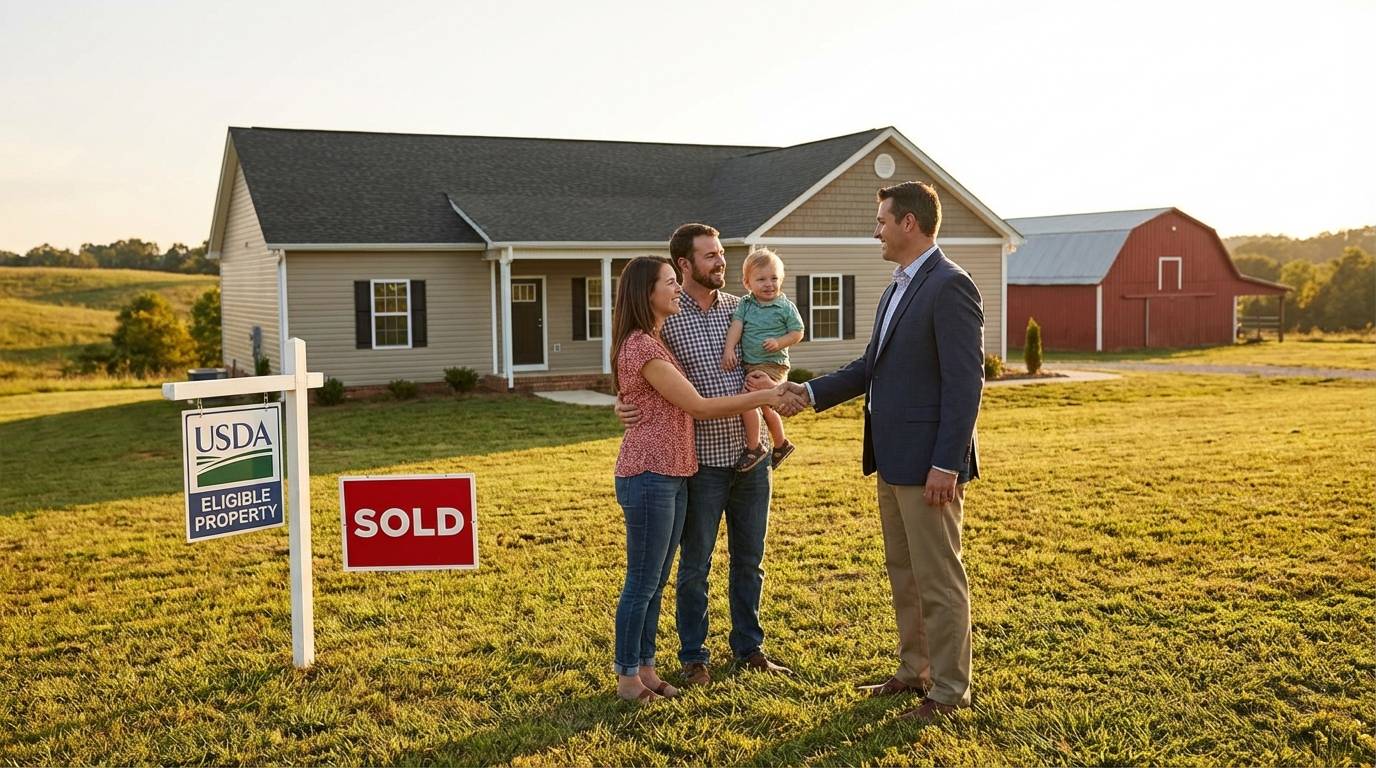
USDA Loans in Georgia: Which Counties Qualify and How Rural Buyers Are Closing with Zero Down
Here's a number worth knowing: $0. That's how much some buyers in Lowndes County, Banks County, and Dodge County are putting down at closing — legally, with a conventional-style loan, backed by the federal government. USDA loans have been around for decades, but they remain one of the most underused mortgage programs in Georgia, mostly because buyers assume they don't qualify. They assume wrong.
Georgia has a sprawling rural geography, and the USDA's eligibility map reflects that. More than 100 Georgia counties — many of them surrounding cities you'd recognize — contain areas where USDA financing is fully available in 2026. That includes places within reasonable driving distance of Gainesville, Warner Robins, and Valdosta that buyers routinely write off as "too suburban" for the program. Some of those buyers are leaving $15,000 or $20,000 on the table by defaulting to FHA or conventional financing when they didn't need to.
This guide walks through how USDA eligibility actually works in Georgia, which counties and communities qualify, where the edges of eligibility sit near mid-size cities, and what zero-down looks like in real dollar terms for a buyer purchasing a home today.
How USDA Eligibility Works — and Why "Rural" Doesn't Mean What You Think
USDA loans come through the agency's Single Family Housing Guaranteed Loan Program, and eligibility has two components: the property has to be in a USDA-designated rural area, and you have to meet income limits. People tend to focus on the geographic piece, and they assume "rural" means farmland and unpaved roads. It doesn't. The USDA defines rural largely by population density and proximity to urban centers, not by what the landscape looks like.
In practical terms, that means plenty of properties in small towns of 10,000 or 15,000 people qualify. It means a three-bedroom house on a cul-de-sac in a small Georgia county seat can be USDA-eligible even if there's a Walmart half a mile away. The USDA updates its eligibility maps periodically, and some areas that qualified a few years ago have since been reclassified as populations grew. That's worth double-checking on the USDA's property eligibility tool before you assume a property is or isn't eligible — the map is address-specific.
Income limits are set by county and household size. For most Georgia counties in 2026, the standard household income limit for the USDA guaranteed loan program sits around $110,650 for households of one to four people, and higher for larger households. These limits are more generous than a lot of buyers realize. A dual-income household making $90,000 combined in a qualifying county is likely under the limit. A teacher and a nurse in South Georgia are almost certainly fine. Your lender will pull the specific limit for the county you're buying in — and it's worth asking, because some counties have higher limits than others.
Georgia Counties Where USDA Loans Are Available in 2026
Most of rural and small-town Georgia qualifies. That covers a wide swath of South Georgia, North Georgia's mountain counties, the coastal plain west of I-95, and the agricultural heartland running through the middle of the state. Counties like Telfair, Wheeler, Treutlen, Echols, Clinch, and Brantley are fully eligible — they've been USDA country for years and likely will be for years to come. Buyers in these areas should always be asking about USDA first, before FHA and before conventional.
But the more interesting conversation is about the counties near mid-size cities, where buyers frequently assume they're in a disqualifying urban area and never even bring up USDA with their lender. That's where a lot of money gets left behind.
Take Hall County, which contains Gainesville. Gainesville itself, as a city, has grown past USDA's rural threshold — you're not going to USDA-finance a house in midtown Gainesville. But parts of Hall County outside the Gainesville city limits, and especially the adjacent smaller counties like Banks, Habersham, White, and Dawson, remain USDA-eligible in large portions. A buyer who's priced out of Gainesville proper and looking at a home in Homer, Clarkesville, or Cleveland is very likely in USDA-eligible territory. That's a 40-minute drive to Gainesville, decent infrastructure, and a zero-down mortgage.
Around Warner Robins, the story is similar. Houston County has urbanized considerably and much of it sits outside USDA eligibility, but neighboring Pulaski County, Bleckley County, and Twiggs County are still very much in play. A buyer working in Warner Robins who can tolerate a 20 or 25-minute commute has real USDA options. Prices in those counties run meaningfully lower than Houston County too — so you're not just saving on the down payment, you're buying into a cheaper market.
Valdosta is another one worth talking about. The city limits and dense suburban areas of Lowndes County have outgrown USDA eligibility in spots, but the county still has qualifying areas, and adjacent Lanier, Echols, and Berrien counties are USDA country without question. Someone looking at a home in Lakeland, Homerville, or Nashville, Georgia — within a reasonable commute of Valdosta — should absolutely be running USDA numbers.
What Zero Down Actually Saves You — The Real Dollar Figures
Let's make this concrete, because abstract talk about "no down payment" doesn't really land until you see the numbers laid out.
Say you're buying a home for $235,000 in Bacon County — a realistic price point for that market in early 2026. Here's what the three most common loan programs look like at closing, just for the down payment piece:
With a conventional loan at 5% down, you're writing a check for $11,750 at closing, plus closing costs. With FHA at 3.5% down, you're putting in $8,225, plus closing costs. With USDA at zero down, you're putting in $0 for the down payment — you still pay closing costs, but in many transactions those get rolled in through seller concessions or lender credits. For a lot of buyers in rural Georgia, USDA is the difference between buying this year and saving for another two or three years.
There's a USDA guarantee fee — currently 1% upfront (which can be rolled into the loan) and 0.35% annually on the outstanding balance. So your monthly payment will be slightly higher than a comparable conventional loan with equity, and you're paying a small annual fee in place of mortgage insurance. But compare that USDA 0.35% annual fee to FHA's 0.85% annual MIP, and USDA starts looking even better for buyers who qualify. The monthly cost difference can be $80 to $120 per month on a $225,000 loan — money that stays in your pocket.
The upfront guarantee fee, at 1% of the loan, works out to $2,350 on that $235,000 home. That gets added to your loan balance, not paid at closing. So your loan becomes $237,350, and your monthly payment reflects that. But again — you kept $8,000 to $12,000 in your bank account that you would have written a check for otherwise. That's an emergency fund. That's furniture. That's a new HVAC unit in year one if the inspection missed something.
The Credit and Income Picture for USDA in Georgia
USDA loans aren't a free pass — you still need to qualify from a credit and income standpoint. Most lenders want to see a 640 credit score or above for the automated underwriting approval, though some lenders will manual-underwrite files down to 580 with compensating factors. If your score is between 600 and 640 and you've got solid income and low debt, it's worth talking to a lender who does manual USDA underwriting rather than assuming the door is closed.
Debt-to-income ratios are evaluated similarly to other programs — typically you want to be under 41% on the back end, though USDA's automated system will sometimes approve higher ratios when other factors are strong. Stable employment history matters. Two years of consistent income, W-2 or self-employed with two years of tax returns, is the standard baseline.
One thing that trips up some buyers: USDA counts all household income, not just the income of people on the loan. If you're buying with a spouse who isn't going on the mortgage but lives in the home, their income still counts toward the household limit. Make sure your lender understands this and runs the full household income calculation before you spend time looking at homes under the assumption you qualify.
Finding USDA-Eligible Properties in Georgia's Gray Zones
The USDA's property eligibility tool at eligibility.sc.egov.usda.gov lets you enter a specific address and get a yes or no. Use it early. Don't wait until you're under contract to find out whether a property qualifies — check it the moment a home goes on your shortlist.
In practice, the eligibility boundaries can look strange on a map. A street that's inside a city limit might be ineligible, and the next street over — technically unincorporated — might qualify. This is especially common in counties where towns have grown in uneven patterns. I've seen buyers lose out on USDA financing because they assumed a home was eligible based on the general area without checking the address, and others who were pleasantly surprised to find that a home in what felt like a suburban setting was right on the eligible side of the line.
Some areas in Georgia where buyers consistently underestimate USDA availability: communities around Rome in Floyd County (especially beyond the city limits toward the Etowah River corridor), areas in Bulloch County outside of Statesboro's core, communities in Tift County around the edges of Tifton, and the rural residential neighborhoods in Madison County between Danielsville and Comer. These aren't wilderness — they're real communities with good infrastructure — and they're regularly eligible for USDA financing.
The Property Itself Has to Qualify Too
USDA has property standards that go beyond location. The home has to be your primary residence — no investment properties, no vacation homes. It has to be a modest, single-family home in reasonable condition. The USDA doesn't publish a hard cap on purchase price, but the appraised value has to be in line with local comparable sales, and the program isn't designed for luxury properties. In most rural Georgia markets, this isn't a constraint — $235,000 buys a solid 3-bedroom home in most qualifying counties, often with acreage.
USDA will flag significant repairs during the appraisal process. A home with a failing roof, structural issues, or major mechanical problems may need those addressed before closing. This is similar to FHA in that regard. If you're buying a fixer-upper, USDA probably isn't your program — though there are USDA repair loan options worth asking your lender about separately.
How to Move Forward as a Rural Georgia Buyer
The first practical step is finding a lender who actually does USDA loans with regularity. Not every mortgage company processes USDA loans, and even among those that do, the level of experience varies a lot. A lender who does two or three USDA loans a year is going to be slower and less efficient than one who handles them regularly. Ask directly: how many USDA loans did your office close last year? Who handles the USDA-specific underwriting on your team?
Get pre-approved before you start making offers. USDA pre-approvals work similarly to other loan types — your lender will pull credit, verify income, and issue a pre-approval letter. Having that letter in hand when you make an offer tells the seller you've done the work and you're serious. In competitive rural markets — and some of them are competitive, particularly in the $175,000 to $250,000 range — a clean pre-approval matters.
And if you're also a first-time buyer, ask your lender to stack Georgia Dream program benefits on top of USDA. Georgia Dream offers down payment assistance up to $10,000, and that money can cover your closing costs when you're financing zero down through USDA. That combination — USDA zero down plus Georgia Dream closing cost coverage — is genuinely one of the most powerful financing setups available to qualifying buyers in this state, and plenty of buyers in rural Georgia are eligible for both and don't know it.
If you've been putting off buying because you don't have $20,000 saved for a down payment, and you're looking at homes in rural or small-town Georgia, run the USDA numbers. There's a real chance the math works out better than you expected — and that you're closer to closing than you think.
Want to know whether a specific Georgia county or address qualifies for USDA financing? Get in touch with a local lender who can check the current eligibility map and run your numbers — it takes about five minutes and could change your timeline significantly.
Have Questions?
Our AI assistant Georgia can help you understand your options.