The Truth About Property Taxes in Forsyth County: Expect a $5,200 Bill on a Mid-Level Ranch
The Truth About Property Taxes in Forsyth County: Expect a $5,200 Bill on a Mid-Level Ranch You found a house in Cumming. Three bedrooms, two baths, a two-car g
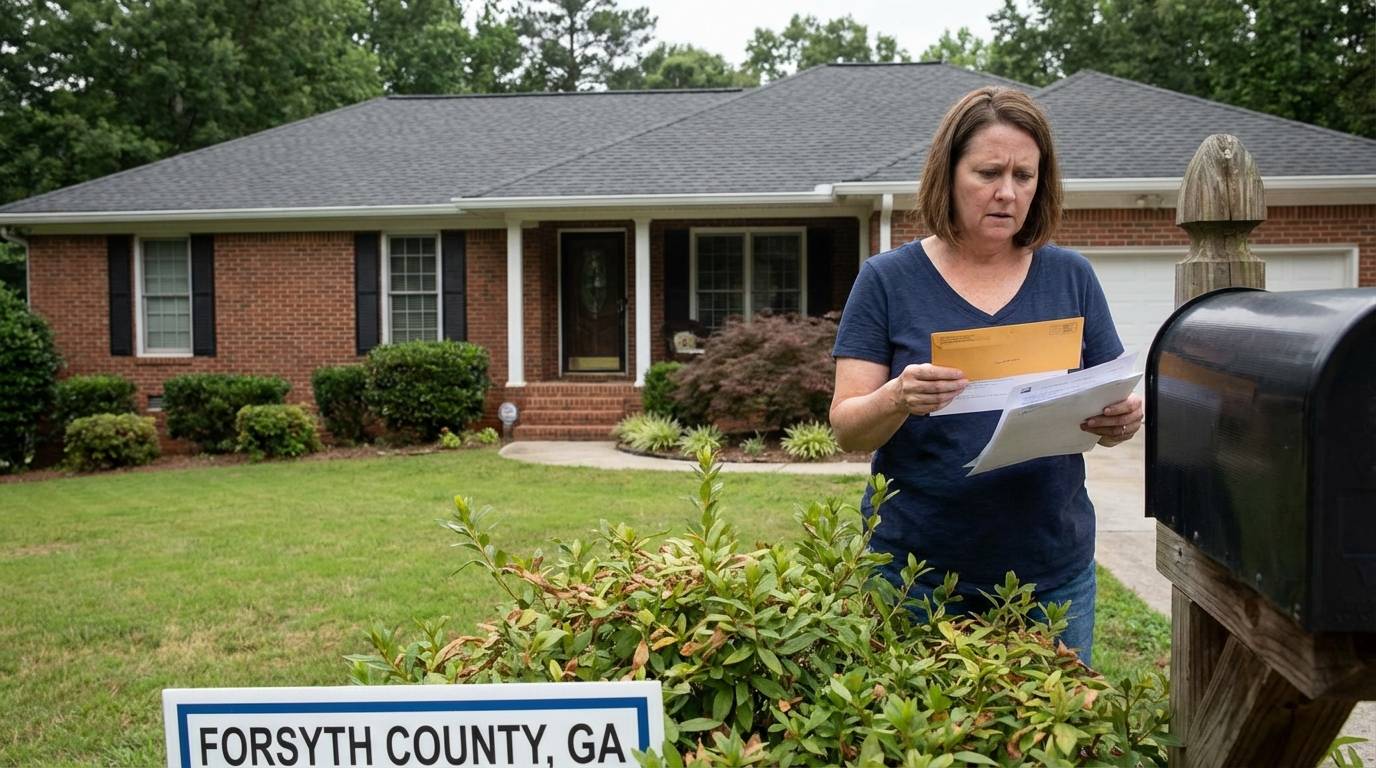
The Truth About Property Taxes in Forsyth County: Expect a $5,200 Bill on a Mid-Level Ranch
You found a house in Cumming. Three bedrooms, two baths, a two-car garage, and a backyard that'll work. The listing price is $425,000, which is pretty typical for Forsyth County right now. Your lender quotes you a monthly payment and you think you can make it work — until you actually sit down and add up what property taxes are going to cost you every single month. That's when a lot of buyers get surprised.
Forsyth County has grown from a mostly rural community north of Lake Lanier into one of the fastest-growing counties in the country. With that growth has come real money — top-rated schools, expanding infrastructure, a commercial corridor along GA-400 that didn't exist fifteen years ago. All of that costs something. And property owners foot a significant chunk of the bill. On a mid-level ranch in Forsyth County, you're realistically looking at a property tax bill somewhere in the range of $5,000 to $5,500 per year. That's not a worst-case number. That's close to average for assessed property at that price point.
Let's break down exactly how Georgia property taxes work, what makes Forsyth County's bills land where they do, and what you can do to reduce the hit — because there are real strategies here that a lot of buyers never use.
How Georgia Property Taxes Are Actually Calculated
Georgia doesn't assess homes at their full market value for tax purposes. The state uses 40% of fair market value as the assessed value — meaning if your home is worth $425,000, the county is technically taxing you on $170,000. That sounds like a deal until you factor in the millage rate.
A mill is one-tenth of a cent, or $1 per $1,000 of assessed value. Forsyth County's combined millage rate — covering county operations, the Forsyth County School District, and any applicable city or special district levies — has hovered in the range of 30 to 32 mills in recent years. The school district alone accounts for roughly 18 to 19 mills of that total. Schools are well-funded in Forsyth County, and that's a big reason families keep moving here — but it shows up on the tax bill.
So the math on a $425,000 home looks something like this: assessed value of $170,000, multiplied by a combined millage rate of approximately 31 mills, comes to right around $5,270 before any exemptions. That's your baseline.
Now, if you qualify for a standard homestead exemption — which you do if this is your primary residence — Forsyth County knocks $2,000 off your assessed value for county taxes, and the school district exemption takes off another $2,000. That reduces your taxable value modestly, but don't expect the exemptions to move the needle dramatically. On a $425,000 home, you're still realistically paying somewhere between $5,000 and $5,400 per year after basic exemptions. Call it $430 to $450 a month folded into your mortgage escrow. Make sure that's in your budget.
What "Mid-Level Ranch" Actually Means in Forsyth County Right Now
A mid-level ranch in Forsyth County in early 2026 is running somewhere between $380,000 and $480,000 depending on location, condition, and how close you are to the schools that people are specifically moving here for. Homes near West Forsyth High School or Denmark High School tend to command a slight premium because the school attendance zone matters to buyers in a way that it doesn't everywhere else.
The sweet spot most buyers are targeting — three beds, two baths, 1,600 to 2,000 square feet, built sometime in the late 1990s through 2010s — is sitting right around $410,000 to $440,000 on the current market. That price range puts your assessed value at roughly $164,000 to $176,000, and your annual tax bill without significant additional exemptions in that $5,000 to $5,500 window I mentioned. Some neighborhoods on the western edge of the county, closer to Canton, run a little cheaper. But you're still working within the same millage framework.
New construction is a different story. Forsyth County has seen a wave of development along the GA-400 corridor, particularly around the Cumming City Center area and out toward the new subdivisions south of Matt Highway. Brand-new builds are moving in the $500,000 to $600,000 range fairly routinely, and some of those homes are being assessed close to purchase price — meaning first-year tax bills that can hit $6,000 or beyond. If you're buying new construction in Forsyth County, ask the builder for the estimated tax figure from the county, not just the base payment number they quote you. Builders tend to quote pre-assessment estimates that run low.
How Forsyth Compares to Neighboring Counties
This is actually important context if you're shopping across county lines. Forsyth County's tax burden is real, but it's not the highest in the metro area, and understanding the comparison helps you make a smarter decision about where to buy.
Cherokee County, right next door to the west, generally runs lower millage rates — somewhere in the 27 to 29 mill range depending on the city. So a comparable home in Canton or Woodstock might carry a tax bill $400 to $600 lower annually. The tradeoff is that Cherokee County schools, while solid, don't quite carry the same reputation as Forsyth's top-ranked districts. For buyers without school-age kids, Cherokee can be worth a serious look if the tax difference matters.
Hall County to the northeast around Gainesville runs millage rates similar to Cherokee — generally lower than Forsyth. But you're moving further from Atlanta, which changes the commute math significantly. Gwinnett County to the south has its own complicated millage structure with city overlays, and some Gwinnett zip codes end up costing as much or more than Forsyth when you add it all up. Fulton County, if you're comparing at all, has some of the highest effective rates in the metro area once you factor in city of Atlanta millage for properties inside city limits.
The point is: Forsyth County costs what it costs because people keep choosing it. The schools are ranked among the best in the state — and that drives demand, which drives values, which drives the tax base that funds those same schools. It's a reinforcing cycle, and it's the reason Forsyth County has grown at a rate that few counties anywhere in the country have matched over the past two decades.
Exemptions That Can Actually Lower Your Bill
Most buyers know about the standard homestead exemption. Fewer know about the other tools available — and some of them can meaningfully reduce what you owe each year.
The standard homestead exemption in Georgia requires that you own the property and use it as your primary residence as of January 1 of the tax year. You have to apply for it — it doesn't happen automatically. In Forsyth County, you apply through the Tax Assessors office, and the deadline is April 1. Miss it and you wait another full year. If you closed in November or December, make this your first priority in January.
Beyond the standard exemption, Georgia offers additional relief for homeowners who are 65 and older. If you qualify by age and your household income falls below the threshold — which the Department of Revenue updates periodically — you may be eligible for an exemption that reduces the school district portion of your taxes substantially. Given that the school levy is the biggest piece of Forsyth County's millage rate, this can make a real difference for retirees on fixed incomes. We're talking hundreds of dollars annually, sometimes more.
Disabled veterans and surviving spouses of veterans killed in action have access to additional exemptions that can be significant. If that applies to you or your household, contact the Forsyth County Tax Assessors office directly — the eligibility rules have specific requirements and the savings are worth the phone call.
There's also a freeze provision worth understanding. Georgia law allows counties to freeze the assessed value of a primary residence at the value when the homestead exemption was first applied — meaning your taxable assessed value can't rise beyond what it was when you bought in, for the county portion of your taxes. This doesn't apply to the school millage or any millage increases the county commission approves, so it's not a complete shield. But it does cap the county piece, which matters in a market where values have climbed as fast as Forsyth's have.
The Appeal Process — More Buyers Should Use It
Every year, a meaningful percentage of Forsyth County homeowners get assessment notices in the spring and just accept the number. That's a mistake. County appraisers are working across thousands of properties, and errors happen. More common than outright errors are assessments that simply don't reflect what the comparable sales data actually supports for your specific house.
You have 45 days from the date on your assessment notice to file an appeal in Georgia. You do this through the Forsyth County Board of Tax Assessors. The process isn't complicated — you're essentially arguing that the county's estimate of your home's fair market value is too high, and you're backing that up with comparable sales. If you bought recently and your purchase price is lower than the assessed value, that's your starting point. The sale price is strong evidence of market value.
Hiring a property tax appeal service is an option — there are several operating in the Atlanta metro area that take a percentage of any savings they get you. For higher-value homes where the potential savings are significant, that can be worth it. For a mid-level ranch where you might save a few hundred dollars, doing it yourself with some comps pulled from Zillow or Redfin isn't unreasonable. Talk to your real estate agent — a good one will know how to pull the relevant comps and can help you build a simple case.
How Property Taxes Affect Your Mortgage Payment
Most lenders in Georgia will escrow your property taxes, meaning a portion of your estimated annual tax bill gets folded into your monthly mortgage payment and held in an escrow account. The lender pays the bill when it comes due. This is the standard setup, and honestly it makes budgeting simpler — you're not scrambling to write a $5,200 check twice a year.
On that $5,200 annual estimate, you're looking at roughly $433 per month added to your principal and interest payment. Combine that with homeowners insurance (budget $1,800 to $2,400 annually for a typical Forsyth County ranch depending on coverage and the age of the home), and your PITI — principal, interest, taxes, insurance — starts to look materially different from a payment quote that only shows principal and interest.
At current rates — the 30-year fixed has been running in the mid-to-upper 6% range through early 2026 — a $340,000 loan on a $425,000 purchase comes to roughly $2,100 to $2,150 per month in principal and interest. Add escrow for taxes and insurance and you're looking at a total monthly obligation in the $2,650 to $2,800 range. That's the real number. Some buyers see the base mortgage payment and think they can stretch to a higher purchase price, then get a shock when the escrow estimate hits their closing disclosure. Don't be that buyer.
What to Do Before You Close
Before you finalize a purchase in Forsyth County, pull the current tax bill on the property — your agent can get this, or you can search directly through the Forsyth County Tax Commissioner's website. Look at what the current owner is actually paying. If they've had a homestead exemption for years and benefited from an assessed value freeze, their bill might be significantly lower than what you'll pay after the property reassesses at your purchase price.
This is a real trap in Georgia real estate. You see the seller paying $3,800 a year in taxes, assume you'll pay roughly the same, and then your first January assessment reflects your $425,000 purchase price and suddenly you're at $5,200. It's not a scam — it's just how the reassessment works. Your lender should be estimating taxes at your purchase price, not the current bill. Make sure they are.
File for your homestead exemption as soon as you're eligible. Set a reminder for January if you're closing in the fall. Ask your lender to walk you through the escrow estimate in detail at closing. And if the assessed value on your first notice comes in higher than what you paid, appeal it. The process exists for exactly that reason.
Forsyth County is expensive to own in, there's no way around it. But buyers keep choosing it because the schools, the infrastructure, and the quality of life justify the cost for a lot of families. Just go in with your eyes open about what the full monthly obligation looks like — not the payment your lender first mentions, but the real number with taxes and insurance folded in. That's the number you'll actually write a check for every month for the next thirty years.
If you're still working through what you can actually qualify for and how Forsyth County's tax picture changes your affordability, talk to a Georgia lender who can run the full PITI number for you before you start making offers. The difference between knowing and guessing is a significant one when you're writing offers in a market that moves this fast.
Get Georgia mortgage updates delivered to your inbox. Rate changes, county-by-county market data, and program updates from someone who actually knows the Georgia market. No spam — just the information that helps you buy smarter.
Have Questions?
Our AI assistant Georgia can help you understand your options.