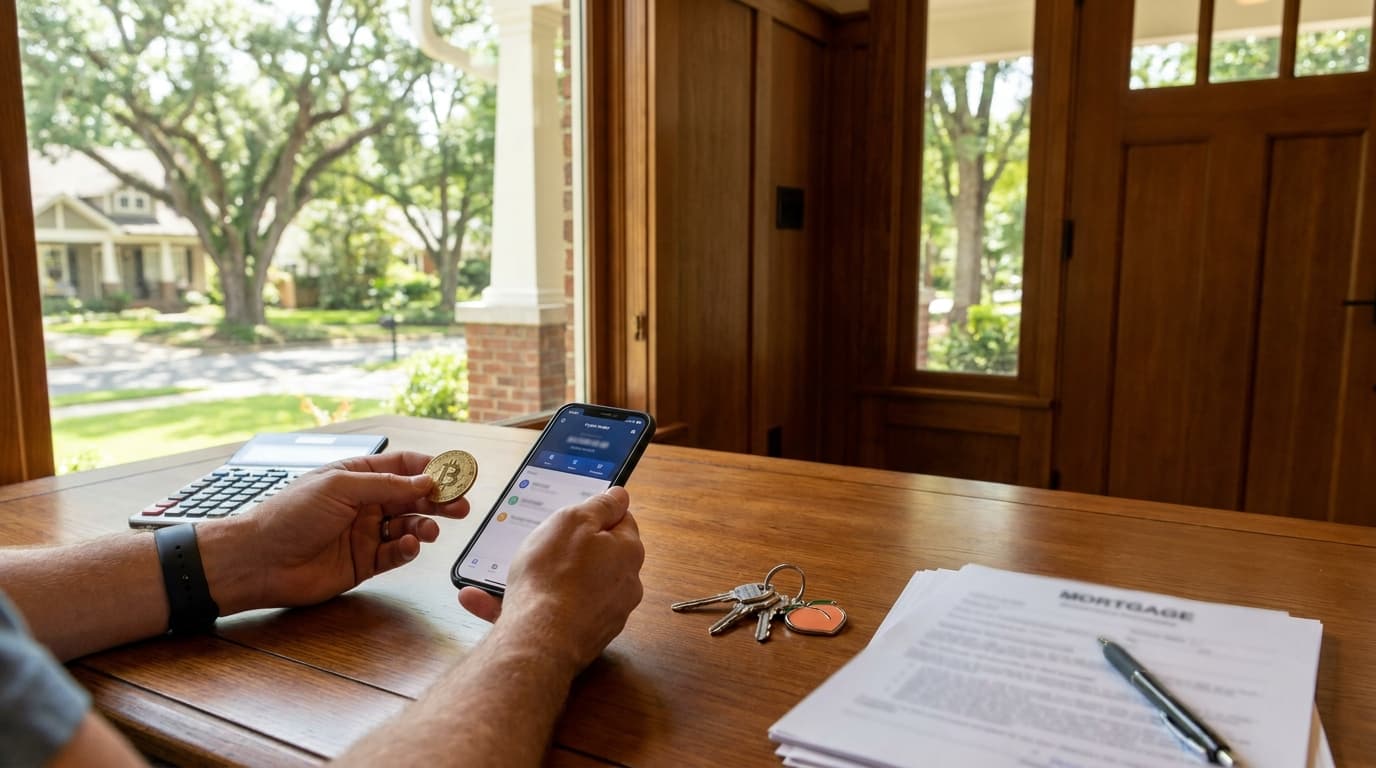
For years, a Georgia buyer sitting on appreciated Bitcoin faced an awkward choice: sell the crypto to raise a down payment — and hand over a chunk of the gain to the IRS and the state — or keep the crypto and keep renting. A new mortgage product aims to remove that either/or. It lets you pledge your crypto as collateral instead of selling it, so you can put cash toward a house without triggering a taxable sale.
It is a genuinely novel option. It is also narrow, heavily collateralized, and comes with risks that are easy to gloss over in the excitement. Here is what actually launched, how the mechanics work in plain English, and what it means specifically for buyers in Atlanta, Savannah, and the rest of the state.
What actually launched
On March 26, 2026, Better Home & Finance and Coinbase announced what they billed as the first crypto-backed conforming mortgage — meaning a loan eligible for purchase by Fannie Mae, not a fringe hard-money product. CNBC reported the announcement and the Fannie Mae eligibility that same day.
The first loan actually funded a few months later. On June 4, 2026, the companies said they had closed a loan for Joe and Amy, a couple in their early 30s in Ann Arbor, Michigan, and announced the official product launch. According to The Block, a nationwide rollout to qualified borrowers is targeted for summer 2026. Coinbase described the same milestone in its own announcement, confirming borrowers can use Bitcoin or USDC held in Coinbase accounts to fund down payments.
The "conforming" label matters. Conventional guardrails apply, and the first mortgage is a standard loan Fannie Mae can buy — so this isn't a boutique instrument bolted onto the shadow lending market. It runs on the same rails as an ordinary Georgia home loan.
The dual-loan structure, in plain English
The part that trips people up is that this isn't one loan. It's two, closed at the same table:
-
A standard Fannie Mae first mortgage on the home itself — the ordinary loan you'd expect, secured by the house.
-
A separate down-payment loan secured not by the house but by pledged crypto — your Bitcoin or USDC — that funds the cash you'd normally bring to closing.
So instead of wiring down-payment cash from a bank account, you pledge crypto to back a second loan that supplies that cash. Both loans close together. HousingWire's coverage frames the target market clearly: Better says roughly 41% of its pre-approved customers qualify on income and credit but lack the cash for a traditional down payment. That's who this is built for — people who are creditworthy but cash-light because their net worth sits in crypto.
The real catch: over-collateralization
Here's where Georgia buyers need to read carefully. You have to pledge far more crypto than you borrow. Per Better's product terms:
-
Bitcoin must be pledged at about 2.5x (250%) of the down-payment loan. A $250,000 Bitcoin pledge backs a $100,000 down-payment loan.
-
USDC, a dollar-pegged stablecoin, is pledged at 1.25x (125%). A $125,000 USDC pledge backs a $100,000 loan.
The Block confirms those same 2.5-to-1 and 1.25-to-1 ratios. In practical terms: to borrow a $100,000 down payment against Bitcoin, you need a quarter-million dollars of it sitting untouched. That crypto stays in Better Mortgage's custodial account on Coinbase for the life of the down-payment loan and is returned only once that loan is repaid. While it's pledged, you cannot sell it or move it — you don't control it.
One small perk: USDC pledgers who are Coinbase One members earn USDC rewards on the collateral held during the loan. That doesn't change the core tradeoff — a large, illiquid pledge — but it's a detail worth knowing.
The 'no margin call' promise — and its limits
The headline feature is that there's no margin call. If your pledged crypto drops in value, your terms don't change and you're not required to top up the collateral. That removes the nightmare scenario of a crypto crash forcing a sudden cash injection.
But read the fine print. Liquidation of the pledged crypto is still triggered by a 60-day payment delinquency — essentially the same threshold as a conventional mortgage default. So the crypto isn't safe from your loan; it's tied to whether you keep paying. And structurally, you are still lashing your housing to a volatile asset. Independent explainers like Griffin Funding's note the recurring downsides of these products: rates on crypto-backed loans often run higher than conventional financing, collateral is illiquid, and volatility introduces risk a plain mortgage doesn't carry.
There's a broader regulatory backdrop worth understanding. This product exists because of a June 25, 2025 directive from FHFA Director William Pulte ordering Fannie Mae and Freddie Mac to consider verified crypto held on U.S.-regulated exchanges as reserves without first converting it to dollars — reversing Fannie's earlier 2022 guidance. Fox Business documented the directive, and the U.S. Senate Banking Committee's July 24, 2025 letter to Pulte captures the policy debate and the risk concerns lawmakers raised. As of mid-2026, no final broad crypto-underwriting guidelines exist across the GSEs; this Better/Coinbase product is the first operational implementation. And when crypto is counted as reserves under the directive, a steep volatility "haircut" of roughly 50–60% applies — Yahoo Finance explains that $100,000 in Bitcoin might count as only $40,000–$50,000. The regulators are treating crypto cautiously even as they open the door.
The Georgia tax reality — and a myth to avoid
The most attractive part of pledging instead of selling is the tax angle, but it's widely misunderstood, so let's be precise.
When you sell appreciated Bitcoin to raise a down payment, you create a taxable disposition. You'd owe federal capital-gains tax (0%, 15%, or 20% depending on income), potentially the 3.8% Net Investment Income Tax on top, and Georgia state tax. Georgia has no separate or special cryptocurrency tax regime. It taxes realized capital gains as ordinary income at its flat state rate — around 5.19% for 2026 under the HB 1437/HB 111 rate phase-down — with no long-term-gain discount, as this Georgia tax breakdown lays out. That state rate stacks on top of the federal bill.
By pledging your crypto instead of selling it, you don't create that taxable event at all. Nothing is sold, so nothing is realized, and the gain is deferred. That's the genuine benefit — and it's a federal deferral first and foremost, with the state deferral coming along incidentally. It is not a Georgia-specific loophole.
Clearing up a common confusion: if you search online, you'll find breathless articles about "Georgia's 0% crypto tax haven." Those refer to the country of Georgia, not the U.S. state. They have nothing to do with buying a home in Marietta or Macon. Don't let that mix-up shape your expectations — the state of Georgia offers no crypto tax break, and this product's advantage is deferral through non-sale, full stop.
Reality check: who this is (and isn't) for
Keep the scale in perspective. This is a niche product. The reported waitlist represents about $250 million in potential loan volume, and roughly 76% of those on it are already Coinbase users. The top states for interest are California, New York, and Florida — not Georgia. More than half of interested borrowers say they want to buy within six months, per The Block's reporting. It's real demand, but it's concentrated among a specific crowd.
Realistically, this fits a high-conviction, long-term crypto holder who has solid income and credit but limited cash on hand, and who is unwilling to sell crypto they expect to keep appreciating. If that's not you — if you'd be uncomfortable locking up 2.5x your borrowed amount in an asset you can't touch, or if your crypto is money you might need — a conventional FHA, VA, or first-time-buyer program is almost certainly the calmer path.
Two practical cautions before anyone signs: consult a tax professional about your specific situation, because deferral mechanics and your income bracket determine whether this even helps you. And read the custody terms closely — you are handing control of your crypto to Better's custodial account for the life of the loan, which introduces counterparty and custody risk that a normal down payment simply doesn't have.
Bottom line for Georgia first-time buyers
This is a legitimately new option, and it solves a real problem: it lets crypto holders preserve their upside and defer a taxable sale while still buying a home. For the right borrower, that's meaningful. But it concentrates risk — heavy over-collateralization, illiquid pledged assets, custody in someone else's account, potentially higher rates, and housing tied to a volatile asset. It is not, and won't soon be, a mainstream path to homeownership in Georgia. Treat it as a specialized tool for a specific financial situation, not a shortcut around saving for a down payment.
Related reading
-
[Georgia Buyers Are Getting Denied Over Student Loans Again — How the 2026 Return of Federal Payment Reporting Is Quietly Wrecking DTI Math](/article/georgia-student-loan-dti-mortgage-2026)
Sources
-
Crypto-Backed Mortgages — Better Mortgage (official product page)
-
Coinbase and Better fund first bitcoin-backed mortgage, plan nationwide rollout soon — The Block
-
Coinbase Powers the First Crypto-Backed, Conforming Mortgages by Better — Coinbase
-
Fannie Mae accepts first crypto-backed mortgage product — CNBC (Mar 26, 2026)
-
Better, Coinbase fund Fannie Mae-backed bitcoin mortgage — HousingWire
-
[FHFA tells Fannie Mae, Freddie Mac to consider crypto as mortgage asset — Fox Business](https://www.foxbusiness.com/economy/us-regulator-directs-fannie-mae-freddie-mac-consider-cryptocurrency-assets)
-
Fannie Mae Now Accepts Crypto as Mortgage Collateral: But There Is a Catch — Yahoo Finance
-
Crypto-Backed Mortgages: What They Are & How They Work — Griffin Funding
-
Georgia Capital Gains Tax: 5.19% Flat + the Retiree Exclusion — Taxstra