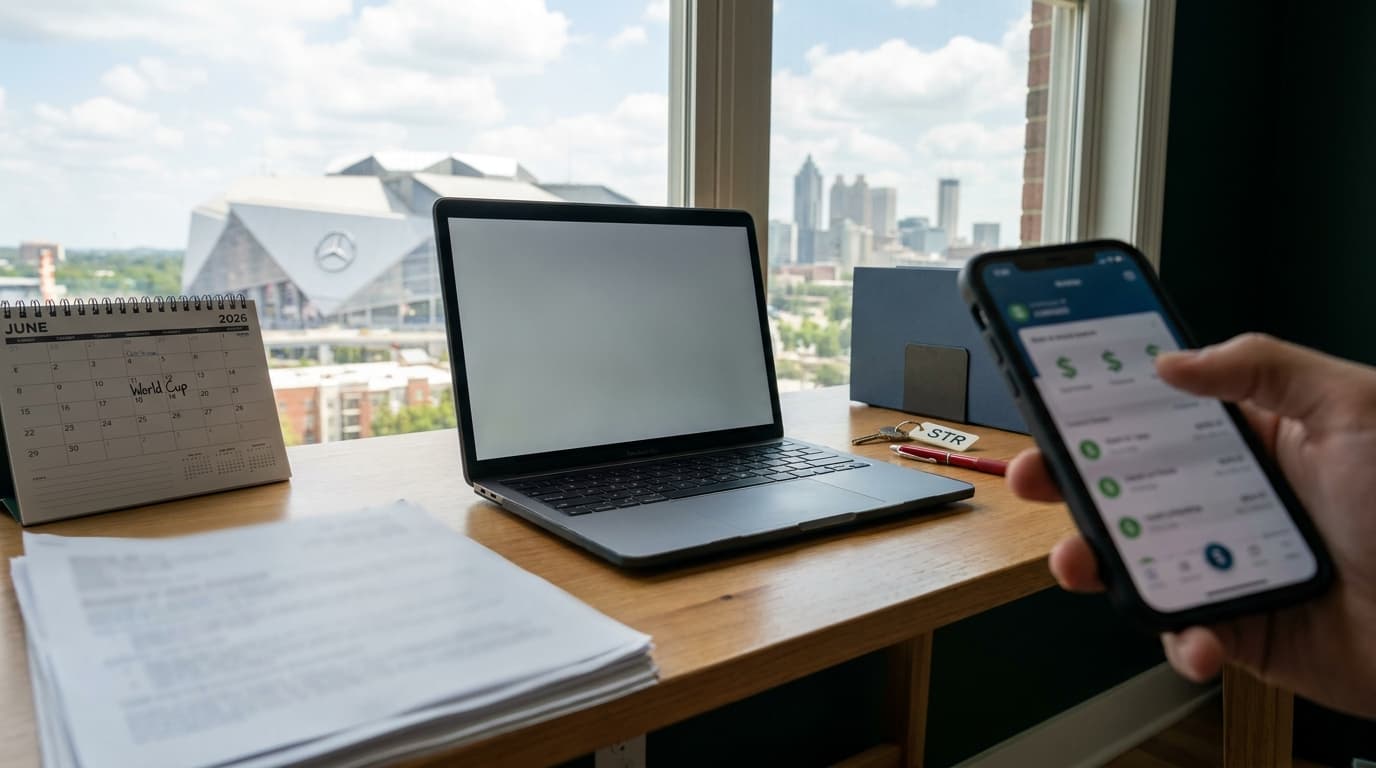
Atlanta is one of 11 U.S. host cities for the 2026 FIFA World Cup, with matches scheduled at Mercedes-Benz Stadium from June into July 2026. Predictably, short-term-rental demand has surged. A downtown penthouse that normally lists for around $400 a night jumped to more than $1,200 a night for the semifinal window in mid-July, according to Urbanize Atlanta. Reported nightly rates across metro Atlanta now range from roughly $400 up to $5,000, and some neighborhoods have seen enormous year-over-year booking spikes — Chosewood Park up about 4,700% and Buckhead up about 2,335% as of December 2025.
If your neighbor is quietly cashing in, it's tempting to do the same. A Deloitte report commissioned by Airbnb estimates average U.S. host earnings of about $4,000 during the tournament, and it projects roughly $3 million in total host earnings for Atlanta and surrounding areas, or about $3,700 per host on average, as Axios Atlanta reported.
But before you screenshot those numbers and open a listing, understand this: for many Atlanta homeowners, renting out your home for the World Cup can run headlong into two rules most hosts overlook — the City of Atlanta's short-term-rental ordinance, and the owner-occupancy clause buried in your mortgage. Get either one wrong and the payday can turn into fines, or worse.
The two rules most hosts miss
There are two separate legal systems in play, and they answer to different masters.
The first is the city. Atlanta requires a license to operate a short-term rental, and that license comes with a primary-residence requirement and a per-day fine structure for operating without one.
The second is your lender. If you bought with an FHA, VA, or conventional primary-residence loan, you signed paperwork certifying you would live in the home. Turning it into a dedicated short-term rental can conflict with that certification.
The tricky part is that these two rules can point in the same direction — both the city and your lender generally want the home to be your primary residence — and yet the most obvious money-making move (renting out the whole house while you stay elsewhere for the tournament) is exactly the move that can violate both at once. Let's take each in turn.
Deep dive 1 — Atlanta's STR ordinance (20-O-1656)
The City of Atlanta's short-term-rental ordinance, 20-O-1656, has been enforceable since March 5, 2023. Here is what it actually requires, according to the City of Atlanta's official short-term-rental page and the ordinance text in the Municode library:
-
It must be your primary residence. The short-term rental has to be the owner's primary residence. You cannot license a property that isn't your primary home — with one narrow exception below.
-
Primary residence plus one additional unit. A single owner may license up to two properties: their primary residence, plus one additional dwelling unit. The city's ATL311 help article confirms a single short-term rental license (STRL) can cover the primary residence plus one additional dwelling, and that the primary residence must be registered first.
-
$150 a year. An Atlanta STRL costs $150 per year and is valid for 12 months. You'll need proof of residency — for example, a utility bill dating back six months — and issuance can take up to about 10 business days, per the Awning Georgia STR guide.
-
Post the license number on every listing. Atlanta requires your STRL number to appear on every advertisement and online listing. This isn't optional fine print — it's how the city polices the program.
The penalties are where the math gets serious. According to Steadily's Atlanta STR guide, a fully adjudicated violation draws $500. Operating without a license runs roughly $500 to $1,000 per violation per day — and each day the property is listed or rented counts as a separate violation. Three violations on the same property can trigger a 12-month revocation and application ban.
Do the arithmetic against the World Cup window. If you list an unlicensed home for even a couple of weeks at $500–$1,000 per day in fines, the exposure can erase the entire projected windfall and then some.
One more thing worth knowing: these rules are the City of Atlanta's. Other jurisdictions in the metro area set their own terms, and as WSB-TV has noted, places like Decatur and Fayette handle short-term rentals differently. Confirm which government actually has jurisdiction over your address before you assume Atlanta's rules — or anyone else's — apply.
Deep dive 2 — your mortgage's occupancy clause
Now the part almost no listing platform warns you about. If you financed your home as a primary residence, your loan defines what "primary residence" means and generally obligates you to live there. Here's how the major loan types handle it.
FHA loans. An FHA borrower must occupy the home within 60 days and live in it as a primary residence for at least one year before renting it out. The FHA framework does not permit using an owner-occupied loan home as a dedicated short-term or vacation rental.
VA loans. A VA borrower certifies an intent to occupy the home as a primary residence and to move in within a reasonable time — generally about 60 days. Renting the entire property short-term, or moving out too early, can trigger an occupancy audit. As the VA Loan Network and AHRN explain, VA guidance specifically says a VA-purchased home cannot be used as a short-term or vacation rental, and violating the occupancy certification gives the lender grounds to call the full balance due under the acceleration clause. LendFriend lays out how the occupancy certification works and what breaking it can cost.
Conventional (Fannie Mae / Freddie Mac) loans. A conventional primary-residence loan requires occupancy within 60 days and continued occupancy for at least one year, per [Freddie Mac's Seller/Servicer Guide (Section 8405.1)](https://guide.freddiemac.com/app/guide/section/8405.1) and Fannie Mae's occupancy-types guidance (B2-1.1-01). The mortgage's due-on-sale/acceleration clause gives the lender the right — not the obligation — to demand full repayment on a breach. In practice, as Fannie Mae's Servicing Guide (D1-4.2-02) describes, that clause is more commonly invoked on ownership transfers than on rental use — but it exists, and it's what a lender would point to.
The word to sit with is "acceleration." It means the lender can demand the entire remaining balance at once. That's a remote outcome for most casual hosts, but it is the legal backstop your certification rests on, and it's why occupancy clauses aren't just paperwork.
Where the two rules collide
Here's the counterintuitive twist. Because Atlanta also requires the short-term rental to be your primary residence, an owner-occupied loan home can often be a legally licensed Atlanta STR. The city's primary-residence rule and your loan's primary-residence rule can coexist.
The trap is renting out the whole home while you live somewhere else — the exact strategy that looks most lucrative during a two-team, sold-out weekend. That single move can put you offside with both the city (if the property stops being your genuine primary residence) and your lender (if it reads as abandoning owner-occupancy). The neighbor charging $400 a night may be doing it correctly, may be doing it in a different jurisdiction, or may simply not have been caught yet. Don't assume their setup maps onto yours.
The legal playbook
There are several ways to capture World Cup demand without stepping on either rule:
-
Use the tax-free 14-day "Masters rule." Under IRS Section 280A — the same rule Augusta homeowners lean on during the Masters — you can rent your residence for up to 14 days per year without reporting the rental income. It's a legal, low-friction way to capture a short burst of demand, and some counties, such as Fayette, promote it explicitly. For a homeowner who can't or won't get a license, this is often the cleanest path.
-
Get a proper STRL for your actual primary residence. If you genuinely live in the home and it's eligible, register it, pay the $150, wait out the issuance window, and put your license number on every listing.
-
Rent a room or a portion while you stay. Keeping the home as your lived-in primary residence and renting part of it is far more consistent with both the city's primary-residence rule and your loan's occupancy certification than vacating entirely.
-
Check your HOA covenants and any lease terms. An HOA can restrict or ban short-term rentals regardless of what the city allows, and if you rent, your own lease may prohibit subletting.
-
Read your loan documents. Confirm your occupancy status and look for any rental restrictions before you list. If you're unsure how your certification reads, ask your servicer.
Reality check: the payday may be smaller than the headlines
It's worth tempering the whole premise. Despite the eye-popping nightly rates, WSB-TV has reported that World Cup bookings came in softer than some hosts and hotels expected. A surge in listings can lead to oversupply, and the projected windfall is not guaranteed.
Remember, too, that short-term rental income can carry hotel-motel tax and sales-tax obligations depending on how and where you operate. Those aren't in the glossy earnings projections. The Deloitte figures describe an average in a best-case framing; your actual take, after fines you avoid, taxes you owe, and nights that don't book, could be a good deal thinner.
Bottom line — a short checklist
-
Verify license eligibility. Is the property your primary residence, or your one allowed additional unit under 20-O-1656? Confirm which jurisdiction actually governs your address.
-
Display the STRL number. If you license, put the number on every advertisement and listing — it's required.
-
Confirm your loan's occupancy status. FHA, VA, and conventional primary-residence loans all expect you to occupy the home; VA in particular bars use as a short-term/vacation rental.
-
Keep proof of residency. A six-month-old utility bill and similar records support both your license and your occupancy status.
-
Consider the 14-day exemption. If you can't or won't license, the tax-free Masters rule may let you capture demand cleanly.
The World Cup is a genuine opportunity for Atlanta homeowners. But the hosts who come out ahead will be the ones who treated the license and the mortgage as seriously as they treated the nightly rate.
Related reading
Sources
-
Part 20 — Short Term Rentals, Atlanta Code of Ordinances (Municode)
-
Georgia Short-Term Rental Laws: 2026 City-by-City Guide — Awning
-
What You Need to Know About Short-term Rentals in Atlanta — Capital B News Atlanta
-
Short-term rental owners look to cash in on World Cup in Atlanta — WSB-TV
-
Airbnb hosts, hotels report softer-than-expected World Cup bookings in Atlanta — WSB-TV
-
Atlanta's World Cup short-term rental demand already exploding — Urbanize Atlanta
-
Atlanta Airbnb hosts could earn $3M during 2026 World Cup games — Axios Atlanta
-
The Role of Airbnb in the FIFA World Cup 2026 — Deloitte report (via Airbnb)
-
VA Loan Occupancy Requirements & Renting Out Your Home — AHRN
-
Renting Out Your VA Purchased Home, Occupancy Rules — VA Loan Network
-
VA Loan Occupancy Requirements: What Counts as a Primary Residence — LendFriend
-
Conventional Loans With a Due-on-Sale Provision — Fannie Mae Servicing Guide (D1-4.2-02)
-
Freddie Mac Single-Family Seller/Servicer Guide — Section 8405.1 (occupancy)
Related reading
- Your Metro Atlanta Reassessment Notice Just Arrived — and the 45-Day Clock to Lock a 3-Year Value Freeze Is Already Running
- Fannie Mae's Condo 'Blacklist' Is Quietly Freezing Atlanta Intown Financing
- Atlanta's 'For Sale' Inventory Is Quietly Splitting in Two: Why Active Listings Look Healthy While the Houses Buyers Actually Want Sit Below 2019 Levels
- Georgia's EV Boom Towns: How Hyundai's Metaplant Is Reshaping Mortgage Demand — and Prices — Around Savannah