The Savannah housing market 2026 story so far is about supply, not a price crash. In September 2026, Realtor.com counted 2,456 active listings in the Savannah metro, up 16.71% from a year earlier and up from 1,515 in September 2024. The median home sat on the market for 79 days, compared with 67 days in May. Buyers have more choice and more time. Prices are softening on some measures and holding flat on others. They are not falling sharply.
That matters for two groups this fall: buyers trying to figure out how hard to negotiate, and owners who bought in 2025 and are wondering whether they overpaid.
What the price numbers say, and why they disagree
Different sources measure different things, so you will see different numbers depending on where you look. Here is what each one reports:
-
Realtor.com, metro listing prices: The median listing price was $399,900 in September 2026, compared with $415,000 a year earlier. That is a 3.64% year-over-year decline. From May through August 2026, the yearly declines ranged from 4.13% to 5.75%.
-
Redfin, metro sale prices (reported by Stacker): The median sale price for January through June 2026 was $362,419, down 3.3%, with 5.6 months of supply. Over the same period the national median rose 1.5% to $391,879.
-
Georgia Association of REALTORS, Chatham County (reported by NFM Lending): In July 2026, the median sale price for single-family detached homes was $370,095, unchanged from a year earlier. Sellers received 97.5% of list price on average.
-
Savannah Area REALTORS: Its August 2026 residential statistics show the median sales price up 1.1% and inventory up 15.8%. The page does not say what area it covers or whether the changes are year over year.
-
Georgia MLS, Bryan, Chatham and Effingham combined: The September 2026 median was $347,450, down 2.1%. That figure rests on only 70 closed sales, and Georgia MLS is not the main local MLS, so treat it as a secondary data point.
A few things explain the spread. Listing prices are what sellers ask, and sale prices are what buyers actually pay. A metro figure covers several counties, while a county figure covers only Chatham. Some reports separate single-family homes from condos and townhomes, and others combine them. Put together, the data points to a market that is flat to modestly lower on price, not one that has dropped sharply below last year.
Where all the supply came from
The building surge is real. Census building permit data shows Chatham County authorized 2,691 housing units in 2024 and 4,426 in 2025, an increase of roughly 64%. For comparison, the county permitted 1,672 units in 2023 and 959 in 2015. Neighboring Bryan County permitted 733 units in 2025, up from 510 in 2024.
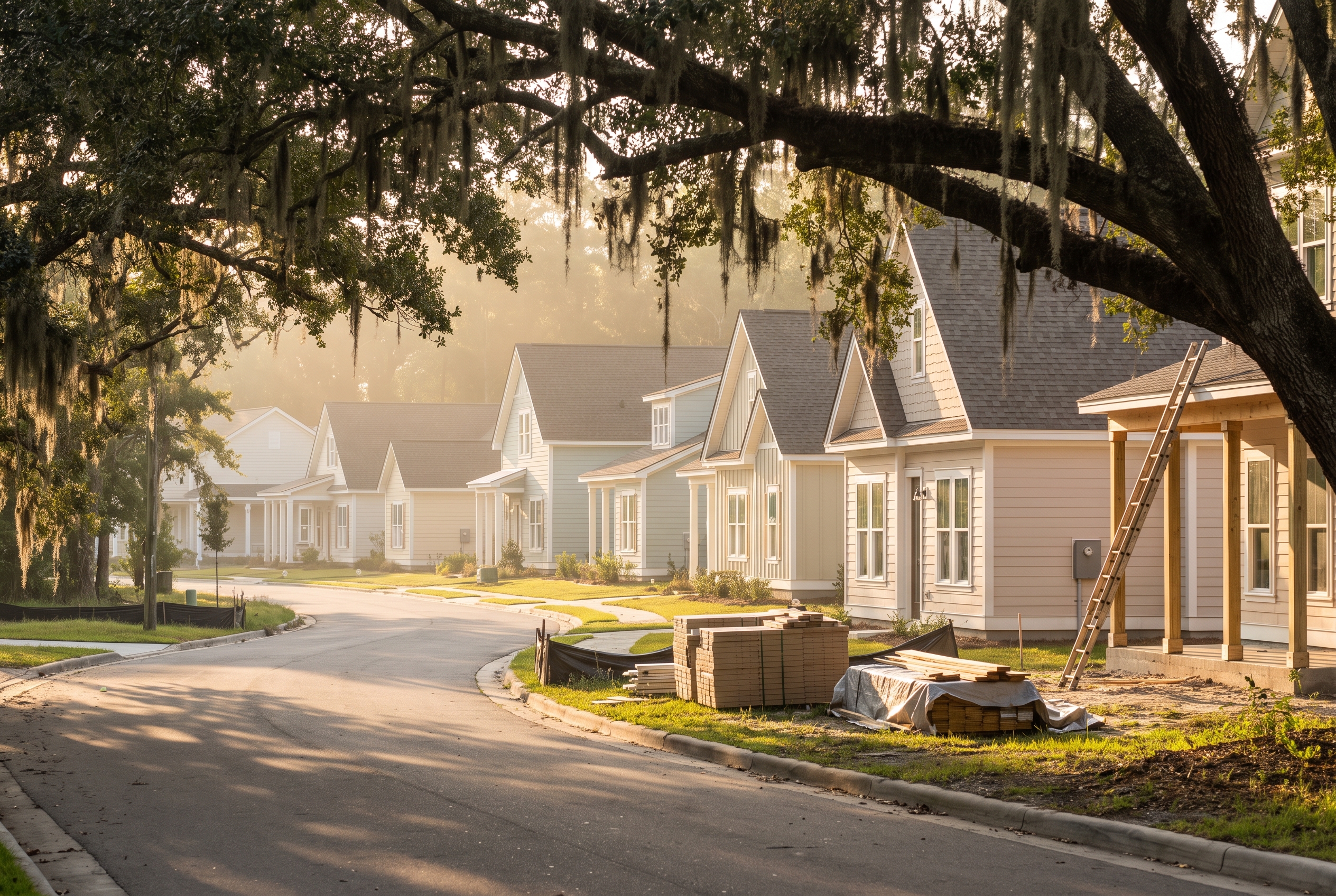
The Atlanta Journal-Constitution reported in August that "since 2023's start, 11,500 new units have come up for sale or rent." That is significant progress, but a Georgia Tech assessment projected the region would need 41,000 new units by the end of the decade. Bryan Wardlaw, a second-generation Savannah home builder, told the AJC the region has seen a "decade's worth of growth" in just a few years.
Demand drove much of that growth. The AJC notes that Hyundai and its suppliers have promised more than 15,000 new jobs by 2031.
The AJC's summary of the price effect is restrained: "Sales prices and rental rates have dipped slightly, with builders offering discounted upgrades and rental managers a month's free rent for new tenants for the first time in years." The paper also reported "a 25% dip in new building permits" as a sign of cooling demand, which suggests builders are already pulling back. The new supply has given buyers more leverage. It has not caused a broad price collapse.
How much room buyers have to negotiate
The clearest sign of a shift is how long homes are sitting and how few are drawing bidding wars. Redfin data for May 2026, reported by Stacker, showed:
-
Only 12.0% of listings sold above their original list price, down 5.7 percentage points from a year earlier.
-
56.2% of inventory was still unsold after 60 days, up 8.8 points.
-
Median days on market was 75, two weeks longer than a year earlier.
In September 2026, 882 metro listings had a price cut, slightly more than a year earlier (up 1.85%).
The leverage is uneven. In Chatham County, condos and townhomes had 9.4 months of supply in July 2026, up from 5.6, and took a median 110 days to sell, compared with 52 a year earlier. Single-family detached homes had 5.6 months of supply, up from 4.4, with 80 days on market. Condo and townhome buyers likely have the most room to negotiate. Even so, the Chatham condo and townhome median rose 7.2% to $302,000, so do not assume a slow market means lower prices everywhere.
What to ask for
When a home has been listed for a while, price is not the only thing you can negotiate. Things to consider:
-
Seller-paid closing costs. These reduce the cash you need at closing.
-
A rate buydown. Builders and some resale sellers may be willing to pay to lower your interest rate, either temporarily or permanently. Ask your lender to compare that offer against an equivalent price reduction.
-
Upgrades on new construction. The AJC reports builders are offering discounted upgrades. Get every incentive in writing, and find out whether it depends on using the builder's preferred lender.
-
Keeping your contingencies. Buyers in a hot market often waive inspection or appraisal protections. With more inventory, you have a better chance of keeping them.
Check how long a specific home has been listed and whether its price has been cut before you decide how hard to push. Market-wide numbers will not tell you how a particular seller is thinking.
If you bought in 2025
Owners who bought last year have reason to be watchful, but most do not have reason to panic. The Federal Housing Finance Agency's repeat-sales index for the Savannah metro, which follows price changes on the same homes over time, stood at 470.51 in the third quarter of 2025. It dipped to 455.63 in the first quarter of 2026, then rebounded to 469.92 in the second quarter. That is about 3.4% above a year earlier and roughly 0.1% below the 2025 high.

For most 2025 buyers, that means home values are roughly flat, not deep underwater. Keep in mind that the index is a metro-wide average. A particular home, neighborhood or property type, such as a condo in a complex with many competing listings, can do better or worse.
The real risk is for anyone who has to sell soon. Selling costs, such as agent commissions and closing costs, come on top of a flat market. If you bought with a small down payment, you could end up bringing cash to closing. If you can stay put, a flat stretch matters much less.
Affordability context
The AJC puts the region's median home price at $376,000, which it says "translates to a monthly mortgage payment of more than $2,200 on a 30-year loan at a 6% interest rate." The paper reports the average two-bedroom rental in Savannah costs $1,800. Treat the 6% figure as an example, not a quote. Your rate will depend on your credit, down payment and loan type.
The AJC also cites "the economic infeasibility of building single-family homes for less than $300,000." That helps explain why new supply has not brought entry-level prices down much, even with all the construction.
What to watch
These signals will show whether buyers keep their leverage. None of them is a forecast:
-
Pending sales. In May, pending sales were up 9.1% from a year earlier even as closed sales slipped 1.7% (Redfin via Stacker). If pending sales keep rising, demand is catching up with supply.
-
Building permits. The pullback the AJC reported means fewer new homes in the pipeline later.
-
Growth in Effingham and Bryan. Along with the Hyundai supplier network, the AJC reports that OpenAI announced plans for a $20 billion data center in Effingham County employing 1,000 people.
Over the long run, local economists expect the supply to be absorbed. Of the inventory that is planned but not yet built, Georgia Southern University economist Michael Toma told the AJC, "we're going to need all of it … and more." For now, Savannah buyers have choices, time and room to negotiate that they did not have two years ago.
Related reading
-
Who Pays the 2026 Property Tax Bill at a Fall Closing in Gwinnett, Coweta or Hall?
-
Metro Atlanta Has More Homes for Sale Than at Any Point in a Decade
-
Georgia Home Contracts Slid in September While Listings Kept Climbing
-
What Happens Between a Missed Payment and a Georgia Foreclosure Sale
Sources
-
FRED / Realtor.com: Median Listing Price, Savannah, GA (CBSA)
-
FRED / Realtor.com: Median Listing Price Year-Over-Year, Savannah, GA (CBSA)
-
FRED / Realtor.com: Active Listing Count, Savannah, GA (CBSA)
-
FRED / Realtor.com: Active Listing Count Year-Over-Year, Savannah, GA (CBSA)
-
FRED / Realtor.com: Price Reduced Count, Savannah, GA (CBSA)
-
FRED / Realtor.com: Price Reduced Count Year-Over-Year, Savannah, GA (CBSA)
-
FRED / Realtor.com: Median Days on Market, Savannah, GA (CBSA)
-
FRED / FHFA: All-Transactions House Price Index, Savannah, GA (MSA)
-
NFM Lending: Savannah Housing Market Report 2026 (Georgia Association of REALTORS data)
-
Stacker: Savannah mid-year housing market review (Redfin data)
-
Stacker: Are homes selling in Savannah in 2026? (Redfin data)