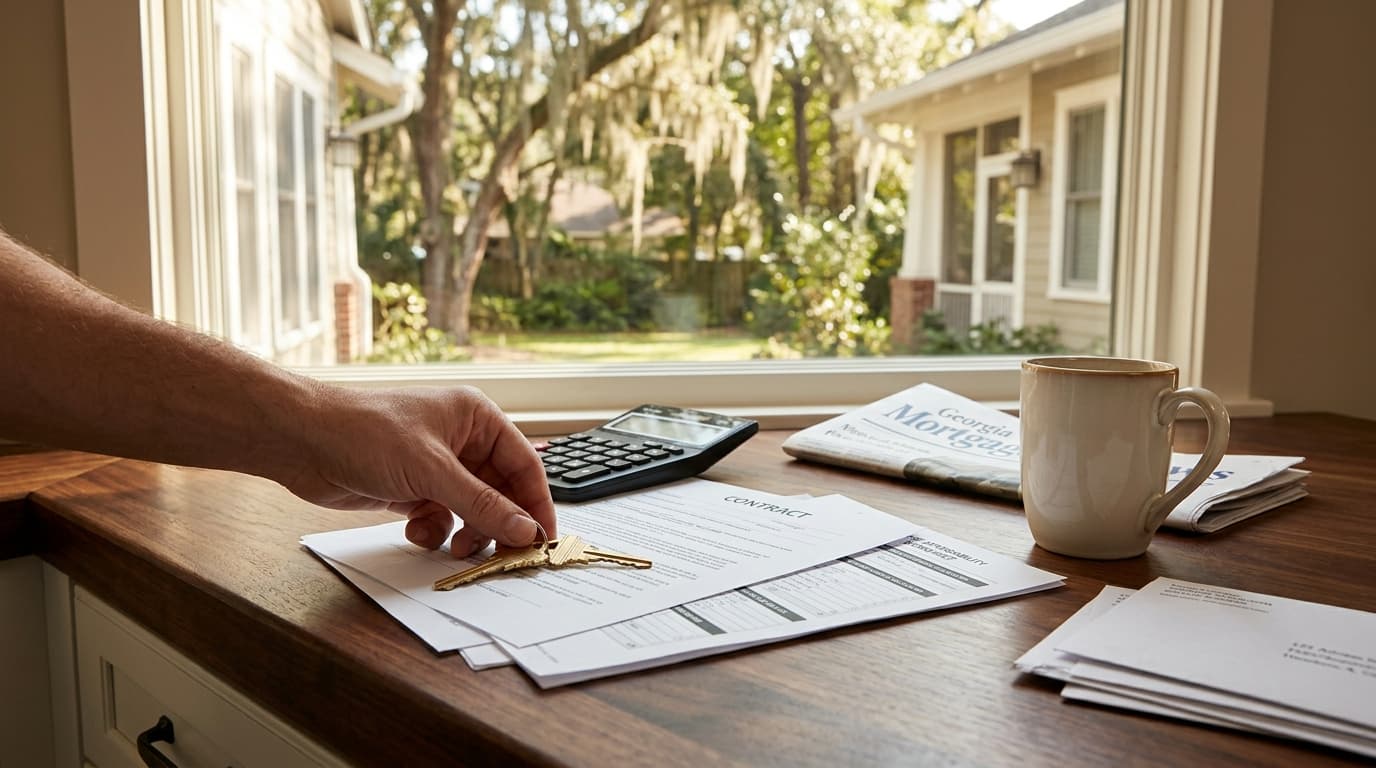
For most of the last five years, the income you needed to afford a typical American home only moved in one direction: up. That's no longer the case. According to Redfin's most recent affordability report, released February 11, 2026 using December 2025 data, U.S. buyers now need to earn $111,252 a year to afford the typical home — down roughly 4% from $115,870 a year earlier and about $11,000 below the mid-2025 peak of just over $122,000.
That reading marks the second consecutive month of declines in Redfin's series, and the first sustained reversal in years of mostly steady increases. It is not yet a long winning streak for buyers — but the direction has changed, and the mechanism behind it (wages catching up to prices, rather than prices falling) is one the Atlanta Fed and Redfin both expect to continue through 2026.
For Georgia readers, the more useful question is what that national figure means on the ground in Atlanta, Savannah, Augusta, and the exurban Hall County market north of the metro. The answer varies more than most national headlines admit.
What the $111,252 national number actually means
Redfin's calculation assumes a buyer spends no more than 30% of gross income on principal, interest, taxes, and insurance — the standard HUD affordability threshold. The underlying inputs are a U.S. median sale price of $426,747 and an assumed 30-year fixed mortgage rate of about 6.1%. Tweak the rate up or the price down and the required income shifts accordingly.
The gap between what buyers need and what households actually earn is still substantial. The typical U.S. household income is roughly $86,185, leaving a shortfall of about $25,000 between what the median family earns and what it would take to comfortably afford the median home. Improvement is real; the gap is still real, too.
Freddie Mac's Primary Mortgage Market Survey put the 30-year fixed at 6.51% the week of May 21, 2026, up modestly from 6.36% the week prior but well below the 6.86% reading from a year earlier. The article's working assumption of a rate in the mid-6s is consistent with where the market sits today, though the weekly number moves and your quoted rate will too.
Georgia at a glance
The state runs noticeably more affordable than the U.S. average, but the spread between metros is wider than the spread between Georgia and the country as a whole. Atlanta carries the highest absolute price tag. Augusta is among the most affordable mid-size metros in the Southeast. Savannah sits on a knife-edge where the median household qualifies on paper but most of the inventory is out of reach. Hall County, in the Gainesville area, tracks closer to the Atlanta metro profile than to anything else in the state.
Atlanta and Fulton County: required income $90,426
Per Stacker's January 2026 monthly Redfin compilation, Atlanta-area buyers need to earn $90,426 to afford the typical home in the metro. The metro's median household income is $99,155 — one of the relatively few large U.S. metros where the typical household clears the affordability bar. Median earners spend about 27.4% of income on housing, just under the 30% threshold, and roughly 52.5% of listings are affordable to a household at that income.
There's a caveat worth flagging. The Atlanta metro includes more affordable outer counties like Bartow, Paulding, and Henry that pull the metro median down. Fulton and DeKalb, especially inside the perimeter, run meaningfully more expensive. The 'metro affordable' headline is true; it just doesn't mean Buckhead.
Savannah and Chatham County: the qualifies-on-paper trap
Savannah is the most interesting Georgia case. The income needed to afford a typical Savannah-area home is $84,384. The metro's median household income is $84,620. The typical household, in other words, clears the threshold by about $236 — essentially a rounding error.
That paper qualification disguises a tighter inventory reality. Median earners in Savannah spend 29.9% of income on housing, right at the HUD ceiling, and only 39.6% of listings are affordable to a household at the metro median. A buyer can technically qualify and still find that six in ten homes on the market are out of reach. Savannah is the Georgia metro where the gap between 'affordability' as a single number and affordability as a lived experience is widest.
Augusta and Richmond County: Georgia's affordability outlier
Augusta is the cleanest affordability story in the state. The Augusta-Richmond County housing market shows median sale prices in the $200,000-to-$225,000 range in early 2026, with Zillow putting the average home value at $224,573, up 5.6% year over year. At a 6.5% rate, the income required to comfortably carry that median home lands somewhere in the $51,000-to-$55,000 range — well below the local median household income.
Augusta isn't included in Redfin's national 50-metro affordability table, so it doesn't appear in the headline rankings, but the underlying math is the most forgiving of any major Georgia metro. The trade-offs are real: slower price appreciation, a lower wage base, and a smaller pool of higher-paying jobs than Atlanta. For buyers whose work doesn't require Atlanta proximity, though, Augusta is where the national affordability narrative looks least daunting.
Hall County and Gainesville: Atlanta's exurban profile
For commuters and remote workers willing to live north of the metro core, Hall County is the relevant data point. Median sale prices there ran about $399,500 in early 2026, up roughly 3.2% year over year. The city of Gainesville itself showed a median around $375,000 in March 2026.
Hall is much closer to Atlanta's affordability profile than to Augusta's. The county has benefited from spillover demand as buyers priced out of north Fulton and Forsyth look further out the I-985 corridor. The income math here looks a lot like the Atlanta metro figures above — required income in the $85,000-to-$95,000 range depending on rate and exact price point.
Where the gap is closing fastest — and where it isn't
Among the 50 largest U.S. metros, Redfin found the year-over-year affordability improvement was strongest in Dallas (-7.4%, to $112,175 required income), Sacramento (-6.8%, to $148,102), and Jacksonville (-5.9%, to $97,898). The metros moving the wrong way were Detroit (+3.6%), Chicago (+3.5%), and St. Louis (+3.0%). No Georgia metro appears in either the top improvers or the worsening list — Atlanta sits in the broad middle, where required income is easing in step with the national trend but not dramatically.
How rate moves change the math
At 6.5%, a 0.25% move in the 30-year fixed shifts the required income on a $400,000 home by roughly $2,500 to $3,500 per year, depending on tax and insurance assumptions. That's why the headline 'income required' number bounces month to month even when prices don't. If Freddie Mac's weekly survey drops back into the high 5s — something Redfin's 2026 outlook treats as plausible but not assured — the national required-income figure could fall back below $105,000 without any change in home prices. The reverse is also true.
The practical takeaway: when you read a national affordability headline, mentally adjust for the rate they assumed. Redfin's $111,252 figure is built on roughly 6.1%. At today's 6.51%, the real required income is a bit higher.
What this means for Georgia buyers
If you earn close to the Georgia median household income, the affordability picture in 2026 looks something like this:
-
Augusta: comfortably within reach, with a wide selection of affordable listings.
-
Atlanta metro: within reach for the median household, but inventory inside the perimeter and in higher-priced north metro counties remains expensive.
-
Savannah: you qualify on paper, but only about four in ten listings are actually within reach at the metro median income.
-
Hall County / Gainesville: within reach at the upper half of median, particularly for households with two earners or non-mortgage savings.
Readers who want a county-level view can cross-check these numbers against the Atlanta Fed's Home Ownership Affordability Monitor, which publishes affordability indices for Fulton, Chatham, Richmond, and Hall counties and uses a similar 30%-of-income methodology. HOAM data through July 2025 showed the cost of a national median-priced home eating about 47% of national median income — well above the HUD threshold, and a useful reminder that 'affordability is improving' starts from a difficult baseline.
An honest forecast
Redfin's 2026 outlook and the Atlanta Fed both expect gradual continued improvement, driven primarily by wage growth outpacing home-price growth rather than by prices falling. That's a slower, less dramatic path to affordability than headlines about 'crashes' suggest — and it's the most likely one. If you're waiting for a sharp price drop in Atlanta or Savannah before buying, the data does not support that bet. If you're waiting for the income required to keep easing modestly while you grow your savings and watch rates, that's a reasonable read of where the market is heading.
Either way, the era of dramatic monthly affordability swings looks more likely to be behind us than ahead. The question for Georgia buyers in 2026 isn't whether the market will hand them a discount — it's which of the state's very different metros matches their budget and their inventory tolerance.
Related reading
Sources
-
Redfin: Affordability Is Improving — Buyers Must Earn $111,000 to Afford the Typical Home, Down 4% From Last Year (Feb 11, 2026)
-
Redfin Press Release: Buyers Must Earn $111,000 to Afford the Typical Home (Feb 11, 2026)
-
Redfin Affordability Press Release PDF — full 50-metro table
-
WSB-TV / Stacker: What salary do I need to afford a house in Atlanta in 2026?
-
Stacker: What salary do I need to afford a house in Savannah in 2026?
-
Federal Reserve Bank of Atlanta: Home Ownership Affordability Monitor
-
Fox Business: Mortgage rates rise to 6.51% — Freddie Mac (May 21, 2026)
-
Redfin: 2026 Housing Market Mood — Buyers Cautious, Sellers Showing Up
This article reflects publicly available data as of late May 2026. Mortgage rates, home prices, and affordability figures change weekly; verify current numbers with the sources above before making a purchase decision.