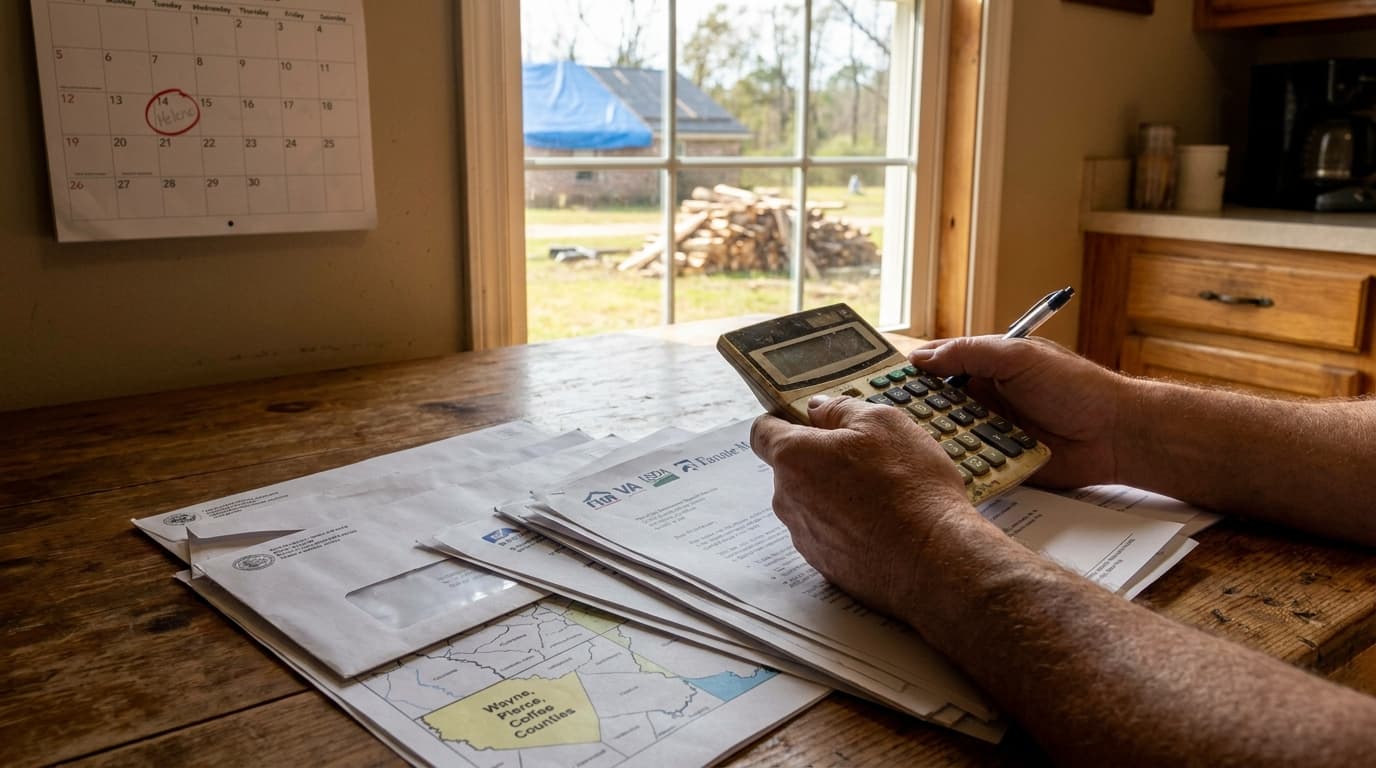
The phone calls have started. One year after Hurricane Helene drove inland through South and East Georgia, the disaster forbearance plans that gave thousands of mortgage holders a 12-month breather are running out — and the servicers on the other end of the line are not all offering the same exits. In Wayne, Pierce, and Coffee counties, where roofs, wells, and timberlands are still in mid-repair, the option a borrower picks in the next workout call will determine whether they keep their house or re-default trying to catch up.
This is a plain-English guide to what changed, what your servicer is allowed to offer, and which options actually preserve a household budget that is already absorbing insurance deductibles, contractor invoices, and lost wages.
What Helene actually did to South Georgia mortgage portfolios
Helene made landfall in Florida on September 26, 2024 and tore through South and East Georgia overnight. On October 1, 2024, FEMA issued Major Disaster Declaration DR-4830-GA. The next day, 41 Georgia counties were designated for Individual Assistance, including Coffee and Pierce. Two days after that, an eight-county expansion added Wayne, Bryan, Butts, Camden, Charlton, Glynn, Long, and Newton, as local reporting at the time noted.
The footprint matters because every federal loan program — FHA, VA, USDA, Fannie Mae, Freddie Mac — pegs its disaster relief to the FEMA-designated Presidentially Declared Major Disaster Area (PDMDA). HUD twice extended the FHA foreclosure moratorium for Helene/Milton-affected PDMDAs, most recently through July 10, 2025, covering more than one million FHA borrowers nationwide. That moratorium has now expired. The forbearance clock has, too.
The forbearance cliff, in one paragraph
Standard disaster forbearance under FHA, VA, USDA, Fannie Mae, and Freddie Mac is up to 12 months total. It does not forgive principal. Interest continues to accrue. At the end of the forbearance period, the missed payments must be resolved through one of the program's loss-mitigation options. The mistake South Georgia borrowers are making right now is treating that resolution like a single conversation with a collections rep — and accepting the first offer on the table, which is almost always a 12-month repayment plan.
A repayment plan effectively doubles your housing cost during the catch-up year. For a household still paying for a new roof, a flood deductible, and weeks of lost income, that math frequently fails inside the first three months. There are better options. They have to be requested.
The four waterfalls in plain English
FHA borrowers: ask about the Partial Claim first
FHA's permanent loss-mitigation framework was rewritten by Mortgagee Letters 2025-12 and 2025-21, and the revised waterfall is the operative framework for Helene exits as of October 1, 2025. The home-retention tools are the Standalone Partial Claim, Loan Modification, Combination Modification + Partial Claim, and the Payment Supplement. The Urban Institute's analysis and the National Consumer Law Center's plain-language breakdown walk through what changed.
For most Helene-affected households, the Standalone Partial Claim is the cleanest exit. HUD funds a payment to your servicer for the full delinquent amount — back payments, escrow advances, certain fees — and you owe that amount as a non-interest-bearing second lien due only when you sell, refinance, or pay off the loan. Your monthly principal-and-interest payment does not change. There is no catch-up year.
One detail every Helene borrower should know: FHA normally limits borrowers to one permanent home-retention option per 24 months. That limit is waived for borrowers in a presidentially-declared major disaster area like DR-4830-GA. If you used a partial claim during COVID, you can use one again now.
GSE borrowers (Fannie Mae and Freddie Mac): ask for the Disaster Payment Deferral
If your loan is owned by Fannie Mae or Freddie Mac — most conventional loans are — the equivalent tool is the Disaster Payment Deferral. The FHFA program overview and Fannie Mae's servicing guidance describe it the same way: up to 12 months of missed payments are moved to the end of the loan as a non-interest-bearing balance, due at sale, refinance, or maturity. Your original monthly payment is preserved. Fannie Mae's Helene-specific notice reiterated availability for affected homeowners.
If your income has not recovered to pre-Helene levels — and for many timber, agriculture, and tourism-dependent households in Wayne, Pierce, and Coffee, it has not — a Flex Modification may be the better fit, because it actually reduces the monthly payment by re-amortizing and, when needed, lowering the interest rate.
VA borrowers: the rules narrowed in May 2025
This is the corner of the market with the worst recent news for veterans who waited. The Veterans Affairs Servicing Purchase (VASP) program stopped accepting new enrollees on May 1, 2025, as documented in industry coverage of the cutoff. Veterans approved before that date remain in the program, but anyone exiting Helene forbearance now is in a post-VASP environment.
What remains, per the VA Servicer Handbook M26-4, Chapter 5 and the broader 2024 VA loss-mitigation reset: repayment plans, traditional and disaster modifications (including trial periods), Homeowner Assistance Fund (HAF) grants where state programs are still accepting applications, and an IRRRL refinance for borrowers who have continued to make payments. The VA's standing natural-disaster policy and its consumer-facing guidance point veterans to the VA Loan Technician line at 877-827-3702 — and that call should happen before, not after, the servicer's first repayment-plan offer.
USDA Guaranteed borrowers: the lender runs the workout
South Georgia has a high concentration of USDA Section 502 Guaranteed loans, and the workout pathway is structurally different. The USDA Single Family Housing Guaranteed Loan Program Loss Mitigation User Guide and the recently revised HB-1-3555 Chapter 18 (April 2025) are clear: the lender — not USDA — runs the loss-mitigation process. Available options include Informal Forbearance, Special Forbearance, Loan Modification, Special Loan Servicing, and Pre-Foreclosure Sale.
Two practical points: USDA does not require a lump-sum payment at the end of forbearance, and lenders are instructed to offer affordable repayment plans or term extensions. If your servicer is opening with a 12-month catch-up plan and nothing else, ask in writing for evaluation under Special Loan Servicing, which is the modification track that re-amortizes and can extend the term.
Why a partial claim or payment deferral usually beats a repayment plan
The cash-flow comparison is straightforward. A 12-month repayment plan adds the missed amount, divided over twelve months, on top of your existing payment. If you missed $1,800 a month for twelve months, you owe roughly $3,600 a month for the catch-up year — your normal payment plus $1,800 in monthly catch-up. Households that could not afford one $1,800 payment during the disaster cannot, as a rule, afford two.
A partial claim (FHA) or disaster payment deferral (Fannie/Freddie) preserves the original $1,800 payment and parks the missed amount at the back of the loan. You sell, refinance, or pay off — and that is when it comes due. For a recovering household, that is the difference between staying in the home and re-defaulting in the catch-up year.
The pre-call checklist
Before you call your servicer, gather:
-
A short hardship letter describing Helene's impact on your income and home — names, dates, county.
-
Last two paystubs, 60 days of bank statements, and your most recent tax return.
-
FEMA registration ID and any disaster-assistance award letters.
-
Homeowners and flood insurance claim correspondence.
-
Contractor invoices and repair receipts.
-
A current monthly budget reflecting post-Helene reality, not pre-Helene income.
What not to do on the call: do not accept a verbal offer as final, do not agree to a repayment plan without asking — in writing — to be evaluated for the program's full waterfall (partial claim, payment deferral, modification, payment supplement), and do not let the conversation pivot to collections language. You are exiting a federally-recognized disaster forbearance, not negotiating an overdue bill.
Local resources
Free help exists. HUD-approved housing counselors — including agencies serving Waycross, Douglas, and Jesup — can be located through HUD.gov or by calling 800-569-4287. They will sit on the loss-mitigation call with you, free of charge. The state's emergency management hub at GEMA's Hurricane Helene resource page still routes to recovery contacts. The SBA's extended relief deadlines reflect the long tail of federal recovery assistance still in motion. If a servicer mishandles your workout — wrong waterfall, lost paperwork, dual-tracking — file a complaint with the Consumer Financial Protection Bureau.
Red flags during the recovery year
Disasters draw scams. Be skeptical of anyone soliciting you to pay for "forbearance exit services" — HUD-approved counseling is free. Be even more skeptical of unsolicited offers to "buy out" your equity, deed-transfer schemes, and any pitch that requires you to sign over title in exchange for a promise to handle the loan. None of the legitimate FHA, VA, USDA, or GSE workout options require giving up your deed.
Bottom line
Borrowers in DR-4830-GA who proactively request the right waterfall option — in writing, with documentation — preserve their homes. Borrowers who passively accept the first repayment plan a servicer offers re-default at high rates inside the catch-up year. The difference is a phone call, a folder of paperwork, and the right vocabulary. Trade-press coverage from HousingWire, The MortgagePoint, and MBA Newslink has tracked the federal posture throughout the recovery. The vocabulary your servicer needs to hear from you is: partial claim, disaster payment deferral, special loan servicing, payment supplement, and loss-mitigation evaluation in writing.
One year on, the forbearance cliff is here. The federal waterfalls were rewritten precisely because the COVID-era ones did not work for households still in active recovery. Use them.
This article contains AI-assisted content and has been reviewed in our publication workflow. It is general information, not legal or financial advice for any individual loan.
Related reading
-
An Atlanta Retiree Just Won HGTV's $2.4M Dream Home. The Tax Bill Comes Before the Keys.
-
Wells Fargo's $100M Mortgage-Discrimination Fund: Atlanta Borrowers Qualify, Savannah Does Not
Sources
-
GEMA — Major Disaster Declared for 41 Georgia Counties (Oct 2, 2024)
-
GEMA — Major Disaster Declared for Four Additional Counties (Oct 4, 2024)
-
FOX 5 Atlanta — 8 Additional Counties Eligible for Federal Help
-
HUD No. 25-052 — Foreclosure Relief Extended Through July 10, 2025
-
HUD — Servicer Loss Mitigation for Major Disasters fact sheet
-
VA Servicer Handbook M26-4, Chapter 5 — Loss Mitigation
-
Consumer Finance Monitor — VA Sweeping Loss Mitigation Changes
-
USDA — SFH Guaranteed Loan Program Loss Mitigation User Guide
-
HousingWire — FHA Reiterates Loss-Mitigation Options for Helene
-
The MortgagePoint — HUD Extends Assistance for Helene/Milton Victims
-
SBA — Hurricane Helene Relief Deadline Extended for Georgia Survivors